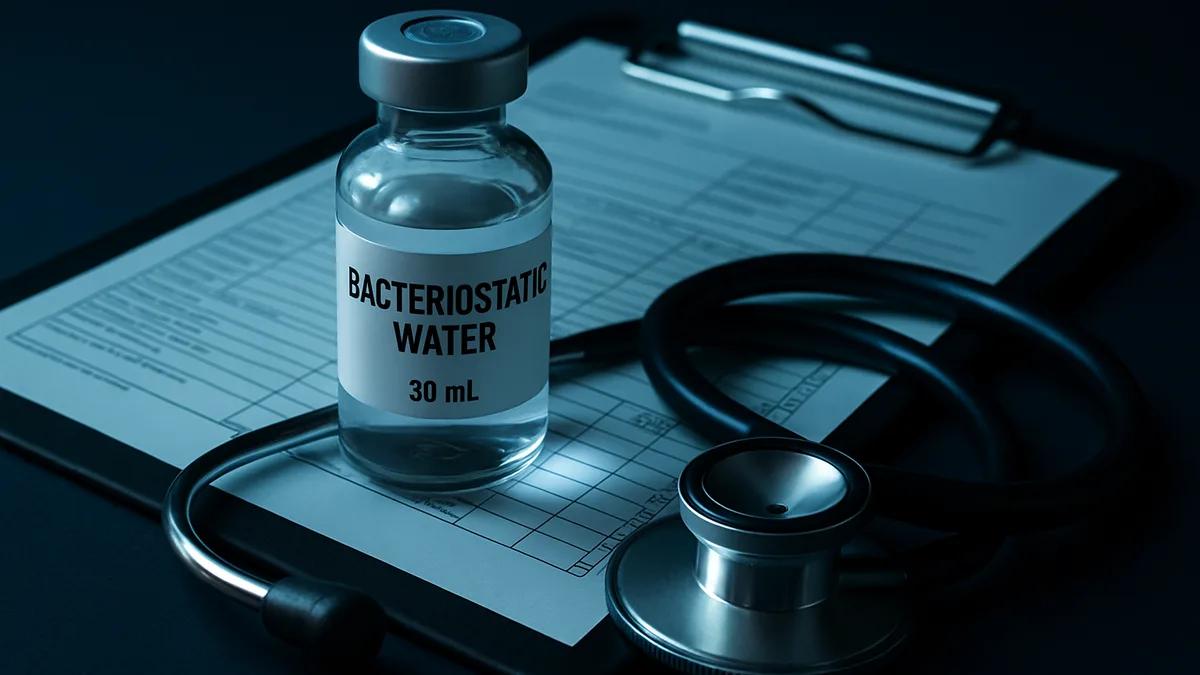
Bacteriostatic water used in clinical settings — as a diluent for injectable medications — is billed under HCPCS Level II code A4216. There is no CPT code specific to bacteriostatic water itself. The billing distinction matters for clinics, compounding pharmacies, and medical practices that administer reconstituted injectables and need to capture diluent costs on claims.
Informational purposes only. This article summarizes publicly available CMS coding guidance and HCPCS classification for bacteriostatic water as a pharmaceutical diluent. Billing rules vary by payer, region, and clinical context. Consult a certified medical billing specialist or compliance officer for claim-specific guidance.
HCPCS code A4216: the primary billing code
The Healthcare Common Procedure Coding System (HCPCS) Level II code A4216 is described by CMS as:
"Sterile water, saline, and/or dextrose, diluent/flush, 10 mL"
This code covers bacteriostatic water when it is used as a diluent or flush in the preparation and administration of injectable medications. The code is not exclusive to bacteriostatic water — it encompasses sterile water for injection, normal saline, and dextrose solutions used in the same diluent capacity.
A4216 falls under the HCPCS "A" code series, which covers medical supplies, equipment, and related items. CMS categorizes injectable diluents as supply codes rather than drug codes, which affects how reimbursement flows through the claim.
Key specifications of A4216:
- Unit of measure: 10 mL per billable unit
- Category: Medical supply — diluent/flush
- Applicable products: Sterile water, bacteriostatic water, normal saline, dextrose
- Context requirement: Must be used as a diluent or flush for an injectable medication
- Standalone billing: Generally not reimbursable without an accompanying drug administration code
Billing for volumes greater than 10 mL
A4216 is defined per 10 mL. Clinical use frequently requires volumes exceeding that threshold. The billing approach is straightforward: submit multiple units.
| Volume Used | Units of A4216 | Notes |
|---|---|---|
| 10 mL | 1 | Standard single-unit claim |
| 20 mL | 2 | Common for larger reconstitution volumes |
| 30 mL | 3 | Standard vial size for bulk diluent |
| 50 mL | 5 | Less common; typical for IV flush applications |
Rounding rules apply. CMS guidance specifies that partial units above 50% of the unit threshold round up. A clinical encounter using 15 mL of bacteriostatic water as a diluent would be billed as 2 units of A4216. Documentation should reflect the actual volume used and the medication being reconstituted.
Some payers require itemized records showing the drug reconstituted, the diluent volume, and the clinical rationale — particularly for multi-unit diluent claims that exceed typical reconstitution volumes.
Medicare and Medicaid reimbursement
Medicare covers A4216 when the diluent is medically necessary for the administration of a covered Part B injectable drug. The reimbursement rate is published in the quarterly DMEPOS (Durable Medical Equipment, Prosthetics, Orthotics, and Supplies) fee schedule and varies by Medicare Administrative Contractor (MAC) region.
Medicare billing requirements:
- The diluent must be incident to a covered drug administration service
- The claim must include the corresponding J-code for the drug being reconstituted
- Medical necessity documentation must support the use of the specific diluent
- Claims for A4216 submitted without an accompanying drug administration code are typically denied
Medicaid reimbursement follows a similar framework but varies significantly by state. Some state Medicaid programs bundle diluent costs into the drug reimbursement and do not accept separate A4216 line items. Others reimburse A4216 independently. Billing teams working across multiple state programs should verify diluent billing rules per state fee schedule.
Commercial payers follow their own adjudication logic. The most common denial reason for A4216 is bundling — the payer considers the diluent cost already captured in the drug's J-code reimbursement. Pre-authorization or payer policy verification before submission reduces denial rates.
J-codes vs A-codes: when each applies
The distinction between J-codes and A-codes in injectable billing is a common source of confusion in clinical billing departments.
J-codes (J0000-J9999) cover the drugs themselves. When a clinic administers semaglutide, the drug is billed under its assigned J-code. The J-code reimbursement is intended to cover the drug's acquisition cost.
A-codes (A4216 and related) cover the supplies used to prepare and administer the drug — including diluents like bacteriostatic water, syringes, and alcohol swabs.
In a standard reconstitution-and-injection encounter, the claim structure looks like this:
- Drug code (J-code): Covers the medication
- Administration code (96372 or similar): Covers the injection service
- Supply code (A4216): Covers the diluent used for reconstitution
Whether the payer reimburses all three line items separately or bundles them depends on the specific payer contract. Medicare Part B generally reimburses A4216 as a separate line item when documentation supports medical necessity. Some commercial plans bundle supply codes into the administration fee.
Billing staff should check each payer's National Correct Coding Initiative (NCCI) edits and bundling rules. NCCI edits define which code pairs can be billed together and which are considered mutually exclusive or bundled.
Clinical ordering vs retail purchasing
The procurement channel for bacteriostatic water differs between clinical and retail contexts, and the distinction has billing implications.
Clinical/pharmacy channel: Hospitals, clinics, and compounding pharmacies typically procure USP-grade bacteriostatic water through pharmaceutical distributors (McKesson, Cardinal Health, AmerisourceBergen). Product acquired through these channels carries NDC (National Drug Code) numbers, which some payers require on A4216 claims for adjudication. The NDC links the supply code to a specific manufacturer and package size, providing the audit trail that payer compliance departments expect.
Retail/research channel: Bacteriostatic water sold through research-supply vendors or direct-to-consumer channels does not always carry NDC labeling. Product without an NDC may be rejected on claims that require NDC-level documentation. Clinics billing for diluent reimbursement should ensure their procurement source provides NDC-labeled, USP-grade product.
The cost differential between channels is meaningful at volume. Pharmaceutical distributors price bacteriostatic water at wholesale rates that reflect bulk purchasing agreements. Retail channels price per-vial with markup. For clinics administering reconstituted injectables at volume, procurement cost directly affects margin — particularly when A4216 reimbursement rates are fixed by fee schedule.
COA documentation for clinical procurement
Clinics purchasing bacteriostatic water in bulk — whether through pharmaceutical distributors or specialty suppliers — should maintain Certificates of Analysis (COA) on file for each lot received.
COA documentation serves multiple purposes in a clinical billing context:
- Compliance: State pharmacy boards and accreditation bodies (PCAB, ACHC) may require COA records for compounding and reconstitution supplies
- Audit defense: Payer audits of A4216 claims sometimes request documentation verifying that the billed diluent meets USP specifications
- Quality assurance: COA confirms benzyl alcohol concentration (0.9% USP spec), sterility testing results, endotoxin levels, and pH range
- Lot traceability: In the event of an adverse event report, COA documentation enables lot-level traceability from the diluent back to the manufacturer
Clinics that reconstitute injectable medications at scale — particularly those operating under 503A or 503B compounding regulations — face stricter documentation requirements. COA records for every input material, including bacteriostatic water, are a standard component of the quality management system these facilities are required to maintain.
Bulk procurement considerations
For practices administering reconstituted injectables regularly, bacteriostatic water is a recurring supply cost. The economics favor bulk purchasing for several reasons:
Per-unit cost reduction: Wholesale pricing through pharmaceutical distributors or specialized suppliers drops significantly at case quantities (typically 25-100 vials per case). The per-vial cost at bulk rates can be a fraction of single-vial retail pricing.
Inventory efficiency: Standard 30 mL vials of bacteriostatic water carry a 28-day post-puncture use window (per USP guidance and manufacturer labeling). Clinics that administer multiple reconstituted injections per day may cycle through vials quickly enough that expiration waste is minimal at bulk inventory levels.
Reimbursement margin: When A4216 reimbursement exceeds the bulk acquisition cost per 10 mL unit, the diluent line item becomes a net-positive component of the claim. This margin is modest per encounter but compounds across high-volume practices.
Suppliers offering bulk bacteriostatic water with COA documentation, USP-grade certification, and NDC labeling provide the documentation stack that clinical billing requires. Practices evaluating procurement sources should verify all three — USP grade, COA availability, and NDC labeling — before committing to a supplier for reimbursement-eligible inventory.
Key takeaways for clinical billing teams
- A4216 is the HCPCS code for bacteriostatic water used as a diluent — billed per 10 mL unit
- The code covers sterile water, bacteriostatic water, saline, and dextrose in the diluent context
- Medicare reimburses A4216 when incident to a covered drug administration; standalone claims are denied
- J-codes cover the drug; A4216 covers the diluent — check payer bundling rules before split-line submission
- Bulk procurement with COA, USP-grade certification, and NDC labeling supports both compliance and reimbursement
- Documentation of volume used, drug reconstituted, and clinical indication reduces denial and audit risk