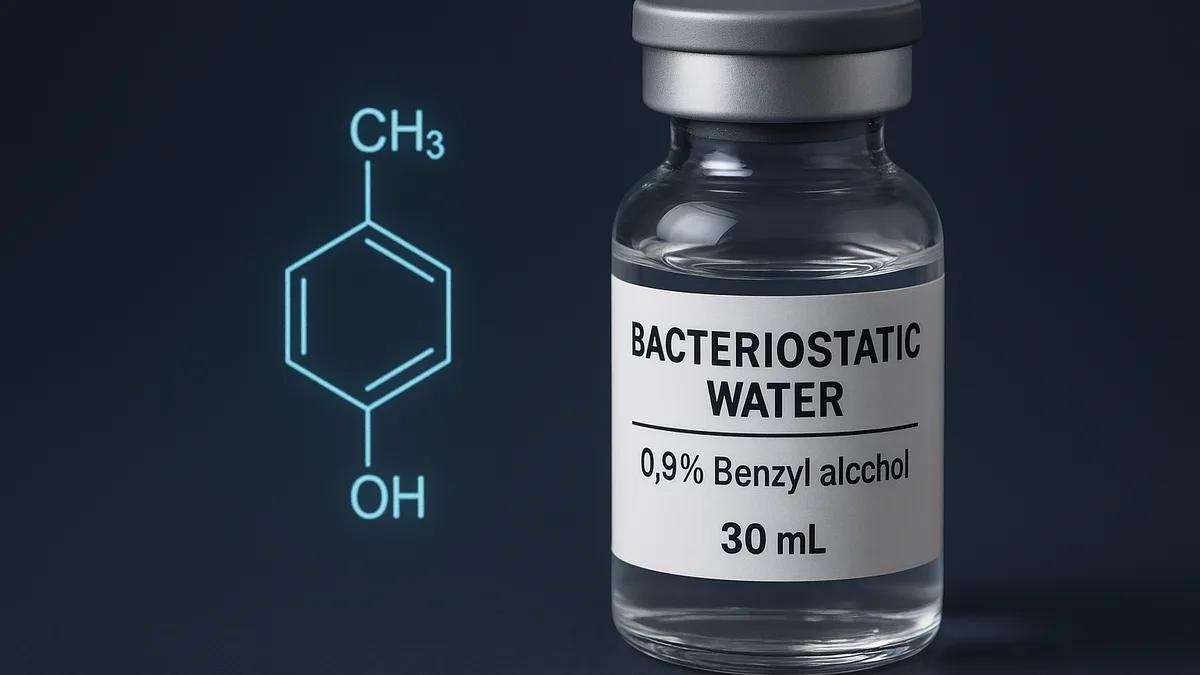
Bacteriostatic water contains exactly one active ingredient: benzyl alcohol at 0.9% concentration. That single compound — an aromatic alcohol with the CAS registry number 100-51-6 — is the entire functional difference between a multi-dose injectable solvent and single-use sterile water. Everything about how bacteriostatic water works, how long it lasts, and whether a given product is worth trusting traces back to whether that 0.9% is actually present and correctly concentrated.
Research-context information only. Bacteriostatic water for injection is an FDA-regulated injectable product. The information below reflects USP standards, manufacturer prescribing information, published pharmaceutical literature, and self-reported community sources. This article reports what has been documented, not what should be done. Consult a licensed physician for personal medical decisions.
Understanding what benzyl alcohol does — and how to verify that it is present at the correct concentration — is one of the more practical quality-assurance skills for anyone working with injectable reconstitution.
What benzyl alcohol is
Benzyl alcohol (C6H5CH2OH, CAS 100-51-6) is an aromatic alcohol — a simple organic compound consisting of a benzene ring bonded to a hydroxymethyl group. It occurs naturally in several plants, fruits, and essential oils. In pharmaceutical applications, it serves as a preservative, solvent, and viscosity-reducing agent across a range of injectable and topical formulations.
The compound has been used as a pharmaceutical preservative since the early 20th century. It appears in the FDA's Inactive Ingredient Database for injectable products at concentrations ranging from 0.5% to 2.0%, depending on the formulation. In bacteriostatic water specifically, the concentration is fixed at 0.9% (9 mg/mL) per USP monograph.
Benzyl alcohol is colorless with a faint aromatic odor, freely soluble in water, and stable under the storage conditions typical of sealed glass vials. Its physical properties make it well-suited for an injectable preservative: it dissolves uniformly in aqueous solution, does not precipitate under refrigeration, and does not interact chemically with the water-for-injection base.
How benzyl alcohol works as a preservative
The term "bacteriostatic" is precise and important. Benzyl alcohol at 0.9% does not sterilize — it does not kill bacteria on contact the way a bactericidal agent would. Instead, it inhibits bacterial reproduction. The distinction matters for understanding both what the preservative can and cannot do.
Mechanistically, benzyl alcohol disrupts bacterial cell membrane integrity. Published pharmaceutical literature describes two primary modes of action: the compound inserts into phospholipid bilayers, increasing membrane fluidity and permeability, and it interferes with membrane-associated protein function. The net effect is that bacterial cells exposed to 0.9% benzyl alcohol cannot maintain the membrane potential required for active transport and cell division.
This activity is effective against the organisms most commonly introduced through routine needle puncture of a sealed vial: Staphylococcus epidermidis, Staphylococcus aureus, Streptococcus species, and Escherichia coli — all skin-flora or environmental contaminants that ride on needle tips during aseptic but non-sterile handling.
The practical consequence is the 28-day multi-dose window documented in USP guidance and manufacturer prescribing information. Each time a needle punctures the rubber stopper, a small number of organisms may enter the vial. The benzyl alcohol suppresses their proliferation, keeping microbial counts below clinically significant levels for the documented window. Without that suppression, contamination compounds with each puncture — which is why sterile water without preservative reverts to single-use status within hours.
One critical limitation: benzyl alcohol does not rescue an already-contaminated vial. If a vial is compromised by a non-aseptic puncture, introduced organisms may exceed the concentration that 0.9% benzyl alcohol can suppress. The preservative works as a prophylactic against low-level incidental contamination, not as a corrective against gross contamination events.
Why 0.9% specifically
The 0.9% concentration in USP bacteriostatic water is not arbitrary. It represents the documented balance point between two competing constraints: bacteriostatic efficacy and injectable tolerability.
The efficacy floor. Published preservative efficacy testing — conducted per USP <51> Antimicrobial Effectiveness Testing — describes a concentration-dependent curve for benzyl alcohol activity. Below approximately 0.7%, bacteriostatic activity against common skin-flora organisms begins to degrade. At 0.5%, published data shows inadequate suppression of S. aureus and E. coli within 7-14 days. At 0.3%, preservation fails within days. The efficacy floor for reliable 28-day bacteriostasis is in the 0.7-0.9% range.
The tolerability ceiling. Higher concentrations of benzyl alcohol increase injection-site irritation. Published literature on benzyl alcohol in injectable formulations describes a tolerability curve that begins to steepen above 1.0-1.5%. At 2.0%, injection-site pain and tissue irritation become clinically notable in published reports. The FDA Inactive Ingredient Database lists approved injectable products with benzyl alcohol up to 2.0%, but formulations above 1.0% are typically for applications where the volume of injection is very small or the route is intravenous with significant dilution.
The 0.9% specification sits at the upper edge of the efficacy range without approaching the irritation threshold. It provides reliable bacteriostasis with a safety margin, while remaining well below the concentration where tissue tolerance becomes a concern for the subcutaneous and intramuscular volumes typical of peptide reconstitution (0.1-1.0 mL per injection).
The specification also includes a manufacturing tolerance: USP-grade product is tested to confirm 0.9% within the allowed assay range, typically 0.85-0.95% to account for measurement variability and minor evaporative loss during manufacturing. Product outside this range fails the USP monograph.
What happens when the concentration is wrong
Product that deviates from the 0.9% spec fails in predictable ways, depending on the direction of the deviation.
Below spec (under-preserved):
Product at 0.5% benzyl alcohol or below loses effective bacteriostasis before the 28-day window expires. Community quality reports describe the failure mode as a vial that is clear at first puncture but develops turbidity or visible particulates by day 7-14 — microbial growth that the insufficient preservative concentration could not suppress. The product functions more like sterile water than bacteriostatic water: it may hold for a few punctures early in the window but cannot reliably support multi-dose use across weeks.
Under-preserved product is particularly insidious because it looks and behaves normally for the first several days. The failure is delayed, appearing only after enough time has passed for microbial populations to overwhelm the inadequate preservative concentration.
Above spec (over-preserved):
Product significantly above 0.9% — in the 1.5-2.0% range — increases injection-site irritation without meaningful gains in bacteriostatic efficacy. Published literature describes the relationship between benzyl alcohol concentration and injection-site pain as roughly linear above 1.0%. Over-preserved product may also interact differently with certain peptide chemistries, though documented incompatibilities at these concentrations are specific to individual peptides rather than a universal effect.
Zero preservative (mislabeled product):
The worst-case deviation is product labeled "bacteriostatic water" that contains no benzyl alcohol at all — functionally sterile water sold under the wrong name. This failure mode is documented in community quality reports for marketplace-sourced product. The user treats the product as multi-dose, re-puncturing across weeks, while the contents have no preservation against the contamination introduced with each puncture. The result is progressive microbial contamination of both the water and the reconstituted peptide.
How COAs verify benzyl alcohol concentration
A Certificate of Analysis (COA) is the documented verification that a batch of bacteriostatic water meets USP specifications. For benzyl alcohol concentration specifically, the COA should contain several key data points.
What a legitimate COA includes:
- Benzyl alcohol assay result — the measured concentration, reported as a percentage or in mg/mL. The result should fall within the USP specification range (approximately 0.85-0.95%, accounting for allowed tolerance around the 0.9% target).
- Test method reference — typically a USP or compendial method such as HPLC (High-Performance Liquid Chromatography) or GC (Gas Chromatography). The method determines the precision and reliability of the measurement.
- Lot number and manufacturing date — tying the analytical results to a specific production batch.
- Specification limits — the acceptable range against which the result is compared, with a pass/fail determination.
- Sterility and endotoxin results — confirming the product also meets USP sterility (<71>) and bacterial endotoxin (<85>) specifications.
How to read the benzyl alcohol line:
The benzyl alcohol assay typically appears as a single line item on the COA. A properly documented result looks something like:
| Test | Method | Specification | Result | Status |
|---|---|---|---|---|
| Benzyl alcohol | USP HPLC | 0.85-0.95% | 0.91% | Pass |
The result should be a specific number within the specification range, not a generic "complies" without a measured value. A COA that lists benzyl alcohol as "present" without a concentration is not verifying the USP specification — it is confirming detection without quantification.
Red flags on COAs:
- No benzyl alcohol assay line at all (the product may not contain it)
- "Complies" without a numeric result (no quantitative verification)
- Specification listed as a wide range like "0.5-1.5%" (not USP spec)
- No lot number (the COA cannot be tied to the actual product received)
- COA issued by the seller rather than the manufacturer or an independent lab (conflict of interest)
- Photocopied or generic COA reused across multiple lot numbers
Benzyl alcohol sensitivity
A small percentage of the population exhibits sensitivity to benzyl alcohol. Published dermatological literature estimates contact sensitivity at approximately 1-2% in patch-testing studies, though the relationship between dermal contact sensitivity and injection-route tolerance is not fully characterized.
Documented reactions:
Community sources and published case reports describe benzyl alcohol sensitivity reactions primarily as localized injection-site effects: stinging or burning at the injection site, erythema (redness) extending beyond the puncture site, localized swelling, and in some cases pruritus (itching) lasting several hours post-injection. Systemic reactions to benzyl alcohol at the 0.9% concentration and the volumes used in peptide reconstitution are rare in published literature.
Neonatal contraindication:
Manufacturer prescribing information for bacteriostatic water includes a boxed contraindication for neonatal use. Historical reports of neonatal gasping syndrome — associated with high cumulative benzyl alcohol doses administered to premature infants in the 1980s — led to the FDA requiring this contraindication. The syndrome was dose-dependent and related to immature hepatic metabolism of benzyl alcohol in neonates. This contraindication is not relevant to adult use at standard reconstitution volumes but is a consistent feature of manufacturer labeling.
Workarounds for sensitivity:
Community sources describe individuals with documented benzyl alcohol sensitivity substituting single-dose sterile water for injection. The trade-off is the loss of the multi-dose window: the reconstituted vial becomes single-use, any remaining volume must be discarded after each draw, and per-dose cost increases. Some community protocols describe pre-loading syringes from a single reconstitution event and storing the pre-drawn doses, though this workflow introduces its own handling considerations.
Why marketplace product frequently fails the benzyl alcohol test
The quality gap between USP-grade bacteriostatic water and the cheapest marketplace listings typically manifests at the benzyl alcohol specification. Published community quality reports and third-party testing results describe several recurring failure patterns.
No benzyl alcohol present. The most common failure mode in third-party testing of low-cost marketplace listings is product that contains no detectable benzyl alcohol — functionally sterile water or distilled water in a vial. The product is labeled as bacteriostatic water but lacks the single active ingredient that defines the product category.
Sub-spec concentration. Product that does contain benzyl alcohol but at concentrations below 0.7% — insufficient for reliable 28-day bacteriostasis. This often results from improper manufacturing (inaccurate benzyl alcohol addition) or degradation from improper storage (benzyl alcohol can slowly volatilize from improperly sealed containers).
No COA available. Many low-cost listings ship without a Certificate of Analysis, without a lot number, and without manufacturer identification. Without these documents, there is no way to verify that the product meets any specification — benzyl alcohol, sterility, or endotoxin. The buyer is trusting the label on a product with no verifiable provenance.
Plastic containers. USP bacteriostatic water is specified for glass vial packaging with rubber stopper and metal-crimp seal. Some marketplace listings ship in plastic bottles, plastic ampoules, or re-sealed containers. Benzyl alcohol can interact with certain plastics — leaching plasticizers or losing concentration through container walls — which is one reason the USP specification calls for glass.
The price differential between USP-grade product from a documented source and the cheapest marketplace listing is typically $5-10 per vial. For a product that serves as the solvent for peptides costing $50-200+ per vial, the economics of choosing the cheapest possible water are difficult to justify against the quality risks.
The bottom line
Benzyl alcohol at 0.9% is not a minor ingredient detail. It is the entire functional identity of bacteriostatic water — the single compound that creates the 28-day multi-dose window, the single specification that separates a USP-grade injectable solvent from a bottle of water with a clinical-looking label. Verifying that the 0.9% is actually present, via a COA with a quantitative assay result, is the most straightforward quality check available for the product that serves as the foundation of every multi-dose reconstitution.