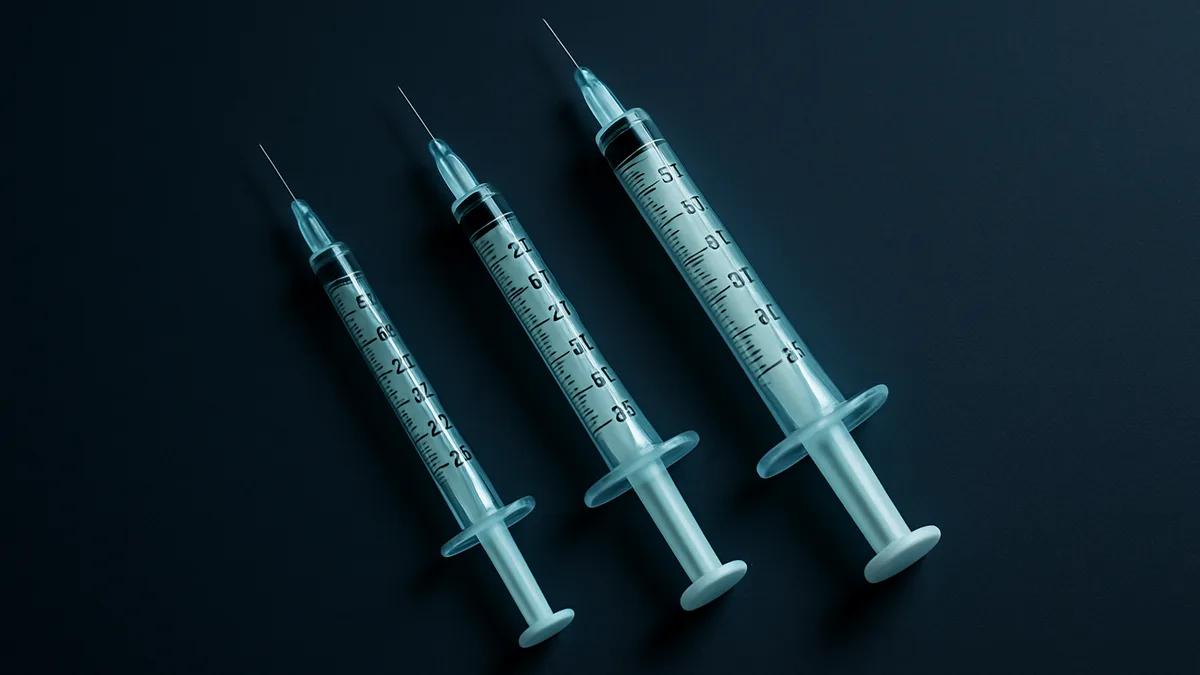
Insulin syringes mark their barrels in units, not milliliters. For peptide reconstitution and dosing, the conversion is straightforward: on a U-100 syringe, 100 units equals 1 mL. Every unit marking represents exactly 0.01 mL of volume.
Research-context information only. The information below reflects published pharmaceutical references, manufacturer syringe specifications, and self-reported community protocols. This article reports what has been documented, not what should be done. Consult a licensed physician for personal medical decisions.
That single relationship — 100 units = 1 mL — is the foundation of every peptide dose measurement made with an insulin syringe. The rest is choosing the right syringe size and reading the markings correctly.
The core conversion: U-100 syringes
U-100 insulin syringes are the standard in peptide research protocols. The "U-100" designation means the syringe is calibrated for insulin at a concentration of 100 units per milliliter. For peptide dosing purposes, the insulin-concentration context is irrelevant — the markings function purely as volume divisions.
The math:
- 100 units = 1 mL
- 1 unit = 0.01 mL
- 10 units = 0.10 mL
This is a fixed physical relationship. The unit lines etched or printed on the syringe barrel divide the total volume into equal increments. Drawing liquid to the 50-unit mark means the syringe contains exactly 0.50 mL of whatever liquid is inside — bacteriostatic water, reconstituted peptide, or anything else.
Full U-100 conversion table
| Units | mL | Common reference |
|---|---|---|
| 1 | 0.01 | Smallest readable mark on most syringes |
| 2 | 0.02 | |
| 3 | 0.03 | |
| 5 | 0.05 | Typical micro-dose volume |
| 10 | 0.10 | One-tenth of a mL |
| 15 | 0.15 | |
| 20 | 0.20 | Common peptide dose volume |
| 25 | 0.25 | Quarter-mL; max comfortable volume for 0.3 mL syringe |
| 30 | 0.30 | Full capacity of a 0.3 mL syringe |
| 40 | 0.40 | |
| 50 | 0.50 | Half-mL; full capacity of a 0.5 mL syringe |
| 60 | 0.60 | |
| 75 | 0.75 | Three-quarter mL |
| 80 | 0.80 | |
| 100 | 1.00 | Full capacity of a 1 mL syringe |
Community protocols and vendor reconstitution guides reference these volumes interchangeably — "draw to 20 units" and "draw 0.20 mL" describe the same physical volume on a U-100 syringe.
U-40 vs U-100: why it matters
U-40 syringes exist but follow a different scale: 40 units = 1 mL on a U-40 syringe, meaning each unit marking represents 0.025 mL instead of 0.01 mL.
The danger is cross-contamination of the math. Drawing to the "40" mark on a U-100 syringe delivers 0.40 mL. Drawing to the "40" mark on a U-40 syringe delivers 1.00 mL — a 2.5x difference in actual volume for the same number on the barrel.
| Syringe type | 40-unit mark = | 1 unit = |
|---|---|---|
| U-100 | 0.40 mL | 0.01 mL |
| U-40 | 1.00 mL | 0.025 mL |
Community sources describe this mismatch as one of the most common dosing errors reported in peptide forums. The fix is simple: peptide protocols overwhelmingly specify U-100 syringes, and sticking with U-100 exclusively eliminates the conversion risk entirely.
U-40 syringes are primarily manufactured for veterinary insulin dosing. They occasionally appear in online supply listings alongside U-100 syringes, which is where the confusion originates. The barrel will always be labeled "U-40" or "U-100" — checking that label before use is the single most important step.
The three common syringe sizes
U-100 insulin syringes come in three standard capacities. Each has a different barrel diameter, graduation resolution, and ideal use case.
0.3 mL syringe (30-unit)
The smallest standard insulin syringe. Graduation marks are typically spaced at 0.5-unit (0.005 mL) increments, making it the most precise option for small volumes.
- Total capacity: 30 units / 0.30 mL
- Graduation: 0.5-unit marks (half-unit precision)
- Best for: Dose volumes under 0.25 mL
- Needle gauge: Typically 29G-31G, 8 mm or 12.7 mm length
Community protocols describe this syringe as the preferred choice for concentrated reconstitutions where dose volumes fall in the 5-20 unit range. The narrower barrel means each unit marking is physically farther apart, making it easier to distinguish between adjacent lines.
0.5 mL syringe (50-unit)
The middle option and the most commonly referenced syringe size in peptide community protocols.
- Total capacity: 50 units / 0.50 mL
- Graduation: 1-unit marks (whole-unit precision)
- Best for: Dose volumes between 0.10 mL and 0.50 mL
- Needle gauge: Typically 29G-31G, 8 mm or 12.7 mm length
This size covers the majority of standard peptide dose volumes. The 1-unit graduation is fine enough for most reconstitution concentrations. When a community protocol specifies "insulin syringe" without further detail, a 0.5 mL / 50-unit syringe is the typical assumption.
1 mL syringe (100-unit)
The largest standard insulin syringe.
- Total capacity: 100 units / 1.00 mL
- Graduation: 1-unit or 2-unit marks depending on manufacturer
- Best for: Dose volumes above 0.50 mL, or reconstitution draws
- Needle gauge: Typically 28G-30G, 12.7 mm length
The 1 mL syringe is frequently used for the reconstitution step itself — drawing bacteriostatic water from the bac water vial and transferring it into the peptide vial. For actual dose measurement, the larger barrel diameter means each unit marking is physically closer together, which reduces precision for small doses. Community sources recommend stepping down to the 0.5 mL or 0.3 mL syringe for the dosing step when the required volume allows it.
Reading the markings
Every insulin syringe barrel has numbered major lines and unnumbered minor lines between them. The reading method depends on syringe size.
On a 0.5 mL (50-unit) syringe:
- Major lines at every 5 units (5, 10, 15, 20, 25, 30, 35, 40, 45, 50)
- Minor lines at every 1 unit between the majors
- Drawing to the third minor line past "10" = 13 units = 0.13 mL
On a 0.3 mL (30-unit) syringe:
- Major lines at every 5 units (5, 10, 15, 20, 25, 30)
- Minor lines at every 0.5 units between the majors
- Drawing to the second minor line past "10" = 11 units = 0.11 mL
On a 1 mL (100-unit) syringe:
- Major lines at every 10 units (10, 20, 30, 40, 50, 60, 70, 80, 90, 100)
- Minor lines at every 2 units between the majors
- Drawing to the second minor line past "20" = 24 units = 0.24 mL
The plunger's rubber gasket has a slightly domed top edge. The correct reading point is the top edge of the gasket where it contacts the barrel wall — not the dome peak and not the bottom edge. Manufacturer instructions and community guides consistently reference this as the measurement line.
Choosing the right syringe for the dose
The principle is straightforward: use the smallest syringe that comfortably fits the required dose volume. Smaller syringes have finer graduations and wider physical spacing between marks, both of which improve measurement accuracy.
| Dose volume | Recommended syringe | Why |
|---|---|---|
| Under 0.25 mL (25 units) | 0.3 mL (30-unit) | Half-unit graduation, maximum precision |
| 0.10 - 0.50 mL (10-50 units) | 0.5 mL (50-unit) | 1-unit graduation, covers most protocols |
| 0.50 - 1.00 mL (50-100 units) | 1.0 mL (100-unit) | Only option for volumes above 0.50 mL |
| Reconstitution (drawing bac water) | 1.0 mL (100-unit) | Full mL capacity for water transfer |
How reconstitution concentration affects syringe choice
The amount of bacteriostatic water added during reconstitution directly determines the dose volume — and therefore which syringe is appropriate.
Consider a 5 mg peptide vial. Reconstituting with different volumes of bacteriostatic water changes the concentration and the draw volume for the same dose:
| Bac water added | Concentration | Volume for 250 mcg dose | Syringe choice |
|---|---|---|---|
| 1 mL | 5 mg/mL (5000 mcg/mL) | 0.05 mL / 5 units | 0.3 mL |
| 2 mL | 2.5 mg/mL (2500 mcg/mL) | 0.10 mL / 10 units | 0.3 or 0.5 mL |
| 3 mL | 1.67 mg/mL (1667 mcg/mL) | 0.15 mL / 15 units | 0.5 mL |
| 5 mL | 1 mg/mL (1000 mcg/mL) | 0.25 mL / 25 units | 0.5 mL |
Community protocols often describe selecting reconstitution volume specifically to land the dose in a measurable range. Adding less bac water creates a more concentrated solution (smaller dose volumes, requires finer syringe), while adding more creates a dilute solution (larger volumes, easier to measure but uses the vial faster).
The general pattern documented across peptide community sources: reconstitute with enough bacteriostatic water to place the most common dose volume between 5 and 30 units on a 0.3 mL or 0.5 mL syringe. This range offers the best balance of measurement precision and practical handling.
Common mistakes
Three errors appear repeatedly in community troubleshooting threads:
Using U-40 syringes with U-100 math. As covered above, drawing to the same unit number on the wrong syringe type delivers 2.5x too much or too little volume. Always verify the syringe type printed on the barrel.
Reading the wrong edge of the plunger gasket. The domed rubber gasket has a top edge and a bottom edge separated by approximately 1-2 unit marks. Inconsistent reading — sometimes top, sometimes bottom — introduces systematic measurement variation across draws.
Using a 1 mL syringe for micro-doses. Drawing 5 units on a 1 mL syringe means reading a line that may be less than 1 mm from the next graduation mark. The same 5-unit dose on a 0.3 mL syringe spans a physically larger section of the barrel with half-unit marks between each whole unit. Precision improves dramatically by matching syringe size to dose volume.
Quick-reference formula
For any U-100 insulin syringe, the conversion in either direction:
- Units to mL: divide by 100. Example: 20 units / 100 = 0.20 mL
- mL to units: multiply by 100. Example: 0.15 mL x 100 = 15 units
That relationship holds for every U-100 syringe regardless of total capacity. The syringe size changes the graduation resolution and maximum volume — not the units-to-mL ratio.