Research-context disclaimer: The information below is compiled from published literature, manufacturer documentation, and community-reported protocols. It is presented for educational and informational purposes only. Nothing in this article constitutes medical advice, and no content here should be interpreted as a recommendation to use any substance. Consult a licensed healthcare provider before making any decisions related to peptide use.
Why Supplies Matter Before the First Vial
Reconstitution is a sterile process. The lyophilized peptide powder sitting in a sealed vial is stable — it is the transition from powder to solution that introduces contamination risk. Every supply in this checklist exists to maintain sterility during that transition and throughout the multi-dose use window that follows.
Community sources consistently describe supply failures — wrong syringe gauge, non-sterile water, reused needles — as the most common source of reconstitution problems. Having the correct supplies staged before opening the first vial eliminates the improvisation that leads to those failures.
The Essential Supplies List
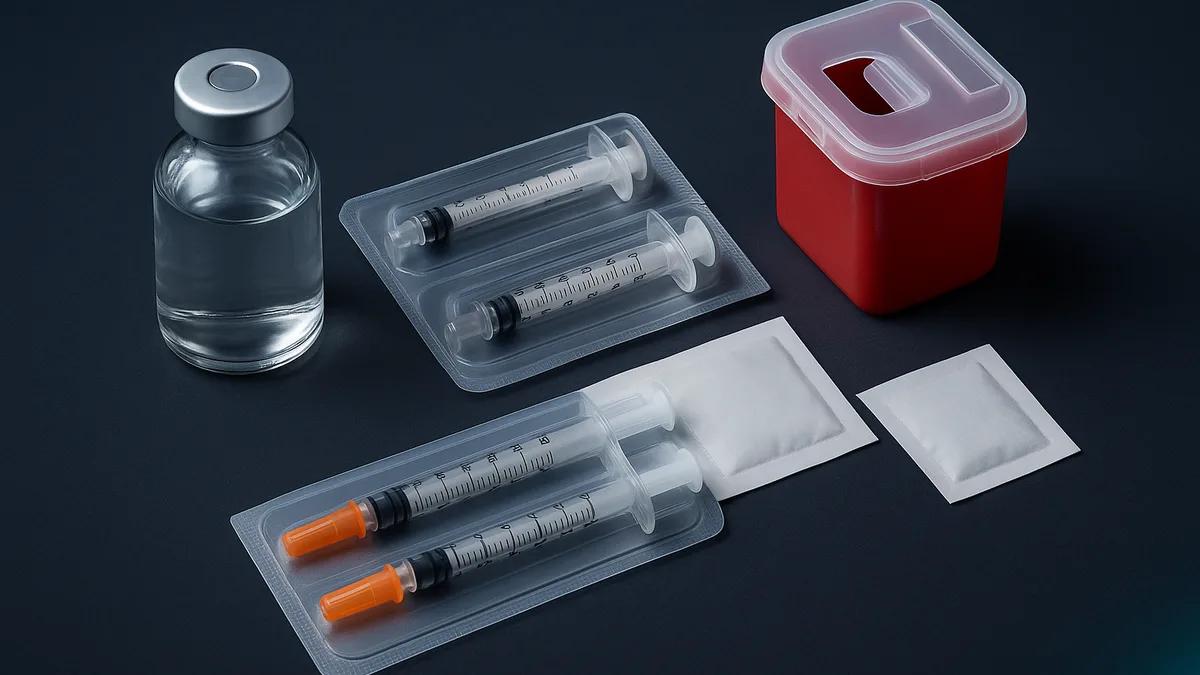
1. Bacteriostatic Water (30 mL Multi-Dose Vial)
Spec: USP-grade bacteriostatic water for injection, 0.9% benzyl alcohol preservative, 30 mL multi-dose vial with rubber septum.
Bacteriostatic water is the solvent. The 0.9% benzyl alcohol suppresses microbial growth across the 28-day multi-dose window described in USP guidance — this is the entire reason it is the documented solvent for multi-dose peptide vials rather than sterile water or saline.
A single 30 mL vial reconstitutes many peptide vials. A typical reconstitution uses 1-3 mL of bacteriostatic water per peptide vial, so one 30 mL vial covers roughly 10-30 reconstitutions depending on the ratio.
Common mistakes: Using sterile water for injection (no preservative — 24-hour window, not 28 days). Using normal saline (different osmolality, not interchangeable for all peptides). Using tap water or distilled water (non-sterile, no preservative, immediate contamination risk).
2. Insulin Syringes (U-100, 29-31 Gauge)
Spec: U-100 insulin syringes, 29 to 31 gauge needle, 0.3 mL or 0.5 mL capacity, individually wrapped and sterile.
These are the administration syringes — used to draw the measured dose from the reconstituted peptide vial. The fine gauge (29-31G) produces a narrow needle appropriate for subcutaneous injection, which is the route most commonly cited in community peptide protocols.
The 0.5 mL (50-unit) syringe is the most versatile starting point. It covers the dose volumes for the majority of documented protocols. The 0.3 mL (30-unit) syringe offers finer graduation marks and is referenced for protocols involving very small volumes — typically under 15 units.
Common mistakes: Using 1 mL (100-unit) syringes for small doses — the wider barrel makes it harder to measure 5 or 10 unit increments accurately. Using syringes without the U-100 designation, which changes the unit-to-volume math that reconstitution calculators assume.
3. Mixing Syringes (18-21 Gauge, 1-3 mL)
Spec: Luer-lock syringes, 1 mL or 3 mL capacity, with separate 18 to 21 gauge drawing needles.
Mixing syringes serve a different purpose than insulin syringes. The larger-gauge needle (18-21G) draws bacteriostatic water from the water vial efficiently and transfers it to the peptide vial during reconstitution. The wider bore prevents the coring (punching a plug of rubber into the vial) that can occur when a fine insulin needle is pushed through a rubber septum repeatedly.
Community sources describe a common workflow: draw bacteriostatic water with the mixing syringe, inject it slowly down the inner wall of the peptide vial, then set the mixing syringe aside. The insulin syringe is used only for the final measured dose draws.
Common mistakes: Using the same insulin syringe to draw bacteriostatic water and then inject — this works in a pinch but the fine needle makes drawing from the water vial slow and increases septum coring risk over multiple punctures.
4. Alcohol Swabs (70% Isopropyl)
Spec: Individually packaged, 70% isopropyl alcohol prep pads, medical grade.
Every vial septum is swabbed before every needle puncture. This is the baseline aseptic technique described across community sources, vendor documentation, and clinical handling guidelines. The 70% concentration is specific — it is more effective at microbial disinfection than higher concentrations because the water content aids cell wall penetration.
A typical reconstitution session uses 2-4 swabs: one for the bacteriostatic water vial septum, one for the peptide vial septum, and one or two for the injection site if applicable.
Common mistakes: Skipping the swab step. Using household cleaning wipes (wrong concentration, often contain additives). Touching the septum after swabbing.
5. Sharps Disposal Container
Spec: FDA-cleared sharps container, puncture-resistant, with a locking or sealing lid. 1-quart size is sufficient for personal use.
Used syringes and needles go in the sharps container immediately after use — not in the trash, not recapped on the counter. Community sources and municipal waste guidelines uniformly describe proper sharps disposal as non-negotiable. Most pharmacies accept full sharps containers for disposal, and many municipalities provide mail-back programs.
A 1-quart container holds roughly 70-100 insulin syringes and lasts most users several months.
Common mistakes: Throwing used syringes in household trash (biohazard risk, illegal in many jurisdictions). Recapping needles (needlestick risk). Using improvised containers that are not puncture-resistant.
6. Refrigerated Storage (2-8 degrees Celsius)
Spec: Dedicated mini fridge or a designated shelf in a standard refrigerator, maintaining 2-8 degrees Celsius consistently.
Reconstituted peptide vials require refrigeration. Community sources and vendor documentation universally cite 2-8 degrees Celsius as the storage range after reconstitution. The peptide molecule is the temperature-sensitive component — bacteriostatic water itself is stable at room temperature.
A small, dedicated mini fridge is cited in community sources as the preferred approach because it avoids temperature fluctuations from frequent door opening and eliminates contamination risk from food storage. A designated shelf in a standard refrigerator works if temperature is consistent and the vials are stored upright in a sealed container or bag.
Common mistakes: Storing reconstituted vials at room temperature (accelerated degradation). Freezing reconstituted vials (freeze-thaw cycles damage most peptides). Placing vials in the refrigerator door (most temperature-variable zone).
7. Optional but Useful: Labels and a Tracking Notebook
Vial labels documenting the peptide name, reconstitution date, concentration (mg/mL), and bacteriostatic water volume used prevent dose-calculation errors when multiple vials are in rotation. Community sources describe mislabeled or unlabeled vials as a common source of dosing mistakes.
A simple notebook or spreadsheet tracking reconstitution dates, dose draws, and vial depletion helps maintain the 28-day use window. The 28-day clock starts at first puncture — not at reconstitution, not at purchase — and tracking it prevents using a vial past its documented window.
What NOT to Use
Community sources and published handling guidelines consistently flag the following as reconstitution failures:
- Reused syringes or needles. Insulin syringes are single-use by design. Reuse dulls the needle, compromises sterility, and introduces contamination into multi-dose vials.
- Tap water, distilled water, or purified drinking water. None are sterile. None contain a preservative. Reconstituting with any of these introduces bacteria into the vial immediately.
- Sterile water for single-dose use. Sterile water lacks the benzyl alcohol preservative. It produces a working solution with a documented 24-hour window — incompatible with multi-dose peptide vials that span weeks of use.
- Non-sterile containers or surfaces. Setting uncapped vials on kitchen counters, touching septums with fingers, or storing syringes loose in drawers all introduce contamination vectors.
Storage Summary
| Item | Storage Condition | Notes |
|---|---|---|
| Lyophilized (unreconstituted) peptide vials | Freezer (-20 degrees Celsius) or refrigerator | Stable for months to years per community sources |
| Reconstituted peptide vials | Refrigerator (2-8 degrees Celsius) | 28-day window from first puncture |
| Bacteriostatic water (unopened) | Room temperature (20-25 degrees Celsius) | Per manufacturer labeling |
| Bacteriostatic water (opened) | Room temperature | 28-day window from first puncture |
| Insulin syringes (unused) | Room temperature, sealed packaging | Single-use, discard after one use |
| Alcohol swabs | Room temperature, sealed packaging | Check expiration date on box |
Budget Estimate: Starter Kit
Retail pricing as of 2026 for a basic reconstitution supply set:
| Item | Typical Price Range | Quantity |
|---|---|---|
| Bacteriostatic water (30 mL vial, COA-verified) | $25 - $35 | 1 vial |
| Insulin syringes (U-100, 29-31G) | $12 - $20 | Box of 100 |
| Mixing syringes + needles (18-21G) | $5 - $15 | Pack of 10-20 |
| Alcohol swabs | $3 - $8 | Box of 100-200 |
| Sharps container (1 qt) | $5 - $10 | 1 container |
| Total starter kit | $50 - $88 |
The consumables — syringes and swabs — are the recurring cost. A single 30 mL vial of bacteriostatic water and one box of insulin syringes typically cover multiple peptide vials before replacement is needed. Community sources describe the initial supply purchase as a one-time setup cost that amortizes quickly across ongoing use.
The Foundation of the Setup
Bacteriostatic water is the single supply that every reconstitution depends on. The syringes, swabs, and sharps container are standardized medical supplies available from any pharmacy. But the solvent itself — USP-grade, 0.9% benzyl alcohol, multi-dose format — is the component that determines whether the reconstituted peptide maintains stability across its documented 28-day use window.
Starting with the correct bacteriostatic water and building the rest of the supply list around it is the documented approach across community sources, vendor reconstitution sheets, and published handling guidelines.