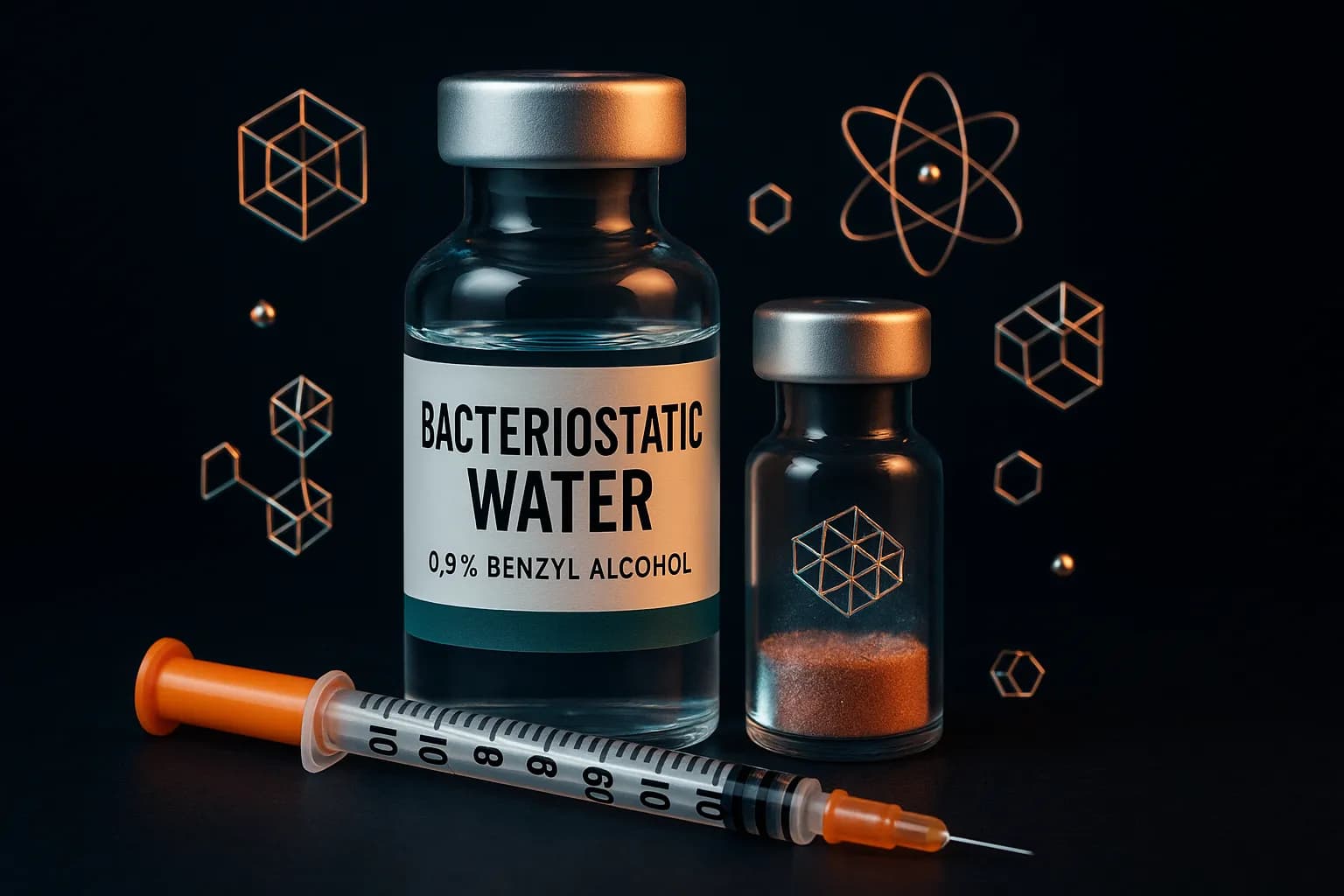
GHK-Cu is a tripeptide (glycyl-L-histidyl-L-lysine) complexed with copper, used in both injection and topical/transdermal community-reported protocols. The reconstitution math depends on two variables: the vial size (50mg, 100mg, and 200mg are the most common formats) and the intended route. Injection use typically targets higher mg/mL concentrations than other peptides because the per-dose amounts are measured in milligrams rather than micrograms.
Research-context information only. GHK-Cu is a research chemical without FDA approval as a finished pharmaceutical product. The reconstitution math reflects vendor documentation and community-reported protocols. Research and community sources describe skin, hair, and connective-tissue applications; outcome claims are not supported by FDA-approved indications. This article reports what has been documented, not what should be done. Consult a licensed physician for personal medical decisions.
GHK-Cu vial sizes
GHK-Cu is most commonly packaged in 50mg, 100mg, or 200mg lyophilized vials. These are notably larger amounts per vial than most research peptides (which are typically 2mg or 5mg). The larger format reflects the higher dose ranges community sources cite — both injection and topical routes typically use mg-scale rather than mcg-scale per-dose amounts.
The lyophilized peptide appears as a pale blue or pale blue-purple cake inside the vial, reflecting the copper-complex coloration. Upon reconstitution with bacteriostatic water, the solution takes on a deeper blue-purple color. Community sources cite this coloration as the documented appearance — it is the copper complex itself, not a contamination signal.
Reconstitution math for injection use
50mg GHK-Cu vial: Community sources and vendor reconstitution sheets commonly cite 2 mL or 5 mL of bacteriostatic water for a 50mg vial. A 2 mL reconstitution produces 25 mg/mL — concentrated, with each 10-unit mark on a U-100 insulin syringe corresponding to 2.5 mg. A 5 mL reconstitution produces 10 mg/mL — more dilute, where each 10-unit mark corresponds to 1 mg. The 1-2mg injection dose steps commonly cited in community protocols land cleanly on the 10-20 unit marks at the 10 mg/mL concentration.
100mg GHK-Cu vial: Community sources commonly cite 5 mL or 10 mL of bacteriostatic water for a 100mg vial. A 5 mL reconstitution produces 20 mg/mL; a 10 mL reconstitution produces 10 mg/mL. The 10 mg/mL concentration matches the 50mg-vial alternative and is commonly cited because each 10-unit mark on a U-100 insulin syringe corresponds to 1 mg — a clean math fit for the 1-3mg injection dose steps documented in community protocols.
200mg GHK-Cu vial: Community sources commonly cite 10 mL or 20 mL of bacteriostatic water for a 200mg vial. A 10 mL reconstitution produces 20 mg/mL; a 20 mL reconstitution produces 10 mg/mL. Note that 20 mL exceeds the volume of a single 10 mL bacteriostatic water vial — community sources sometimes cite using two 10 mL vials of bacteriostatic water for the 20 mL ratio, or alternatively reconstituting in two stages.
Topical and transdermal concentration math
Community-reported topical GHK-Cu protocols typically target a concentration of 0.05% to 0.2% in a carrier base. Converting between percentages and per-gram amounts:
- 0.05% = 500 mcg per gram of carrier
- 0.1% = 1 mg per gram of carrier
- 0.2% = 2 mg per gram of carrier
The community-documented preparation method typically involves two steps:
Step 1 — reconstitute the lyophilized vial with bacteriostatic water at a standard injection-route ratio (e.g. 100mg in 10 mL produces 10 mg/mL).
Step 2 — dilute the reconstituted solution into a separate carrier base — commonly a cosmetic-grade serum, niosome carrier, hyaluronic acid gel, or moisturizer base. The dilution math depends on the target percentage. For example, mixing 1 mL of the 10 mg/mL reconstituted solution (= 10 mg GHK-Cu) into 10 grams of carrier produces a final concentration of 0.1% (1 mg/g) — assuming approximately equal mass-to-volume for a water-based carrier.
Community sources note that the carrier-base step is where most variability appears across published topical protocols — some use ready-made cosmetic bases, some use compounded niosome formulations cited for enhanced transdermal penetration, some cite hyaluronic acid gels for moisturizing properties on top of the peptide.
Some community sources cite single-step reconstitution directly into a finished topical carrier, bypassing the bacteriostatic water intermediate. The trade-off cited is no antimicrobial preservation window — the resulting product is typically described as having a shorter usable shelf life than the bacteriostatic water reconstitution.
Storage notes for the copper-peptide complex
GHK-Cu's copper complex is described in research and community sources as more sensitive to oxidation, light, and temperature cycling than most research peptides. Vendor documentation and community sources commonly cite:
- Refrigerated storage at 2-8°C after reconstitution for the injection-route bacteriostatic water solution
- Shielding from light — amber vials, opaque storage boxes, or wrapping the vial in foil
- Avoiding repeated temperature cycling — keeping the vial in consistent cold storage
- Finishing the reconstituted vial within two to four weeks — community sources cite this window for the bacteriostatic water reconstitution
- Shorter windows for topical formulations in cosmetic carrier bases — often one to two weeks, because cosmetic bases typically lack antimicrobial preservation
The blue-purple coloration of the reconstituted solution is the documented appearance. Community sources cite progressive color change to brown or significant darkening over time as a stability-failure signal — distinct from the initial blue-purple, which is normal.
Lyophilized (unreconstituted) GHK-Cu vials are typically more stable than reconstituted ones. Community sources cite long-term storage at freezer temperatures (-20°C or below) as the standard approach for vials not yet reconstituted.
Common questions
The FAQ at the top of this article covers vial-size reconstitution math, the injection vs topical distinction, light sensitivity, and the storage window.
Bottom line
GHK-Cu reconstitutes with bacteriostatic water using vendor-documented and community-cited ratios that depend on vial size and intended route. The 10 mg/mL concentration produced by 5 mL into a 50mg vial (or 10 mL into a 100mg vial) is the most commonly cited for injection use because each 10-unit mark on a U-100 insulin syringe corresponds to a clean 1 mg — fitting the 1-3mg injection dose steps documented in community protocols. Topical and transdermal protocols typically reconstitute first with bacteriostatic water at an injection-route ratio, then dilute into a separate cosmetic carrier base targeting 0.05% to 0.2% final concentration. The copper-peptide complex is reported as light- and oxidation-sensitive — refrigerated, light-shielded storage is the community-cited standard.
Related reading
- Buying GHK-Cu: Vendor + COA Guide (2026) — vendor comparison, COA verification, and current pricing on thepeptidecatalog
- What Is Bacteriostatic Water? Benzyl Alcohol + Uses (2026) — definition, USP standards, benzyl alcohol mechanism
- How Long Does Bacteriostatic Water Last? 28-Day Rule (2026) — the post-puncture window and storage variables
- Why Is Bacteriostatic Water Cloudy? 5 Causes (2026) — quality signals and contamination modes
- Bacteriostatic Water for BPC-157 + TB-500 (Wolverine Stack, 2026) — healing-peptide reconstitution math
- Bacteriostatic Water for Melanotan-1 and Melanotan-2 (2026) — melanotan reconstitution math