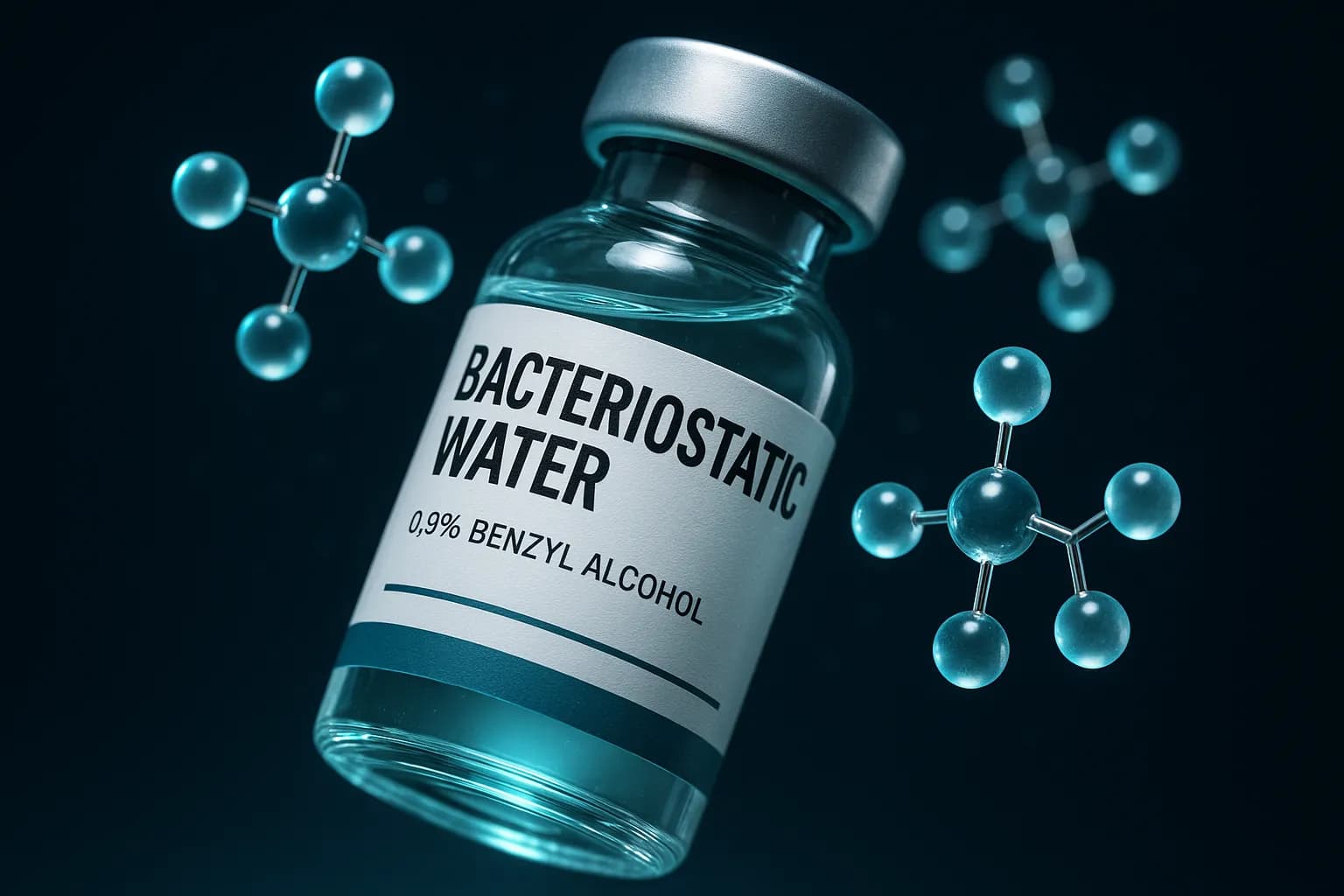
Bacteriostatic water is sterile, non-pyrogenic water containing 0.9% benzyl alcohol as a preservative. The benzyl alcohol is what separates it from regular sterile water — and the entire reason it can be punctured multiple times across a 28-day window without losing its safe-use status.
Research-context information only. Bacteriostatic water for injection is an FDA-regulated injectable product. The information below reflects USP standards, manufacturer prescribing information, published trial protocols, and self-reported community sources. This article reports what has been documented, not what should be done. Consult a licensed physician for personal medical decisions.
That single-ingredient difference — sterile water plus benzyl alcohol — is the load-bearing detail. Everything else about how bacteriostatic water is used follows from it.
What bacteriostatic water actually is
Bacteriostatic water for injection is defined in the United States Pharmacopeia (USP) as sterile water meeting strict purity and pyrogen-free standards, with 9 mg per mL (0.9%) of benzyl alcohol added as a bacteriostatic preservative. Pfizer and Hospira are the two largest USP-grade manufacturers in the U.S. market, and their prescribing information describes the same composition: water for injection, benzyl alcohol at 0.9%, nothing else.
The product is packaged almost universally in glass vials with metal-crimp seals — typically 10 mL, 20 mL, or 30 mL volumes. The crimp seal is part of what makes the multi-dose use case work: the rubber stopper underneath the metal crimp re-seals after each puncture, and the benzyl alcohol inside suppresses any microbial entry that does occur.
Community sources and peptide protocols cite bacteriostatic water as the documented solvent for multi-dose peptide reconstitution. USP-grade product carries pharmacopeial guarantees on sterility, pyrogen content, and benzyl alcohol concentration — three specifications that generic or unlabeled "bac water" listings on marketplace channels frequently fail to verify.
The pharmaceutical-grade product is what published trial protocols, vendor reconstitution sheets, and community references consistently specify. Substitutes — distilled water, tap-sterilized water, mislabeled saline — are not the documented solvent and have been associated with the cloudy-vial failure mode that destroys reconstituted peptide.
How benzyl alcohol works
Benzyl alcohol at 0.9% is bacteriostatic — it inhibits bacterial growth without necessarily killing existing organisms. The distinction matters: the preservative is not a sterilizer. It does not rescue an already-contaminated vial. What it does is suppress the proliferation of any microbes introduced through routine needle puncture.
Mechanistically, benzyl alcohol disrupts bacterial cell membranes and interferes with protein function at the concentration used in USP bacteriostatic water. Research and pharmaceutical documentation describe its activity against common skin-flora contaminants — Staphylococcus, Streptococcus, Escherichia coli — which are the most likely organisms to enter a punctured vial during routine handling.
The 0.9% concentration is the spec value because it provides effective bacteriostasis at a level low enough to be tolerated parenterally for most adult subcutaneous and intramuscular routes. Higher concentrations would carry tolerance trade-offs; lower concentrations would lose efficacy against contamination.
The practical consequence is the 28-day multi-dose window. USP guidance and manufacturer prescribing information describe the period during which a punctured vial of bacteriostatic water can be re-accessed under aseptic technique. The window is the entire reason the product exists as a distinct category — sterile water for injection without preservative loses its safe-use status within hours of first puncture; bacteriostatic water extends that to weeks.
USP grade vs generic
Not all liquid labeled "bacteriostatic water" meets USP spec. The pharmacopeial standard imposes specific requirements:
- Sterilization by validated method (typically terminal autoclaving)
- Pyrogen testing under USP <85> Bacterial Endotoxins Test
- Benzyl alcohol assay confirming 0.9% concentration
- Container integrity testing (glass vial, sealed stopper, metal crimp)
- Lot-numbered packaging with documented chain of custody
USP-grade product from Pfizer or Hospira carries all five. Generic or unlabeled marketplace listings frequently fail one or more, and the failure mode is silent — a non-USP product looks identical to USP product in the vial.
Documented failure modes on marketplace listings:
- Bottled saline (0.9% sodium chloride) sold as "bacteriostatic water" — visually identical but lacks benzyl alcohol entirely
- Distilled water in re-sealed plastic squeeze bottles — no pyrogen testing, no preservative
- Re-bottled product without lot tracking — chain of custody broken
- Glycerol- or PEG-adulterated water — labeled "bacteriostatic" but contains co-solvents that interact with peptide chemistries
The cheapest insurance against these failure modes is buying from a source that can confirm what's in the bottle: manufacturer name (Pfizer/Hospira), lot number, USP labeling, glass vial with metal-crimp seal, and the explicit "0.9% benzyl alcohol" line printed on the label. Peptide vendors that source bacteriostatic water specifically for research-peptide reconstitution typically carry the chain of custody to verify all five points.
When bacteriostatic water vs sterile water is the documented choice
Bacteriostatic water and sterile water for injection are sometimes treated as interchangeable. They are not — the use case determines which is the documented solvent.
Bacteriostatic water is the documented choice for:
- Multi-dose peptide vials (5 mg or 10 mg vials used over 2-4 weeks)
- Multi-dose GLP-1 protocols where a vial is re-punctured weekly
- Any reconstitution where the resulting solution will be drawn from more than once
Sterile water for injection is the documented choice for:
- Single-dose reconstitution where the entire vial is drawn in one session
- IV admixture preparation (where benzyl alcohol contraindication applies)
- Reconstitution of products with benzyl alcohol incompatibility documented in vendor protocols
- Use in neonates or other populations where benzyl alcohol carries documented contraindication
The dividing line is the puncture count. One puncture, immediate use, full vial consumed — sterile water works. Multiple punctures across days or weeks — bacteriostatic water is the documented solvent because the preservative is the entire reason multi-dose use is safe.
Detailed comparison of the trade-offs is covered in the bacteriostatic water vs sterile water guide.
Common Questions
The FAQ at the top of this article covers the most common questions. Two additional notes:
Storage before opening: USP bacteriostatic water carries the manufacturer-printed expiration date — typically 18-24 months from the manufacturing date when stored at controlled room temperature. The unopened vial does not require refrigeration. Storage details are covered in the bacteriostatic water shelf life guide.
Storage after opening: USP guidance describes a 28-day window after first puncture under aseptic technique, with refrigeration commonly cited as a community-reported way to maintain stability through that window. The full 28-day rule is covered in the shelf life guide.
Bottom line
Bacteriostatic water for injection is sterile, USP-grade water with 0.9% benzyl alcohol added as a preservative. The preservative is the entire reason the product exists as a distinct category from sterile water — it enables the 28-day multi-dose window that makes multi-dose peptide reconstitution viable.
USP-grade product from Pfizer or Hospira carries pharmacopeial guarantees on sterility, pyrogen content, and benzyl alcohol concentration. Marketplace-sourced "bac water" without those guarantees has been documented to fail the spec in multiple ways, with the failure mode silent until the reconstituted peptide goes cloudy.
Related Reading
- Bacteriostatic Water vs Sterile Water: Which to Use — full comparison of the multi-dose vs single-use divergence, with the benzyl-alcohol-sensitivity trade-off
- How Long Does Bacteriostatic Water Last? 28-Day Rule — USP shelf-life guidance, refrigeration, and what actually shortens the window
- Where to Buy Bacteriostatic Water (Pharmaceutical Grade) — buyer-side framework for verifying USP spec
References
- Pfizer/Hospira. Bacteriostatic Water for Injection, USP — Prescribing Information. Revised 2023.
- United States Pharmacopeia. USP <797> Pharmaceutical Compounding — Sterile Preparations. USP Convention, 2023.
- United States Pharmacopeia. USP <85> Bacterial Endotoxins Test. USP Convention, 2023.
This guide is for educational and informational purposes only. It is not medical advice. Injectable water products are FDA-regulated. Consult a qualified healthcare provider before starting any peptide protocol.