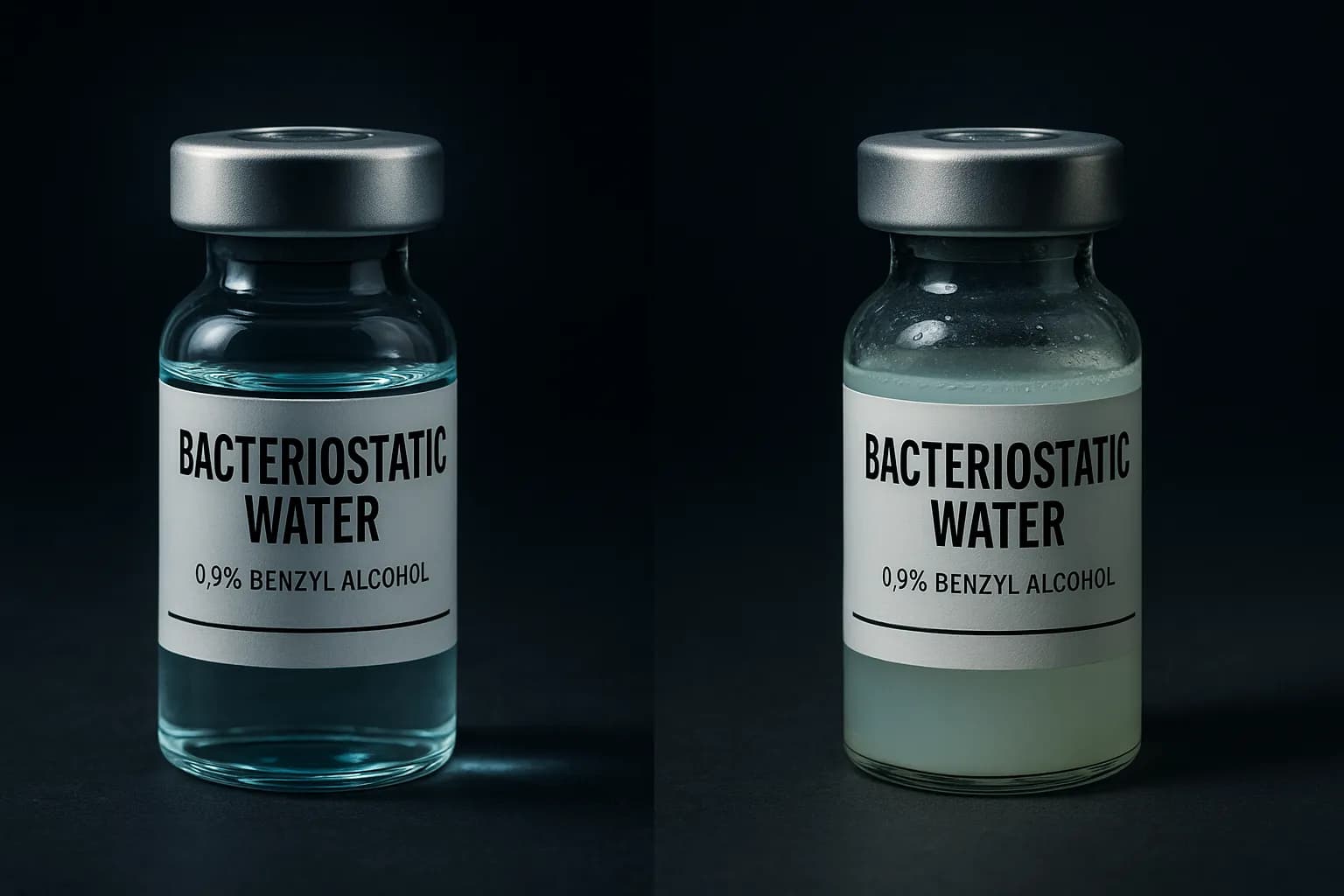
Bacteriostatic water that is compliant with the USP monograph is clear and colorless. Cloudiness in the bottle — at any stage from sealed-and-unopened through end of the 28-day multi-dose window — is a deviation from spec and a signal that something has gone wrong with either the production, the storage, the labeling, or the identity of the product.
Community sources commonly cite cloudiness as the single most useful visual marker for sorting reliable bac water from unreliable bac water. Pharmaceutical procedure notes that no documented method exists for restoring out-of-spec bacteriostatic water to compliant condition. This guide reports the five causes community sources most commonly cite, ranked by frequency.
What cloudy bacteriostatic water actually means
The USP monograph for Bacteriostatic Water for Injection describes the product as sterile, non-pyrogenic water containing 0.9 percent benzyl alcohol as preservative, with appearance characteristics of a clear, colorless solution. Pharmaceutical documentation specifies that:
- Benzyl alcohol at 0.9 percent is fully soluble in water and produces no visible haze at compliant concentration
- pH between 4.5 and 7.0 produces no visible precipitation
- Compliant sterile manufacture produces no particulate matter
- Properly maintained storage (controlled room temperature) does not generate cloudiness through the labeled shelf life
When cloudiness appears in a bottle, one of those four spec elements has been compromised. The cloudiness itself is the visible result of either dissolved particulate, microbial growth, denatured preservative, or contamination introduced post-manufacture.
Community sources commonly distinguish two cloudiness contexts:
- Cloudiness in a sealed, unopened vial. Signals counterfeit product, manufacturing defect, or freeze-thaw damage in transit. Pharmaceutical procedure notes this should never appear in compliant pharmaceutical-grade product.
- Cloudiness developing during the 28-day multi-dose window. Signals microbial contamination from inadequate preservative or technique failure, freeze damage during refrigerated storage, or expiration creep past the 28-day window.
The cause matrix below maps the observed cloudiness pattern back to the most likely root cause.
The 5 most common causes (ranked)
Cause 1 — Sub-spec benzyl alcohol concentration
The dominant cause of cloudy bac water in community-source reports. The USP monograph requires 0.9 percent (9 mg/mL) benzyl alcohol as preservative. Product that tests below this concentration fails to suppress microbial growth over the 28-day multi-dose window.
Cloudiness from sub-spec preservative typically develops over days to weeks during the multi-dose use period — not immediately at first puncture. Community sources commonly describe this pattern as bac water that looked fine on day 1 but turned hazy by day 8 to 14, with reconstituted peptide developing aggregation in parallel.
The trap with sub-spec preservative is that it is not visible at the point of purchase or at first puncture. Benzyl alcohol is fully dissolved at any concentration in the spec range, so visual inspection cannot distinguish 0.9 percent product from 0.4 percent product. Community sources commonly cite Certificate of Analysis (COA) review for the specific production lot as the only reliable pre-purchase check.
Cause 2 — Microbial contamination (technique or seal compromise)
Bacteriostatic water is sterile at manufacture and remains sterile through proper aseptic technique during multi-dose use. Cloudiness from microbial contamination develops when:
- The vial stopper is punctured without 70 percent isopropyl swab between uses
- A needle is re-used between peptide vial and bac water vial (back-contamination)
- The metal-crimp seal has been compromised in transit (visible bent or loose seal)
- A puncture-resistant stopper is over-punctured (community sources commonly cite 10 to 15 punctures as the practical ceiling before coring becomes a contamination vector)
Pharmaceutical procedure notes that visible cloudiness from microbial contamination typically appears 48 to 96 hours after the contamination event, as bacterial colonies reach concentrations the eye can detect.
The 28-day USP window is conditional on aseptic technique. Community sources commonly describe the window collapsing to days rather than weeks when technique fails or when sub-spec preservative is unable to compensate for minor technique gaps.
Cause 3 — Freeze-thaw damage in storage or transit
Bacteriostatic Water for Injection is labeled for storage at controlled room temperature (20 to 25 degrees C, 68 to 77 degrees F). Pharmaceutical procedure notes that the product is not labeled for refrigeration or freezing in its sealed state, and that freezing-and-thawing cycles can produce visible cloudiness through several mechanisms:
- Ice crystal formation can fracture the rubber stopper seal, introducing air and microbial entry points
- Phase separation during slow thaw can produce localized concentration differences that take time to re-equilibrate
- Benzyl alcohol can partially come out of solution at very low temperatures and not fully re-dissolve on thaw
Community sources commonly cite freeze damage as a frequent cause of cloudiness in bac water shipped during winter months by carriers that hold parcels overnight in unheated facilities. The visible signal — haze on arrival in an otherwise sealed bottle — is the marker for this failure mode.
Cause 4 — Age beyond 28 days after first puncture
USP describes the 28-day multi-dose window as the period during which compliant bacteriostatic water maintains preservative efficacy under aseptic technique and refrigerated storage after first puncture. Past day 28, pharmaceutical documentation describes preservative concentration as declining and microbial-suppression efficacy as compromised.
Cloudiness in a multi-dose vial past the 28-day window is the expected outcome under the USP framework. Community sources commonly cite this as the failure mode for users who attempt to extend a 30 mL multi-dose vial across a 6 to 8 week cycle without rotating to a fresh vial — the bac water itself goes cloudy somewhere between week 5 and week 7, and any reconstituted peptide drawn from the cloudy vial inherits the contamination.
The 28-day window applies to the bac water vial itself, not to the peptide vial. A 5 mg peptide vial reconstituted into a fresh bac water vial gets the full 28-day window starting from the peptide reconstitution date — but if the bac water has been open for 20 days before reconstitution, the effective window for the reconstituted peptide is the remaining 8 days, not 28.
Cause 5 — Counterfeit listings (mislabeled product)
The lowest-frequency but highest-severity cause. Community sources have documented multiple marketplace listings where product sold under a "Bacteriostatic Water for Injection" label was on analysis a different product entirely:
- Plain 0.9 percent sodium chloride (saline) with no benzyl alcohol preservative
- Sterile water for injection (no preservative) repackaged with bacteriostatic water labeling
- Tap water or distilled water with no sterility processing
Cloudiness from counterfeit product can appear at any stage: immediately on opening (if particulate is present), within hours of first puncture (if the product was never sterile), or within days as microbial growth proceeds without preservative suppression.
The marker for counterfeit listings is the chain-of-custody failure that preceded the cloudiness — no named manufacturer, no Certificate of Analysis, no lot or expiration printing, no glass-with-metal-crimp-seal packaging, or pricing far below the 20 to 30 dollar range for 30 mL.
How to spot a quality vial before opening
Community sources and pharmaceutical procedure notes commonly cite a pre-opening inspection checklist:
| Check | What compliant product shows |
|---|---|
| Label wording | Explicit "Bacteriostatic Water for Injection, USP" with "0.9 percent benzyl alcohol added as preservative" line |
| Manufacturer identity | Named manufacturer printed on label (Hospira/Pfizer for pharmacy-direct; vendor identity for research-grade) |
| Container | Glass vial with metal-crimp seal and intact rubber stopper |
| Lot and expiration | Both printed legibly on the label or crimp |
| Appearance | Clear, colorless solution with no visible particulate, haze, or precipitate when held against light |
| Seal integrity | Metal crimp fully seated, no visible dents or bent edges |
Failing any of these checks is a return signal under most vendor return policies. Community sources commonly recommend not using product that fails inspection on a peptide vial regardless of how minor the deviation appears.
What to do if reconstituted peptide goes cloudy
Pharmaceutical documentation describes peptide aggregation — the molecular mechanism behind cloudiness in reconstituted peptide solutions — as largely irreversible under home conditions. Community sources commonly describe the practical response:
- Document the failure. Photograph the cloudy vial against a dark background and note the date and time relative to reconstitution.
- Inspect the bac water vial. If the bac water itself is cloudy or near the 28-day post-puncture window, the bac water is the most likely root cause. If the bac water is clear and recently opened, the peptide vial is the more likely root cause.
- Discard the cloudy peptide vial. Pharmaceutical documentation describes injection of aggregated protein as a potential immunogenicity trigger. The cost trade-off is the price of one peptide vial against documented risks.
- Contact the vendor. Both peptide vendors and bac water vendors typically operate replacement policies for documented quality failures reported within a short window after receipt.
- Switch the bac water supply. Community sources commonly cite that repeat cloudy-reconstitution incidents from the same bac water source signal a systematic chain-of-custody failure at that supplier rather than user technique.
The selector below routes to research-grade bac water packaged for the 28-day multi-dose window — 10 mL for shorter cycles, 30 mL for the full window.
Bottom line
Cloudy bacteriostatic water is a quality signal rather than a cosmetic issue. The five causes community sources commonly cite — sub-spec benzyl alcohol, contamination, freeze-thaw damage, expiration past 28 days post-puncture, and counterfeit listings — all map back to chain-of-custody failures at the bac water supplier. Pharmaceutical procedure notes that compliant USP-spec product does not develop cloudiness within its labeled use window under proper storage and aseptic technique.
The dollar exposure scales with the peptide being reconstituted. Research-grade bac water with verifiable chain of custody is the practical countermeasure community sources commonly cite.
Related Reading
- What Is Bacteriostatic Water? Benzyl Alcohol + Uses — USP composition, benzyl alcohol mechanism, and how preservation works
- Bacteriostatic Water vs Sterile Water — the two injectable waters compared and why multi-dose use requires bacteriostatic
- How Long Does Bacteriostatic Water Last? 28-Day Rule — USP guidance on the multi-dose window after first puncture
References
- Pfizer/Hospira. Bacteriostatic Water for Injection, USP — Prescribing Information. Revised 2023.
- United States Pharmacopeia. USP General Chapter <797> Pharmaceutical Compounding — Sterile Preparations. USP Convention, 2023.
- United States Pharmacopeia. Monograph: Bacteriostatic Water for Injection. USP-NF, 2023.
This guide is for educational and informational purposes only. It is not medical advice. Bacteriostatic water for injection is a regulated injectable product subject to FDA labeling standards. As an affiliate partner, The Peptide Catalog may earn a commission on qualifying purchases at no extra cost to the reader. Bacteriostatic water is sold for research and professional use only.