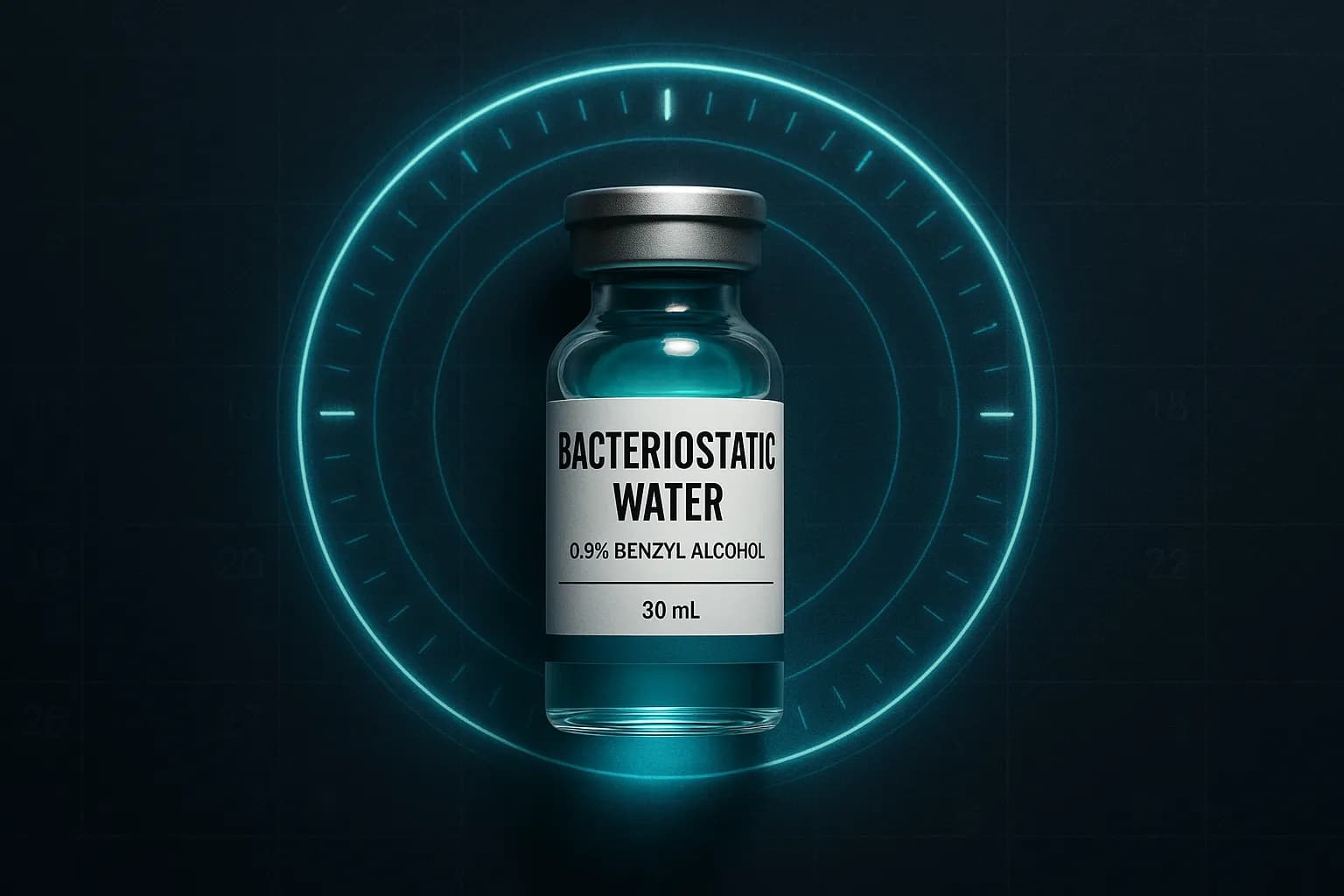
Bacteriostatic water has two shelf-life windows: an unopened expiration date set by the manufacturer (typically 18-24 months from manufacturing), and a 28-day multi-dose window that starts the moment the seal is first punctured. The 28-day rule comes from USP guidance and applies regardless of how much volume has been drawn.
Research-context information only. Bacteriostatic water for injection is an FDA-regulated injectable product. The information below reflects USP standards, manufacturer prescribing information, and self-reported community sources. This article reports what has been documented, not what should be done. Consult a licensed physician for personal medical decisions.
The two windows operate independently. Whichever expires first determines the safe-use period.
The 28-day rule
USP <797> and manufacturer prescribing information from Pfizer/Hospira describe a 28-day multi-dose use window for bacteriostatic water for injection after first puncture, under aseptic technique. The benzyl alcohol preservative is engineered to inhibit microbial growth across that time window — past 28 days, the cumulative microbial exposure from repeated punctures exceeds what the 0.9% benzyl alcohol concentration is documented to suppress.
The rule applies to the punctured vial, not the calendar date or the manufacturer-printed expiration. A vial punctured on day 1 of its 18-month shelf life and a vial punctured on day 500 both carry the same 28-day post-puncture window — assuming the manufacturer-printed expiration has not yet arrived.
The two windows in practice:
| Window | Duration | Starts | Source |
|---|---|---|---|
| Unopened shelf life | 18-24 months typical | Manufacturing date | Manufacturer-printed expiration |
| Multi-dose use window | 28 days | First puncture of the stopper | USP guidance + prescribing info |
Whichever ends first determines the safe-use period. A vial punctured 17 months into its 18-month shelf life carries a multi-dose window capped at the manufacturer expiration (roughly 30 days, in that case), not the full 28-day post-puncture window if those overlap.
The 28-day window assumes proper aseptic technique on every puncture: alcohol-swab the stopper, use a fresh sterile needle for each draw, do not introduce contamination through the needle or syringe. Compromised technique shortens the effective window — see "What shortens it" below.
Unopened vs opened
The shelf-life math diverges at first puncture.
Unopened vial:
USP-grade bacteriostatic water from Pfizer or Hospira carries a manufacturer-printed expiration date — typically 18-24 months from the manufacturing date — stored at controlled room temperature (20-25°C). The unopened product is sealed under sterile conditions with the rubber stopper and metal crimp intact; no microbial exposure has occurred, and the 0.9% benzyl alcohol is not yet doing active work.
Pharmaceutical documentation specifies the unopened product does not require refrigeration. Storage outside the labeled temperature range (sustained heat above 30°C, freeze exposure, direct sunlight) is documented to potentially compromise the product before the printed expiration date.
Opened vial (after first puncture):
The 28-day window begins the moment the rubber stopper is first punctured, regardless of how little volume is drawn. A vial with 0.5 mL drawn out and 29.5 mL remaining carries the same 28-day window as a vial half-empty.
Past 28 days, the documented standard is to discard the remaining volume. USP guidance describes the 28-day window as the period during which the bacteriostatic protection is engineered to suppress microbial proliferation from repeated puncture exposure — past that, the protection is no longer guaranteed, and the failure mode (cloudy reconstituted peptide, peptide aggregation) is documented but typically invisible until the peptide is reconstituted into the contaminated water.
Community references describe marking the puncture date on the vial label with a pharmacy-tape note or marker as a common practice to track the 28-day clock.
Refrigeration matters
USP and manufacturer documentation specify controlled room temperature (20-25°C) for unopened storage. Refrigeration is not a requirement for unopened product.
After first puncture, the documentation diverges. USP guidance and Pfizer/Hospira prescribing information describe the 28-day window without specifying a storage temperature. Community sources consistently cite refrigeration of the punctured vial as the most reliable way to maintain stability through the full 28-day window — the lower temperature suppresses any microbial growth that does occur and reduces benzyl alcohol degradation across the multi-week window.
Documented effects of refrigerated vs room-temperature post-puncture storage (community sources):
| Storage | Effective use window | Notes |
|---|---|---|
| Refrigerated (2-8°C) | Full 28 days community-reported | Most consistent practice in self-reported sources |
| Controlled room temp (20-25°C) | 28 days USP-defined | Documented limit; community reports shortened window in warm climates |
| Heat-exposed (>30°C sustained) | Shorter than 28 days | Community-reported peptide aggregation faster |
| Direct sunlight exposure | Shorter than 28 days | UV exposure documented to degrade benzyl alcohol over time |
| Freeze-thaw cycles | Compromised | Not part of documented storage range |
The refrigeration practice does not extend the window past 28 days. USP guidance caps it at 28 days regardless of storage temperature. Refrigeration is documented as a way to reach the full 28-day window reliably, not to push past it.
What shortens the window
Five documented failure modes shorten the effective post-puncture use window below the 28-day USP cap.
1. Compromised aseptic technique. Punctures without alcohol-swabbing the stopper, or with re-used needles, introduce microbial loads exceeding what the 0.9% benzyl alcohol is documented to suppress. The compounding effect across 20+ punctures in a peptide cycle is what makes technique the dominant variable in real-world use windows.
2. Heat exposure. Storage above 30°C — common in unrefrigerated cars in summer, garage storage in hot climates, or near heat sources — degrades benzyl alcohol over time and accelerates any microbial growth that does occur. Community sources describe shortened effective windows (5-14 days rather than 28) when post-puncture storage exceeds 30°C consistently.
3. Direct sunlight / UV exposure. UV light degrades benzyl alcohol. Storage in clear or translucent containers exposed to direct sunlight is documented to shorten the effective window. Bacteriostatic water vials are typically clear glass, which provides minimal UV protection — community references cite storage in a cabinet or refrigerator drawer as standard practice.
4. Freeze exposure. Freezing is not part of the documented storage range. Community sources describe freeze-thaw cycles producing visible particulates in some cases — typically traced to crystallization or container-integrity issues. Freeze-exposed product is documented as outside the validated spec.
5. Contamination prior to first use. Marketplace listings labeled "bacteriostatic water" that actually contain sterile water, saline, or distilled water carry no benzyl alcohol — the 28-day window does not apply because the preservative is not present. Community references describe this as one of the most documented marketplace failure modes, with the contents only verifiable by checking the explicit "0.9% benzyl alcohol" label line and the manufacturer name. The shelf-life math only works on USP-spec product.
Common Questions
The FAQ at the top of this article addresses the most common storage and shelf-life questions. Two additional notes:
Tracking the 28-day clock. Community references cite three common methods: a marker-and-tape label on the vial showing the puncture date, a calendar reminder set at the time of first puncture, or a small whiteboard or note in the storage area listing active vial dates. The clock starts at first puncture regardless of how much volume has been drawn.
Multiple opened vials. Self-reported community practice cites avoiding multiple simultaneously-opened vials when possible — using one vial through to its 28-day endpoint before opening the next reduces tracking error and waste. Where multiple vials are open (e.g., one in the refrigerator for active reconstitution, one in a kit for travel), labeling each with its individual puncture date is the documented practice.
Bottom line
Bacteriostatic water has two shelf-life windows: an unopened 18-24 month manufacturer expiration and a 28-day post-puncture multi-dose window described by USP guidance. The two windows operate independently — whichever expires first caps the safe-use period.
Unopened storage does not require refrigeration. Post-puncture storage at refrigerated temperature is community-cited as the most consistent way to reach the full 28-day window. Heat, UV exposure, freeze cycles, and compromised aseptic technique all shorten the effective window below the USP cap.
Verifying USP spec at the point of purchase — manufacturer name, lot number, glass vial with metal-crimp seal, explicit "0.9% benzyl alcohol" on the label — is the only way to ensure the 28-day window applies in the first place.
Related Reading
- What Is Bacteriostatic Water? Benzyl Alcohol + Uses — full definition, benzyl alcohol mechanism, USP spec
- Bacteriostatic Water vs Sterile Water: Which to Use — multi-dose vs single-use comparison
- Where to Buy Bacteriostatic Water (Pharmaceutical Grade) — verifying USP spec at purchase
- How to Store Bacteriostatic Water (Pre + Post Puncture) — full storage reference including travel, light exposure, and multi-dose handling
References
- Pfizer/Hospira. Bacteriostatic Water for Injection, USP — Prescribing Information. Revised 2023.
- United States Pharmacopeia. USP <797> Pharmaceutical Compounding — Sterile Preparations. USP Convention, 2023.
- United States Pharmacopeia. USP <85> Bacterial Endotoxins Test. USP Convention, 2023.
This guide is for educational and informational purposes only. It is not medical advice. Injectable water products are FDA-regulated. Consult a qualified healthcare provider before starting any peptide protocol.