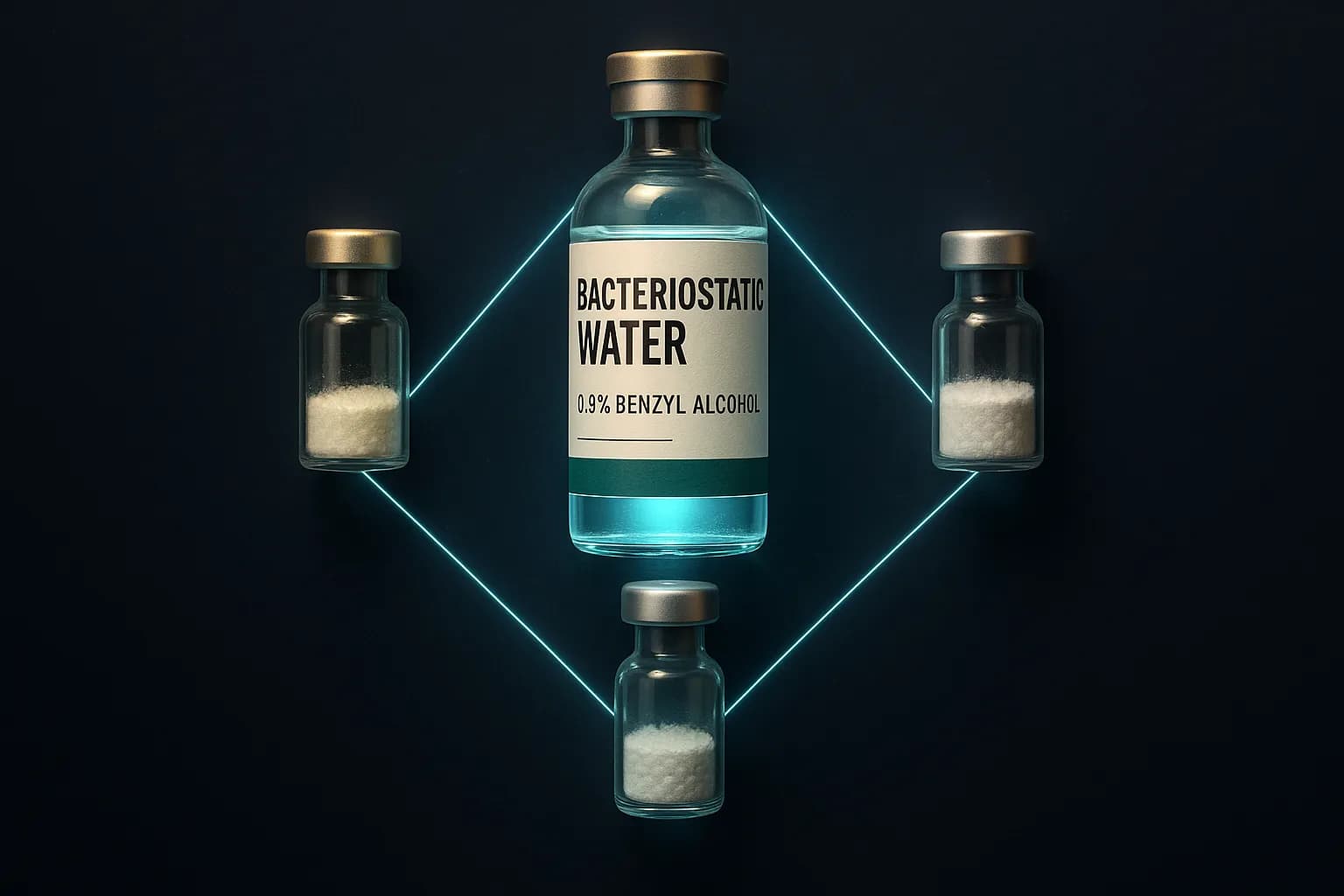
Sermorelin, CJC-1295, and ipamorelin are the three most-cited growth-hormone secretagogues in community research-protocol documentation. All three reconstitute the same way: bacteriostatic water added directly to a lyophilized peptide vial, swirled gently, refrigerated. The dose math differs by vial size and concentration target, and several vendors package CJC-1295 + ipamorelin as a combined vial, which is what makes the cluster worth covering together.
Research-context information only. The peptides discussed below are research chemicals without FDA approval for the indications community sources commonly cite. The reconstitution math reflects vendor documentation and community-reported protocols. This article reports what has been documented, not what should be done. Consult a licensed physician for personal medical decisions.
The GH-secretagogue cluster at a glance
The three peptides covered here belong to a broader class of growth-hormone-releasing compounds. Sermorelin is a GHRH analog. CJC-1295 (without DAC) is a longer-acting GHRH analog. Ipamorelin is a GH secretagogue acting on the ghrelin receptor — a different mechanism that is commonly co-administered with a GHRH analog in community protocols.
Vendor documentation typically packages these peptides in lyophilized (freeze-dried) form in glass vials sealed with rubber stoppers and metal crimps. The most common vial sizes across vendors are 2mg and 5mg per single peptide, plus 2mg+2mg and 5mg+5mg combination vials for CJC-1295 + ipamorelin.
Sermorelin reconstitution math
2mg sermorelin vial: Community sources and vendor reconstitution sheets commonly cite 2 mL of bacteriostatic water for a 2mg sermorelin vial. That produces a concentration of 1 mg/mL (1000 mcg/mL). On a U-100 insulin syringe, each 10-unit mark corresponds to 0.1 mg (100 mcg). The 100mcg, 200mcg, and 300mcg dose steps cited in community protocols land on 10, 20, and 30 unit marks respectively.
An alternative ratio some vendor sheets cite is 1 mL of bacteriostatic water for the same 2mg vial, producing 2 mg/mL. On that concentration, each 10-unit insulin syringe mark corresponds to 0.2 mg, and the same 100mcg / 200mcg / 300mcg dose steps land on 5, 10, and 15 unit marks.
5mg sermorelin vial: Community sources commonly cite 2 mL of bacteriostatic water for a 5mg sermorelin vial, producing a concentration of 2.5 mg/mL. On a U-100 insulin syringe, each 10-unit mark corresponds to 0.25 mg (250 mcg). The dose-per-unit math is less clean than the 2mg version, which is why some vendor sheets instead cite 2.5 mL of bacteriostatic water for the 5mg vial — producing 2 mg/mL and matching the alternative 2mg-vial concentration.
CJC-1295 reconstitution math
CJC-1295 here refers to the standard version without DAC (Drug Affinity Complex). The DAC variant has a much longer half-life and follows different community-protocol dosing patterns, covered separately.
2mg CJC-1295 vial: Community sources commonly cite 2 mL of bacteriostatic water for a 2mg CJC-1295 (no DAC) vial, producing a concentration of 1 mg/mL. On a U-100 insulin syringe, each 10-unit mark corresponds to 0.1 mg (100 mcg). The 100mcg dose-step commonly cited in community protocols lands on the 10-unit mark.
5mg CJC-1295 vial: Community sources commonly cite 2.5 mL or 5 mL of bacteriostatic water for a 5mg CJC-1295 vial. A 2.5 mL reconstitution produces 2 mg/mL; a 5 mL reconstitution produces 1 mg/mL. The 1 mg/mL concentration matches the 2mg-vial math and is the more commonly cited approach in community documentation.
Ipamorelin reconstitution math
2mg ipamorelin vial: Community sources commonly cite 2 mL of bacteriostatic water for a 2mg ipamorelin vial, producing a concentration of 1 mg/mL. On a U-100 insulin syringe, each 10-unit mark corresponds to 0.1 mg (100 mcg). The 100mcg, 200mcg, and 300mcg dose steps cited in community protocols land on 10, 20, and 30 unit marks.
5mg ipamorelin vial: Community sources commonly cite 5 mL of bacteriostatic water for a 5mg ipamorelin vial, producing a concentration of 1 mg/mL — matching the 2mg-vial concentration. Alternative documentation cites 2.5 mL producing 2 mg/mL.
Combined CJC-1295 + ipamorelin vials
Several vendors package CJC-1295 (no DAC) and ipamorelin together as a combined vial — typically 2mg+2mg or 5mg+5mg. Community sources describe the combined format as a packaging convenience for users who already documented the two-peptide combination as their target protocol.
2mg + 2mg combined vial: Community sources commonly cite 2 mL of bacteriostatic water for a 2mg CJC-1295 + 2mg ipamorelin combined vial. That produces 1 mg/mL of each peptide simultaneously. On a U-100 insulin syringe, each 10-unit mark corresponds to 0.1 mg of each peptide. The 100mcg / 200mcg / 300mcg dose steps cited in community protocols land on 10, 20, and 30 unit marks.
5mg + 5mg combined vial: Community sources commonly cite 5 mL of bacteriostatic water for a 5mg + 5mg combined vial, producing 1 mg/mL of each peptide. The dose-per-unit math then matches the 2mg+2mg version.
Community-reported protocols frequently describe doses in the 100-300mcg-per-peptide range, taken once or twice daily depending on the protocol. The combined vial simplifies the draw — one needle puncture delivers both peptides at the same per-unit-mark dose.
Storage notes
Bacteriostatic water itself carries a 28-day multi-dose window under USP guidance with aseptic technique. Sermorelin, CJC-1295, and ipamorelin stability after reconstitution varies by molecule and storage conditions. Community sources and vendor documentation commonly cite:
- Refrigerated storage at 2-8°C after reconstitution
- Shielding from light — amber vials or opaque storage box
- Finishing the reconstituted vial within the 28-day bacteriostatic water window
- Avoiding repeated temperature cycling — keeping the vial refrigerated rather than moving it in and out of cold storage
Lyophilized (unreconstituted) vials are typically more stable than reconstituted ones. Community sources cite long-term storage of unreconstituted peptide at freezer temperatures (-20°C or below) as the standard approach for vials that will not be reconstituted within a few months.
Common questions
The FAQ at the top of this article covers the questions community sources cite most frequently — vial-size reconstitution math, combined-vial protocols, storage windows, and the sterile water vs bacteriostatic water trade-off.
Bottom line
Sermorelin, CJC-1295, and ipamorelin reconstitute with bacteriostatic water using vendor-documented and community-cited ratios that depend on vial size and concentration preference. The 1 mg/mL concentration produced by 2 mL into a 2mg vial (or 5 mL into a 5mg vial) is the most commonly cited because it makes dose-per-unit math clean on a U-100 insulin syringe. Combined CJC-1295 + ipamorelin vials reconstitute the same way as single-peptide vials. USP guidance describes a 28-day window for the bacteriostatic water itself; community sources cite refrigerated storage with light shielding as the standard approach for the reconstituted vial.
Related reading
- Buying CJC-1295 + Ipamorelin: Vendor Guide (2026) — vendor comparison, COA verification, and current pricing on thepeptidecatalog
- What Is Bacteriostatic Water? Benzyl Alcohol + Uses (2026) — definition, USP standards, benzyl alcohol mechanism
- Bacteriostatic Water vs Sterile Water: Which to Use (2026) — when the 28-day window matters and when it doesn't
- How Long Does Bacteriostatic Water Last? 28-Day Rule (2026) — the post-puncture window and storage variables
- Bacteriostatic Water for BPC-157 + TB-500 (Wolverine Stack, 2026) — healing-peptide reconstitution math in a similar format
- Bacteriostatic Water for Semaglutide: Reconstitution + Storage (2026) — GLP-1 reconstitution math for comparison