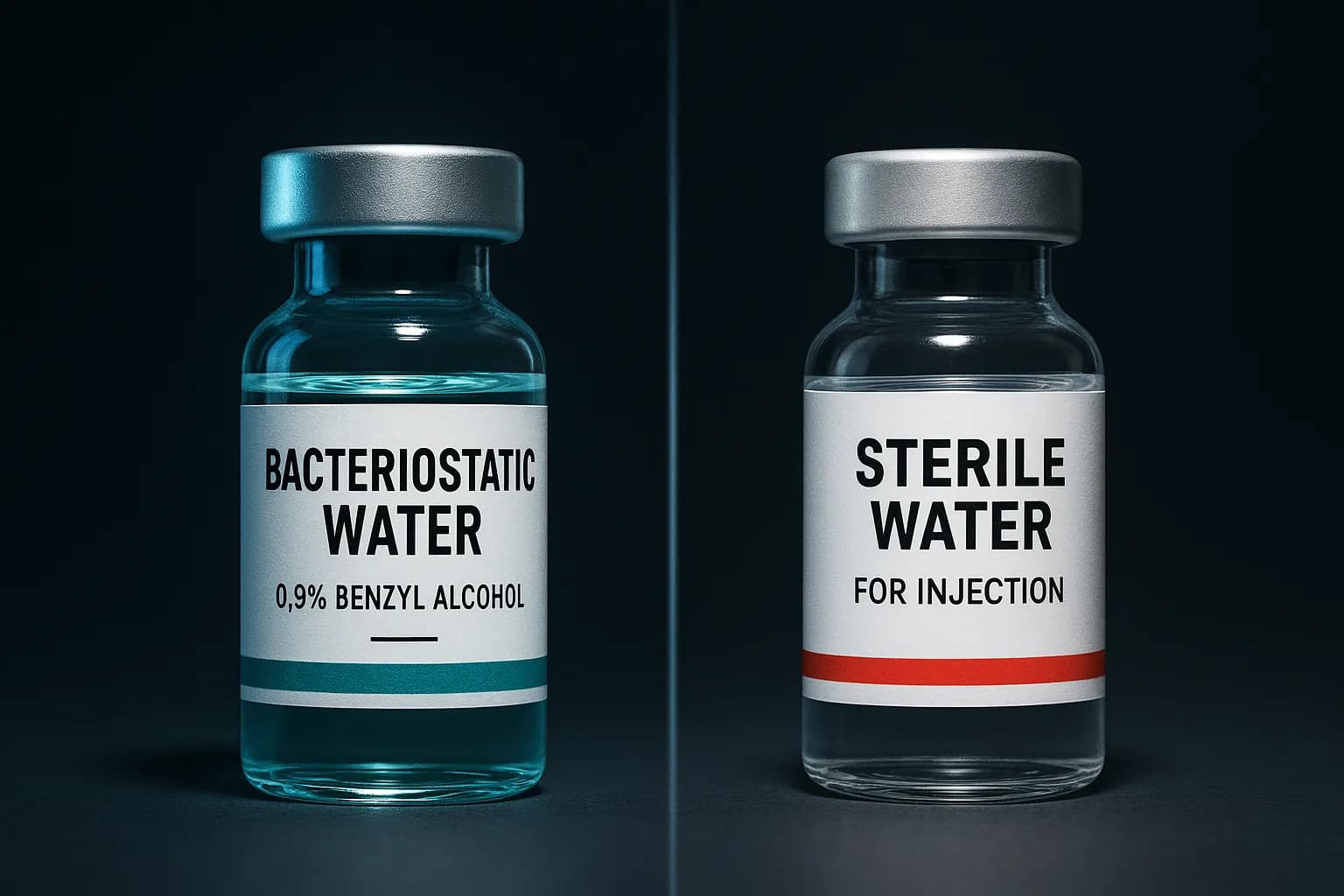
Bacteriostatic water and sterile water for injection are nearly identical products. Same USP-grade water, same packaging, same clinical-looking vial. The difference is one ingredient — 0.9% benzyl alcohol — and that ingredient determines whether the vial can be punctured once or thirty times.
Research-context information only. Both products discussed below are FDA-regulated injectable products. Information reported reflects USP standards, manufacturer prescribing information, published trial protocols, and self-reported community sources. This article reports what has been documented, not what should be done. Consult a licensed physician for personal medical decisions.
For most research-peptide reconstitution, the use pattern decides the question. Multi-dose vials punctured across weeks need the preservative. Single-dose immediate-use vials don't.
The core difference
USP-grade bacteriostatic water for injection is sterile, non-pyrogenic water with 0.9% benzyl alcohol added as a bacteriostatic preservative. USP-grade sterile water for injection is the same sterile, non-pyrogenic water without the preservative. Nothing else differs.
| Feature | Bacteriostatic water | Sterile water for injection |
|---|---|---|
| Composition | USP water + 0.9% benzyl alcohol | USP water only |
| Preservative | Yes (9 mg/mL benzyl alcohol) | None |
| Sterility spec | USP <797> compliant | USP <797> compliant |
| Pyrogen spec | USP <85> tested | USP <85> tested |
| pH | 4.5-7.0 | 5.0-7.0 |
| Tonicity | Hypotonic | Hypotonic |
| Use window after puncture | 28 days under aseptic technique | Hours, single-puncture |
| Multi-dose use | Documented standard | Not the documented solvent |
| Typical container | 10-30 mL glass vial, metal-crimp seal | 10-100 mL glass vial or plastic bottle |
| Typical price (USP-grade) | $10-15 per 30 mL | $5-10 per 30 mL |
The preservative is the load-bearing feature. Benzyl alcohol at 0.9% inhibits bacterial growth inside a punctured vial — suppressing the Staphylococcus, Streptococcus, and E. coli contaminants most commonly introduced through routine needle entry. Without that preservative, sterile water reverts to single-use status once the seal is broken because there is nothing inhibiting microbial proliferation in the punctured vial.
For a single-dose reconstitution where the entire vial is drawn in one session, the preservative is unnecessary. For a multi-dose vial punctured 20+ times across a 4-week peptide cycle, the preservative is the entire reason multi-dose use is documented as safe.
Multi-dose vs single-use
The use pattern decides which product is the documented choice. The dividing line is whether the resulting reconstituted solution will be drawn from more than once.
Multi-dose reconstitution (bacteriostatic water is the documented choice):
- 5 mg peptide vial reconstituted to 2.5 mg/mL, drawn for 20 daily doses across 3-4 weeks
- 10 mg semaglutide or tirzepatide vial reconstituted for weekly dosing across 8-10 weeks
- Any vial that will be punctured more than once after reconstitution
The bacteriostatic water provides the 28-day multi-dose window. USP guidance describes the window assuming aseptic technique: alcohol-swab the stopper before each puncture, use a fresh sterile needle for each draw, store between draws under refrigeration (community-cited as the most consistent way to maintain stability through the full window).
Single-dose reconstitution (sterile water can substitute):
- Reconstitution immediately before injection, full vial drawn in one session, no remaining liquid
- Trial-protocol reconstitution where the protocol explicitly calls for sterile water (rare in research-peptide context)
- Reconstitution intended for IV admixture (where benzyl alcohol contraindication applies — not relevant for SubQ/IM peptide use)
Community sources document the multi-dose pattern as overwhelmingly more common in research-peptide use. The economics of peptide vials — 5 mg or 10 mg per vial, fractional dosing across weeks — make single-dose use rare. The documented solvent for the dominant use pattern is bacteriostatic water.
A reconstituted peptide vial that goes cloudy by day 3-5 of multi-dose use is one of the most commonly community-reported failure modes, and using sterile water instead of bacteriostatic is among the top documented causes. The cloudy-vial failure mode is covered in detail in community references on peptide quality.
Cost comparison
The price differential between USP bacteriostatic water and USP sterile water is small in absolute terms.
| Volume | USP Bacteriostatic water | USP Sterile water |
|---|---|---|
| 10 mL vial | $8-13 | $5-9 |
| 30 mL vial | $10-15 | $6-11 |
| 100 mL vial (less common for peptide use) | $20-30 | $12-20 |
The $3-5 price differential at the 30 mL size reflects the additional benzyl alcohol formulation and assay step required for bacteriostatic spec. For a peptide protocol that consumes 2-3 mL of solvent across a 28-day cycle on a peptide that costs $50-300 per vial, the solvent cost is rounding error.
Where cost actually matters is on mislabeled marketplace product. Listings that advertise "bacteriostatic water" at $3-5 per 30 mL frequently fail USP spec — community references have documented bottled saline, distilled water, and re-sealed plastic-bottle product sold under bac-water branding without benzyl alcohol content. The price signal is the most reliable filter: USP-grade product from Pfizer or Hospira carries a real manufacturing cost; sub-$5 listings typically represent something other than the labeled product.
The cheapest insurance against mislabeled product is buying from a source that confirms manufacturer name, lot number, USP labeling, glass vial with metal-crimp seal, and the explicit "0.9% benzyl alcohol" printed on the label.
When sterile water is the documented choice
Three scenarios appear in community sources and pharmaceutical documentation where sterile water is the documented solvent rather than bacteriostatic water:
1. Documented benzyl alcohol sensitivity. Pharmaceutical documentation describes benzyl alcohol as well-tolerated at 0.9% concentration in most adults via subcutaneous or intramuscular routes. Community sources describe a small subset of users reporting injection-site irritation that resolves when the solvent is changed to sterile water. The trade-off is the loss of the multi-dose window: the vial becomes single-use, the per-dose cost rises, and the workflow changes from weekly reconstitution to per-injection reconstitution.
2. Vendor-protocol specification. Some peptide vendors specify sterile water in their reconstitution sheets for particular peptides — typically peptides with documented benzyl alcohol incompatibility in the chemistry. Where the vendor protocol explicitly specifies sterile water, that is the documented solvent for that peptide; community sources cite vendor-sheet adherence as the most consistent way to avoid reconstitution failure.
3. Neonatal use (not relevant to research-peptide protocols). Pfizer/Hospira prescribing information cites benzyl alcohol contraindication in neonates due to historical neonatal gasping syndrome reports. The research-peptide use case is adult and does not intersect this contraindication.
For the dominant research-peptide use case — adult multi-dose vials reconstituted for SubQ or IM administration across weeks — bacteriostatic water is the documented solvent in published trial protocols, vendor reconstitution sheets, and community references. Sterile water is the documented choice only when one of the three scenarios above applies.
How to verify what is in the bottle
Both products look identical in the vial. The label is the only way to verify which product is which.
| Label check | Bacteriostatic water | Sterile water |
|---|---|---|
| Says "Bacteriostatic Water for Injection" | Yes | No |
| Says "Sterile Water for Injection" | No | Yes |
| Lists "0.9% benzyl alcohol added as preservative" | Yes | No |
| Lists "preservative-free" | No | Sometimes |
| Manufacturer name (Pfizer / Hospira) | Yes (USP-grade) | Yes (USP-grade) |
| Lot number printed | Yes | Yes |
| Glass vial with metal-crimp seal | Yes | Often |
| Plastic squeeze-bottle container | Almost never | Common (larger volumes) |
A product labeled "bac water" without the explicit "0.9% benzyl alcohol" line on the label is not USP-spec bacteriostatic water regardless of marketing claims. Community references describe marketplace listings where the bottle contains sterile water or saline despite the bacteriostatic branding — a silent failure mode that only becomes visible when the reconstituted peptide goes cloudy in days rather than holding for the full 28-day window.
Bottom line
Bacteriostatic water and sterile water for injection share a base — USP-grade sterile, non-pyrogenic water — and diverge at one ingredient. The 0.9% benzyl alcohol in bacteriostatic water enables the 28-day multi-dose window; sterile water without it reverts to single-use status at puncture #1.
For the dominant research-peptide use case (multi-dose vials punctured across weeks), bacteriostatic water is the documented solvent in published trial protocols, vendor reconstitution sheets, and community references. Sterile water is the documented choice only when documented benzyl alcohol sensitivity, vendor-protocol specification, or neonatal use applies — three scenarios that exclude most adult research-peptide workflows.
Related Reading
- What Is Bacteriostatic Water? Benzyl Alcohol + Uses — full definition, USP spec, benzyl alcohol mechanism
- How Long Does Bacteriostatic Water Last? 28-Day Rule — the multi-dose window in detail, what shortens it
- Where to Buy Bacteriostatic Water (Pharmaceutical Grade) — verifying USP spec at the point of purchase
References
- Pfizer/Hospira. Bacteriostatic Water for Injection, USP — Prescribing Information. Revised 2023.
- Pfizer/Hospira. Sterile Water for Injection, USP — Prescribing Information. Revised 2023.
- United States Pharmacopeia. USP <797> Pharmaceutical Compounding — Sterile Preparations. USP Convention, 2023.
This guide is for educational and informational purposes only. It is not medical advice. Injectable water products are FDA-regulated. Consult a qualified healthcare provider before starting any peptide protocol.