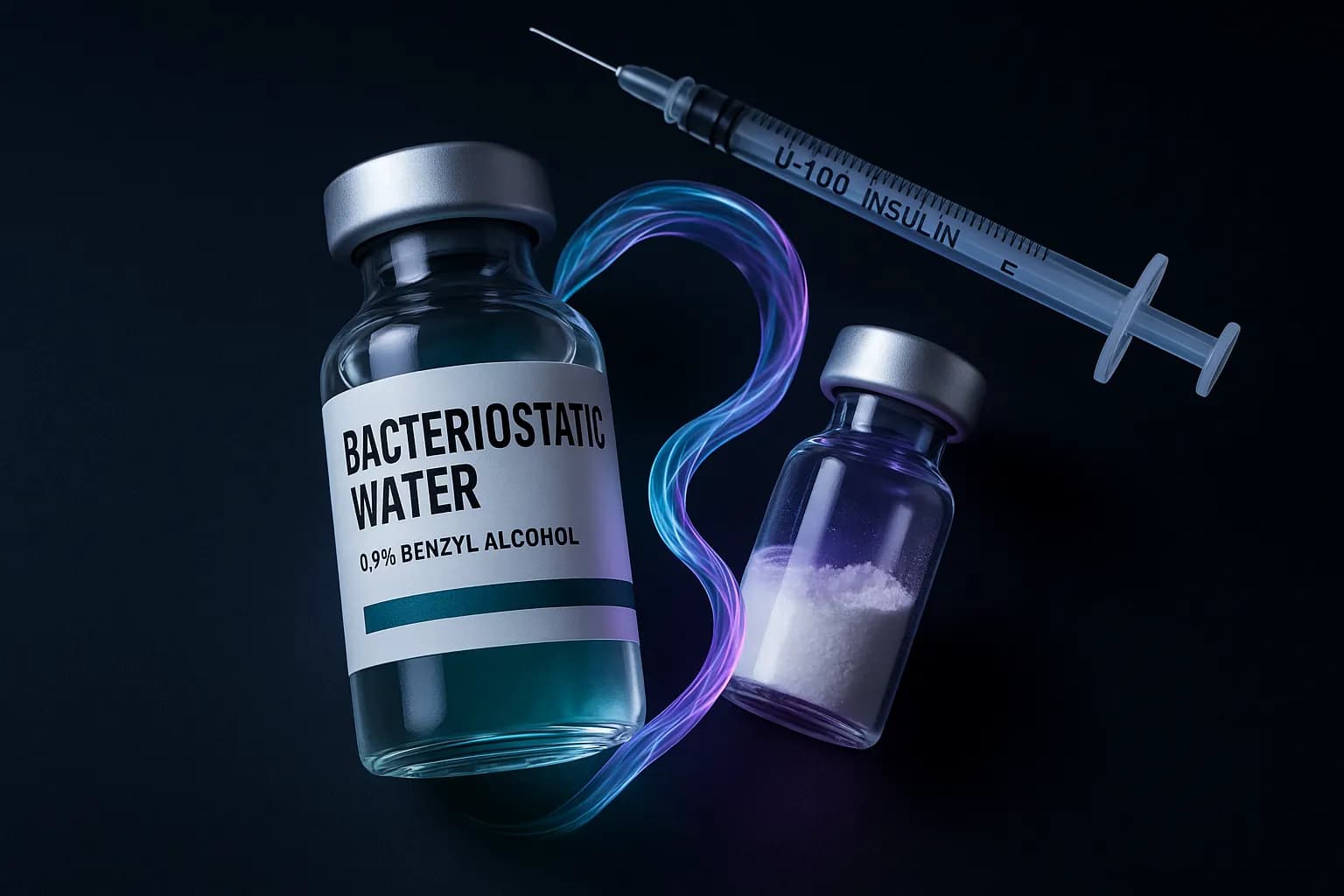
A 30mg tirzepatide vial reconstituted with 3 mL of bacteriostatic water yields a 10 mg/mL solution — the concentration community reconstitution sheets cite most often because it maps the documented 2.5 / 5 / 7.5 / 10 / 12.5 / 15 mg titration steps onto clean unit marks on a U-100 insulin syringe. The 10 mg/mL target carries through scaled volumes for smaller and larger research-format vials.
Research-context information only. Tirzepatide is the active ingredient in FDA-approved products for type 2 diabetes and chronic weight management; research-peptide and compounded forms are not FDA-approved and are sold for research purposes only. Protocols, doses, and reactions reported below come from clinical trials and self-reported community sources. This article reports what has been documented, not what should be done. Consult a licensed physician for personal medical decisions.
The article below reports the dose math for the documented vial sizes, the storage window, and the handling failures community sources cite most consistently.
How much bacteriostatic water for tirzepatide
Research-format tirzepatide is sold in lyophilized vials. Vial sizes cited across community vendor sheets and reconstitution references include 10mg, 30mg, and 60mg formats. The reconstitution ratio determines the final concentration in mg/mL, which determines how many U-100 syringe units correspond to each documented titration step.
The table below reports the concentrations community sources most commonly cite for each documented vial size.
| Vial size | Bacteriostatic water added | Final concentration | Notes from community sources |
|---|---|---|---|
| 10 mg | 1 mL | 10 mg/mL | Smaller draws; doses above 10 mg exceed a single U-100 syringe |
| 10 mg | 2 mL | 5 mg/mL | Larger draws; keeps the 15 mg ceiling within a single syringe |
| 30 mg | 3 mL | 10 mg/mL | Most-cited ratio; full titration range mapped onto a single U-100 syringe with reasonable headroom |
| 30 mg | 1.5 mL | 20 mg/mL | Smallest injection volume; community sources cite this for veteran users at the upper titration range |
| 60 mg | 6 mL | 10 mg/mL | Mirrors the 30mg-plus-3-mL ratio; same unit-to-dose mapping at double the vial size |
| 60 mg | 3 mL | 20 mg/mL | Concentrated format; halves the injection volume across the documented range |
At 10 mg/mL on a U-100 insulin syringe, each 10-unit mark corresponds to 1 mg. The documented titration steps map cleanly: 2.5 mg lands at 25 units, 5 mg at 50 units, 7.5 mg at 75 units, 10 mg at 100 units, 12.5 mg at 125 units, and 15 mg at 150 units. Community sources commonly cite this mapping as the reason 10 mg/mL is the dominant reconstitution target. The 10 mg, 12.5 mg, and 15 mg steps exceed the 100-unit capacity of a single U-100 syringe at this concentration — community sources describe either split injections or alternate concentrations (5 mg/mL) for vials that will be used at the upper titration range.
Step-by-step reconstitution as documented in community sources
The sequence below reports the steps community reconstitution sheets and vendor instruction inserts most commonly describe. It is not an instruction set.
- Surface preparation. Both vial tops — tirzepatide and bacteriostatic water — are wiped with separate alcohol swabs and allowed to air-dry. Community sources commonly cite 10 to 30 seconds of dry time.
- Bacteriostatic water draw. A fresh U-100 insulin syringe is used to draw the documented water volume (3 mL for a 30mg vial at the 10 mg/mL target). The 3 mL volume requires multiple draws on a 1-mL syringe; community sources cite the use of a single 3-mL syringe where available to minimize repeated puncture of the water vial.
- Water injection at the vial wall. The needle is inserted into the tirzepatide vial at an angle aimed at the glass wall — not directly at the lyophilized powder. Community sources cite the side-wall approach as the standard practice for protecting peptide integrity.
- Gentle dissolution. The vial is swirled with a slow rotating motion rather than shaken. Trial documentation and community references uniformly cite gentle swirling. Reconstitution typically completes within 1 to 2 minutes into a clear, colorless solution.
- Refrigerated storage. The reconstituted vial is moved to refrigeration at 2 to 8 degrees Celsius. Community sources cite the move immediately after reconstitution rather than leaving the vial at room temperature.
Vendor instruction inserts and community reconstitution sheets describe the sequence in close to identical form. Variations appear in water volume (1.5 mL, 3 mL, 6 mL for a 30mg vial) rather than in technique.
Storage after reconstitution
USP guidance describes a 28-day multi-dose window for bacteriostatic water under aseptic technique. Community sources commonly cite the same 28-day window for reconstituted tirzepatide held continuously refrigerated at 2 to 8 degrees Celsius.
The conditions community reconstitution sheets cite as the documented storage protocol:
- Temperature: 2 to 8 degrees Celsius (refrigerator, not freezer)
- Light: protected from direct light; vials kept in the original carton or opaque container
- Movement: minimal disturbance; vials not stored in the refrigerator door where temperature cycling is greatest
- Aseptic technique: alcohol swab on the stopper before every puncture; fresh insulin syringe per draw
Self-reported community timelines describe degradation signals — cloudiness, particulate formation, loss of clear-colorless appearance — appearing earlier under non-ideal storage. Room-temperature storage, freeze-thaw cycling, and repeated stopper puncture without alcohol swab are the three handling failures most frequently cited in community degradation reports.
Common mistakes community sources cite
Several handling failures appear repeatedly in community reconstitution reports and vendor support threads. The list below reports what community sources describe, not instruction.
- Shaking the vial instead of swirling. Community sources commonly cite aggressive shaking as a denaturation trigger. Tirzepatide is a 39-amino-acid peptide; mechanical force can disrupt tertiary structure.
- Injecting water directly onto the lyophilized cake. Direct-stream injection onto the powder has been cited as a mechanical-damage source. Community sheets describe aiming the water stream at the glass wall instead.
- Using non-USP bacteriostatic water. Community sources commonly cite cloudy-vial outcomes traced to bacteriostatic water sourced from marketplace listings that lack USP labeling, lot tracking, or 0.9% benzyl alcohol confirmation. USP-grade product from documented manufacturers is the conservative reference.
- Storing at room temperature between doses. Trial documentation describes tirzepatide degradation accelerating outside the documented 2 to 8 degrees Celsius range. Community degradation reports cluster around room-temperature storage as the most common contributing factor.
- Freeze-thaw cycling. Frozen and re-thawed peptide solutions are repeatedly cited in community sources as producing visible cloudiness on rewarming. The 2 to 8 degrees Celsius range — not below — is the documented storage target.
- Re-using insulin syringes across draws. A single-use syringe per draw is the documented practice cited in community sources. Repeated use of the same syringe introduces a contamination pathway that compounds with each draw.
- Drawing across multiple insulin syringes for high doses. The 10 mg/mL concentration produces 100+ unit draws for doses at and above the 10 mg titration step. Community sources describe two pathways — split injections at the same site, or reconstitution at a lower concentration (5 mg/mL via 2 mL of bacteriostatic water in a 10mg vial, or 6 mL in a 30mg vial) — to keep each dose within a single syringe.
The cumulative pattern is that documented protocols are conservative across temperature, technique, and aseptic handling — and community reports of failed reconstitutions cluster around departures from that baseline.
Bottom line
The most-cited reconstitution ratio for research-format tirzepatide is 3 mL of bacteriostatic water per 30mg vial, producing a 10 mg/mL concentration that maps the documented titration range onto clean unit marks on a U-100 insulin syringe. Smaller (10mg) and larger (60mg) vials appear in community sources with proportionally scaled water volumes to preserve the same 10 mg/mL target. Storage is documented at 2 to 8 degrees Celsius across the 28-day multi-dose window described by USP guidance.
Related reading
- Buying Tirzepatide: Vendor Comparison + COA Checks (2026) — vendor comparison, COA verification, and current pricing on thepeptidecatalog
- What Is Bacteriostatic Water? Benzyl Alcohol + Uses (2026) — Composition, benzyl alcohol mechanism, and USP-grade specifications.
- Bacteriostatic Water vs Sterile Water: Which to Use (2026) — Why the 0.9% benzyl alcohol changes the entire multi-dose window.
- How Long Does Bacteriostatic Water Last? 28-Day Rule (2026) — What the USP guidance actually says and where community sources track it.
- Bacteriostatic Water for Semaglutide: Reconstitution + Storage (2026) — Sibling GLP-1 reconstitution math for 5mg, 10mg, and 15mg research vials.
- Bacteriostatic Water for Retatrutide: Reconstitution Math (2026) — Triple-agonist vial sizes (12mg, 20mg, 30mg, 50mg, 60mg) and the math community sources cite.