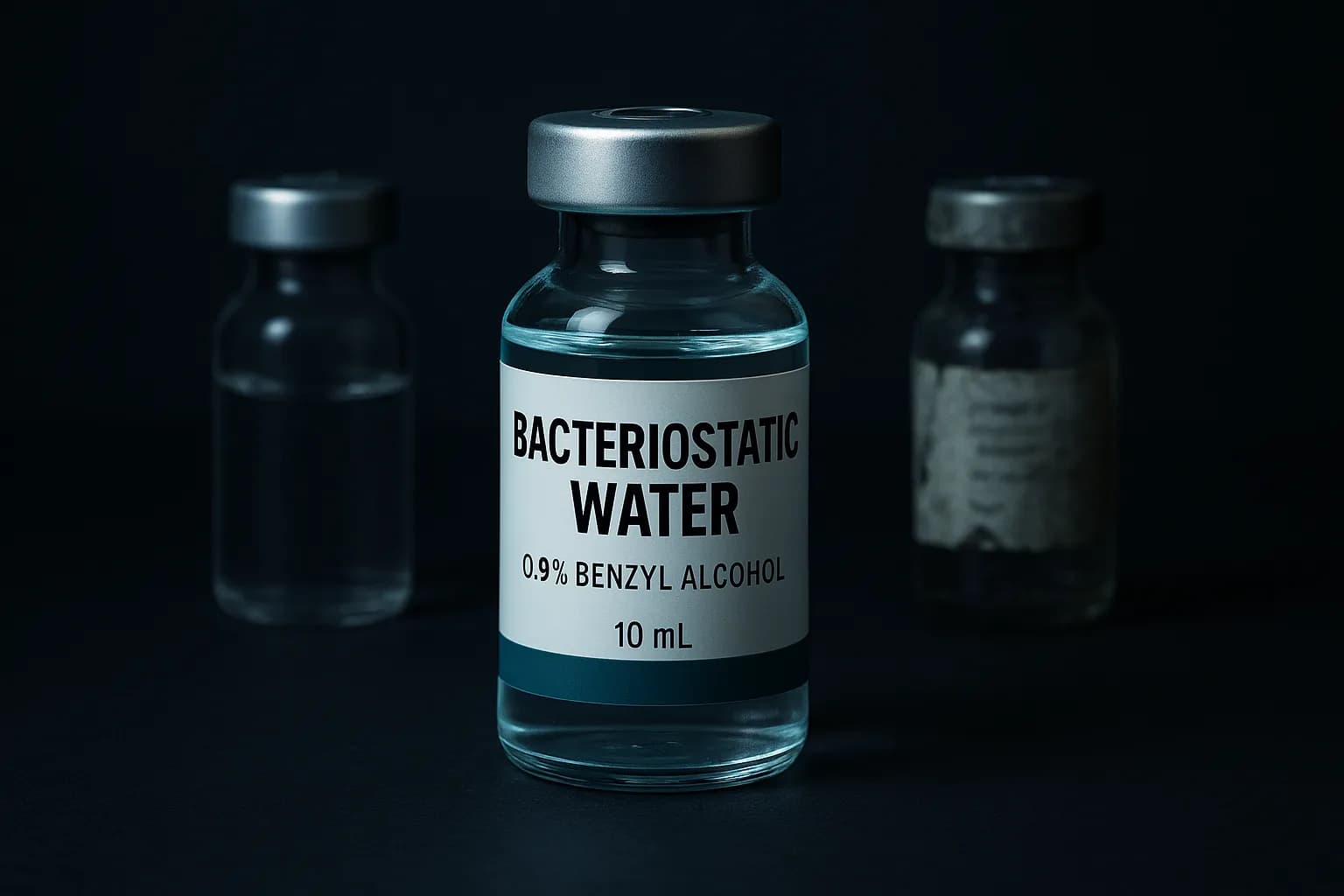
Bacteriostatic water for peptide reconstitution comes from three distinct supply channels, and the channel determines almost everything about whether the resulting solution performs as labeled. Community sources commonly describe this as a chain-of-custody problem more than a pricing problem.
The three channels — pharmacy-direct, online research-grade, and repackaged generic — are not interchangeable. Pharmaceutical procedure notes that the USP monograph for Bacteriostatic Water for Injection is identical regardless of who packages it, but the documented variance in product reaching end users is significant. This guide reports what separates each channel.
The three buyer paths
Path 1 — Pharmacy-direct (Hospira / Pfizer)
The reference-grade supply line. Hospira, owned by Pfizer, manufactures the bacteriostatic water stocked in most US hospitals and dispensed through retail pharmacies. Pharmaceutical procedure notes that this stock is intended for medical-prescription use and is packaged primarily in larger multi-dose vials (30 mL and 50 mL formats dominate).
Strengths described in USP and Hospira prescribing documentation: every monograph spec is met, the chain of custody from manufacture through distribution is documented, and labeling includes manufacturer identity, lot number, expiration date, and the explicit "0.9 percent benzyl alcohol added as preservative" wording.
Limitations community sources commonly cite: pharmacy access typically requires a prescription, end-user retail pricing through pharmacy channels can be higher than vendor-supplied alternatives, and the larger bottle sizes do not always match the multi-dose 28-day usage window that peptide reconstitution operates under.
Path 2 — Online research-grade (peptide-vendor produced or sourced)
Some peptide vendors produce or source their own bacteriostatic water specifically to control the solvent that reconstitutes the peptides they sell. Community sources describe the economics behind this: a customer's reconstituted peptide turning cloudy almost always gets blamed on the peptide itself, and vendors whose business depends on peptide quality found it cheaper to address bac water variance at source than to replace ruined peptide vials downstream.
USP composition for vendor-supplied research-grade product matches pharmacy-direct (sterile, non-pyrogenic, 0.9 percent benzyl alcohol, glass multi-dose vial). The distinguishing factor community sources commonly cite is packaging: vendor-supplied stock is typically offered in 10 mL and 30 mL multi-dose formats that align with the 28-day usage window for peptide reconstitution, and chain of custody runs through a vendor whose published reputation depends on the bac water performing on the peptide it ships alongside.
Path 3 — Repackaged generic and marketplace listings
The third channel covers Amazon, eBay, and miscellaneous online retailers selling product marketed as "bacteriostatic water" across a wide price range (typically 8 to 50 dollars for 30 mL). Community sources have documented several failure modes in this channel:
- Mislabeled saline. Product labeled as bacteriostatic water turning out on independent analysis to be 0.9 percent sodium chloride with no benzyl alcohol preservative. Reconstituted peptide commonly goes cloudy within hours.
- Sub-spec benzyl alcohol concentration. Label states 0.9 percent but actual preservative concentration tests below spec. Multi-dose window collapses within days as microbial growth begins.
- Expired or near-expired stock listed as new. Bac water past expiration loses preservative efficacy. Marketplace listings without visible lot or expiration printing make this difficult to identify before purchase.
- Plastic containers sold as bacteriostatic water. Soft plastic squeeze-bottle product is typically sterile water for injection (no preservative) rather than bacteriostatic water. Pharmaceutical procedure notes that the metal-crimp glass vial format is part of the USP monograph for the bacteriostatic category.
The challenge community sources commonly identify with this channel is that the failure modes are invisible at the point of purchase. A marketplace listing photo of a bottle that resembles Hospira product can still resolve to a product that fails monograph spec on arrival.
What pharmaceutical-grade means in spec terms
USP describes Bacteriostatic Water for Injection with a specific monograph. The product is pharmaceutical-grade when it meets every element:
| Spec element | Requirement |
|---|---|
| Composition | Sterile water for injection plus 0.9 percent (9 mg/mL) benzyl alcohol as bacteriostatic preservative |
| Sterility | Sterile and non-pyrogenic, produced under controlled conditions |
| pH | 4.5 to 7.0 (compatible with most peptide chemistry) |
| Container | Glass multi-dose vial with metal-crimp seal and rubber stopper |
| Labeling | "Bacteriostatic Water for Injection, USP" with explicit "0.9 percent benzyl alcohol added as preservative" wording, manufacturer name, lot number, and expiration date |
| Multi-dose window | USP guidance describes a 28-day window after first puncture under refrigeration and aseptic technique |
Products missing any of these elements are not pharmaceutical-grade in the regulatory sense, even when the front-label wording resembles a compliant product.
Red flags in repackaged stock
Community sources commonly cite six checks for sorting safe stock from risky stock in the repackaged channel:
- Explicit "Bacteriostatic Water for Injection" label wording. Generic "sterile water" or "purified water" describes a different product category.
- The "0.9 percent benzyl alcohol added as bacteriostatic preservative" line. USP requires this wording on compliant product. Absence is a red flag.
- Named manufacturer. Hospira (Pfizer) is the dominant US manufacturer. A peptide vendor producing or sourcing under their own identity is the next tier. Anonymous resellers with no manufacturer disclosure are the highest-variance category.
- Glass container with metal-crimp seal. Soft plastic typically signals sterile water for injection (no preservative), a different product entirely.
- Visible lot number and expiration date. Both must be present and recent. Pharmaceutical procedure notes that bac water past expiration loses preservative efficacy.
- Chain-of-custody answer. A seller able to identify production source, manufacture date, and expiration is operating with chain of custody intact. A listing without that information is operating without it.
Community sources commonly cite that failing any of these checks correlates with the documented failure modes in marketplace stock.
Why peptide users specifically need research-grade
The research-grade designation matters more for peptide reconstitution than for many other use cases for a specific reason: peptide molecules are pH-sensitive and aggregation-prone. The bacteriostatic water that reconstitutes a peptide is not an inert solvent in chemistry terms — it is part of the reaction.
Community sources and pharmaceutical documentation describe three ways sub-spec bac water damages peptides:
- pH drift. Bacteriostatic water that has drifted outside the 4.5 to 7.0 range — usually due to expiration, preservative degradation, or improper buffering — destabilizes peptide tertiary structure on contact. Aggregation (visible as cloudiness) begins within hours.
- Insufficient preservative. Sub-spec benzyl alcohol concentration fails to suppress microbial growth over the 28-day multi-dose window. Bacteria release proteases that degrade the peptide chain. The reconstituted vial that looked fine on day 1 fails by day 6 to 10.
- Wrong solvent entirely. Sterile water (no preservative) used in place of bacteriostatic water collapses the multi-dose window from 28 days to hours. Re-entry contamination compounds across the cycle.
Pharmaceutical-grade bac water — by spec definition — does not have these failure modes. Research-grade vendor-supplied stock that matches the USP monograph does not have them either. The cost premium relative to marketplace stock is modest. The downside of skipping it scales with the cost of the peptide being reconstituted.
What "made for peptide reconstitution" actually signals
The strongest buyer signal community sources commonly cite is bac water packaged specifically for peptide reconstitution rather than adapted from generic injectable-water stock.
The chemistry argument is not that vendor-supplied bac water is different from pharmacy-direct in spec terms — USP-compliant product is USP-compliant product regardless of label. The argument is incentive structure. A vendor whose primary business is peptide sales and who packages bac water for the customers buying those peptides has a direct stake in the bac water performing on reconstitution. Their lot consistency, their pH verification, and their preservative concentration matter to their published reputation in a way that generic stock from anonymous resellers does not.
Community sources commonly describe vendor-supplied bac water from peptide-focused suppliers as the closest functional match to pharmacy-direct Hospira product for peptide reconstitution purposes, with the practical advantage of multi-dose packaging sized to the 28-day window and chain of custody attached to a verifiable vendor identity.
What to skip
Three categories community sources commonly flag as failing more often than they work:
- Marketplace listings under 10 dollars for 30 mL with no manufacturer disclosure. Quality variance is too wide. The cost saving relative to a 20 to 30 dollar vendor-supplied bottle does not offset the documented failure rate.
- Sterile water for injection labeled or sold as bacteriostatic water. Sterile water is a real product but the multi-dose window is hours, not days. Using it on multi-dose peptide vials produces contamination by day 3.
- Boutique "peptide-optimized" water with proprietary additives. USP monograph (0.9 percent benzyl alcohol, sterile, non-pyrogenic) is the spec every published peptide trial protocol operates against. Deviating from that introduces unknown variables.
Bottom line
Three channels supply bacteriostatic water for peptide reconstitution: pharmacy-direct, online research-grade, and repackaged generic. Pharmacy-direct is the spec reference but is access-limited and packaging-mismatched for the multi-dose 28-day use case. Online research-grade from peptide-focused suppliers matches the USP monograph and aligns packaging with the use case. Repackaged generic carries the widest quality variance and the documented failure modes that community sources commonly cite when peptide reconstitution goes wrong.
The selector below routes to the research-grade supply line — 10 mL for shorter cycles, 30 mL for the full 28-day multi-dose window.
Related Reading
- What Is Bacteriostatic Water? Benzyl Alcohol + Uses — definition, USP composition, and how benzyl alcohol preservation works
- Bacteriostatic Water vs Sterile Water — comparison of the two injectable waters and why multi-dose use requires bacteriostatic
- How Long Does Bacteriostatic Water Last? 28-Day Rule — what USP describes for the multi-dose window after first puncture
- How to Spot Fake Bacteriostatic Water (Red Flags) — visual inspection, NDC lookup, and the six red flags that identify counterfeit product
- Bacteriostatic Water Brands Compared — Hospira, Fresenius Kabi, generic, and vendor-channel sources compared
References
- Pfizer/Hospira. Bacteriostatic Water for Injection, USP — Prescribing Information. Revised 2023.
- United States Pharmacopeia. USP General Chapter <797> Pharmaceutical Compounding — Sterile Preparations. USP Convention, 2023.
- United States Pharmacopeia. Monograph: Bacteriostatic Water for Injection. USP-NF, 2023.
This guide is for educational and informational purposes only. It is not medical advice. Bacteriostatic water for injection is a regulated injectable product subject to FDA labeling standards. As an affiliate partner, The Peptide Catalog may earn a commission on qualifying purchases at no extra cost to the reader. Bacteriostatic water is sold for research and professional use only.