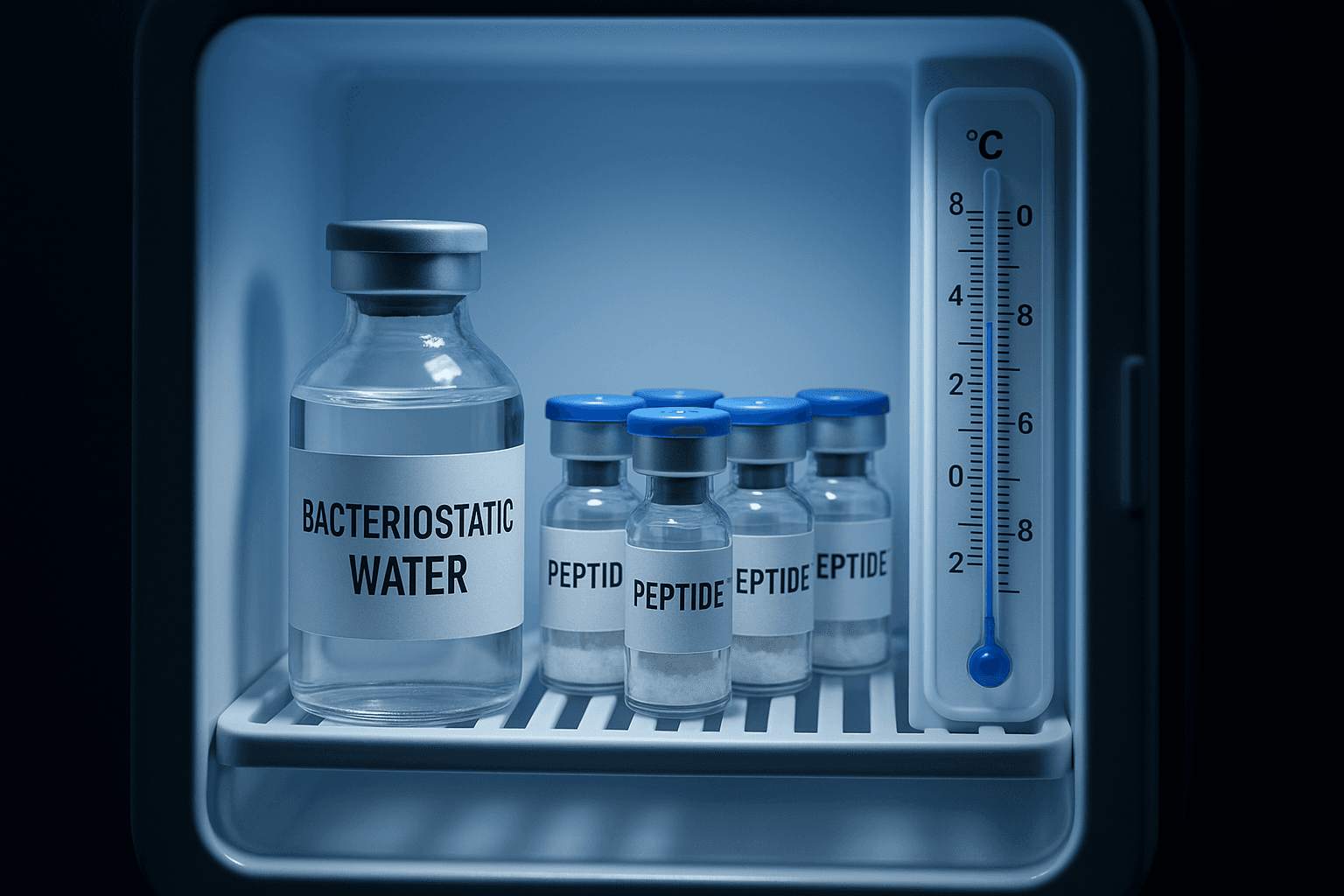
Bacteriostatic water storage divides into two distinct phases: before first puncture (sealed, factory-sterile product with months of shelf life) and after first puncture (a multi-dose vial on a 28-day clock where storage conditions directly affect whether the product maintains its documented quality through that window).
Research-context information only. Bacteriostatic water for injection is an FDA-regulated injectable product. The information below reflects USP standards, manufacturer prescribing information, published pharmaceutical literature, and self-reported community sources. This article reports what has been documented, not what should be done. Consult a licensed physician for personal medical decisions.
The storage requirements are different for each phase, and the consequences of getting them wrong are different too.
Before first puncture: sealed vial storage
Unopened bacteriostatic water vials are the more forgiving storage scenario. The factory seal — glass vial, rubber stopper, aluminum crimp — maintains sterility without refrigeration. The benzyl alcohol preservative is fully contained and not yet being consumed by its primary function (suppressing contamination from needle puncture).
Manufacturer-documented storage conditions:
Pfizer/Hospira prescribing information specifies controlled room temperature, defined as 20-25°C (68-77°F) with excursions permitted to 15-30°C (59-86°F). The product does not require refrigeration in its sealed state.
Shelf life. Manufacturer-printed expiration dates for USP bacteriostatic water typically fall 18-24 months from the date of manufacture. The expiration date on the vial label is the documented endpoint for sealed storage under the specified temperature conditions.
What shortens sealed-vial shelf life:
- Sustained heat above 30°C. Pharmaceutical stability documentation describes accelerated benzyl alcohol degradation at elevated temperatures. Product stored in a hot car, near a heat source, or in an un-climate-controlled warehouse during summer months may lose preservative efficacy before the printed expiration date.
- Direct sunlight or UV exposure. Benzyl alcohol is photosensitive — UV radiation accelerates the oxidation pathway to benzaldehyde. Pharmaceutical packaging guidance specifies light-protected storage. The original manufacturer carton provides this protection; removing vials from the carton and storing them on an open shelf under fluorescent or natural light is a documented degradation accelerant.
- Physical damage to the seal. A dented crimp, a cracked vial, or a stopper displaced from its seated position compromises sterility regardless of the product's chemical stability. Visual inspection of the seal and vial integrity is the minimum check on any stored product before first puncture.
Documented best practice for sealed vials: A cool, dry location at room temperature, protected from direct light, in the original manufacturer carton if possible. Pharmaceutical references and community sources describe this as the standard that requires no refrigeration and maintains the full manufacturer-printed shelf life.
After first puncture: the 28-day window
The storage scenario changes entirely at first puncture. The needle creates a channel through the rubber stopper between the sterile interior and the external environment. From that point forward, the benzyl alcohol preservative is actively suppressing microbial growth from cumulative contamination introduced through each subsequent puncture.
USP <797> guidance describes a 28-day beyond-use date for multi-dose vials after first puncture, assuming aseptic technique on every draw. The 28-day window is covered in detail in the multi-dose vial safety guide and the shelf life guide.
What the 28-day window requires:
The clock starts at first puncture, not at the date printed on the vial. A vial purchased 12 months ago and punctured today has 28 days from today.
Room temperature vs refrigerated after puncture:
USP guidance describes the 28-day window under controlled room temperature conditions. Refrigeration is not strictly required by the USP standard. However, community sources and pharmaceutical handling references consistently cite refrigeration at 2-8°C as the documented best practice for punctured vials, for three reasons:
-
Reduced microbial growth rate. Any organisms that enter through needle puncture proliferate more slowly at refrigeration temperatures than at room temperature. The benzyl alcohol preservative does the primary work of suppression, but lower temperatures reduce the growth rate the preservative must counteract.
-
Slower preservative degradation. Benzyl alcohol oxidation to benzaldehyde is temperature-dependent. Refrigeration slows this conversion, maintaining effective preservative concentration closer to the 0.9% starting level through the 28-day window.
-
Reconstituted peptide stability. Punctured bacteriostatic water vials are frequently used to reconstitute peptides, and the reconstituted peptide solution is stored in the same temperature environment as the bac water vial. Community sources and vendor documentation consistently cite 2-8°C as the documented storage temperature for reconstituted peptide vials. Keeping both the bac water source vial and the reconstituted peptide vials in the same refrigerated environment is the most commonly cited storage configuration.
What the margin difference looks like in practice:
Community sources describe the room-temperature-stored punctured vial as more likely to reach the boundary of preservative efficacy within the 28-day window — still technically within the documented period, but with less safety margin. Refrigerated vials maintain wider margins. Under sub-optimal conditions — warm ambient temperatures, frequent puncture without consistent aseptic technique, light exposure — the effective preservation window may shorten to less than 28 days even though the calendar window has not elapsed.
Technique and tracking: what shortens the window in practice
Storage conditions are only half of it. Merged here from the retired shelf-life article, these are the practice-side variables — the ones that shorten a window that is otherwise stored correctly.
Aseptic technique across repeated punctures. Punctures without swabbing the stopper, or with re-used needles, introduce microbial loads beyond what 0.9% benzyl alcohol is documented to suppress. The effect compounds: a vial drawn on twenty-plus occasions through a peptide cycle has accumulated twenty-plus opportunities for contamination, which is why community sources describe technique rather than temperature as the dominant real-world variable.
Tracking the 28-day clock. The clock starts at first puncture regardless of how much volume has been drawn. Community references cite three common tracking methods: a marker-and-tape label on the vial showing the puncture date, a calendar reminder set at the time of first puncture, or a note in the storage area listing active vial dates.
Multiple opened vials at once. Self-reported community practice cites working one vial through to its 28-day endpoint before opening the next, on the grounds that simultaneous open vials increase tracking error. Where more than one is open — for instance one refrigerated for active use and one in a travel kit — labeling each with its own puncture date is the practice described.
Product that never had a 28-day window. The math only applies to USP-spec bacteriostatic water. Listings labeled "bacteriostatic" that actually contain sterile water, saline, or distilled water carry no benzyl alcohol, so no preservative window exists at any storage temperature. The label line to check is an explicit "0.9% benzyl alcohol" alongside a named manufacturer — see how to spot fake bacteriostatic water.
Light exposure
Benzyl alcohol is photosensitive. UV radiation and, to a lesser extent, visible light accelerate the oxidation of benzyl alcohol to benzaldehyde. Benzaldehyde does not have the same bacteriostatic activity as benzyl alcohol — the conversion reduces effective preservative concentration.
Documented light-protection practices:
- Original carton storage. Manufacturer packaging is designed to protect the product from light. Keeping vials in the original carton — both before and after puncture — is the simplest protection.
- Opaque containers. Community sources cite amber glass containers, opaque zip bags, or small boxes as alternatives to the original carton for individual vials in active use.
- Refrigerator-door avoidance. Beyond the temperature-cycling concern (refrigerator doors experience wider temperature swings than interior shelves), the door is exposed to room lighting every time the refrigerator is opened. Interior shelves — particularly lower shelves toward the back — are more consistently dark and temperature-stable.
Pharmaceutical stability data describes light-accelerated benzyl alcohol degradation as cumulative. A few minutes of light exposure during a draw is negligible. Sustained storage on a counter under fluorescent lighting is not.
Multi-dose vial handling
Bacteriostatic water vials are designed for multi-dose use — the benzyl alcohol preservative and rubber-stopper seal exist specifically for this purpose. The handling practices that maintain quality through the documented window are well-described in pharmaceutical aseptic technique documentation.
Aseptic technique per draw:
Pharmaceutical handling documentation and community sources consistently describe the same sequence:
- The rubber stopper surface is wiped with a fresh alcohol swab before each puncture
- The alcohol is allowed to air-dry (community sources cite 10-30 seconds)
- A fresh, sterile needle is used for each draw
- The needle is inserted at the documented angle through the stopper center
- The required volume is drawn and the needle is removed
Needle reuse. A fresh sterile needle per draw is the documented standard in pharmaceutical aseptic technique. Reusing a needle introduces contamination from the previous injection site and increases coring risk from a blunted needle tip. The multi-dose vial safety guide covers the contamination pathway in detail.
Stopper integrity. Rubber stoppers are rated for a limited number of punctures — pharmaceutical literature describes approximately 10-25 punctures with standard gauge needles before coring risk increases significantly. If visible rubber fragments appear in the vial contents after a draw, the documented standard is to discard the vial regardless of remaining volume or days left in the window.
Vial positioning. Community sources cite upright storage (stopper up) as the standard. Storing a vial on its side or inverted keeps the solution in sustained contact with the rubber stopper, which pharmaceutical literature describes as a potential leachable-contamination pathway over extended periods.
Travel storage
Transporting bacteriostatic water — whether sealed or punctured — introduces temperature and physical-handling variables that stationary storage avoids.
Sealed vials during travel:
Unopened product is more forgiving. Room temperature is the documented storage condition, so travel at ambient temperature is acceptable as long as sustained heat exposure (hot car interiors, checked luggage in cargo holds during summer) is avoided. Physical protection of the glass vial — padding to prevent breakage — is the primary travel concern for sealed product.
Punctured vials during travel:
Vials in active multi-dose use require the same storage discipline during travel as at home: temperature control, light protection, and aseptic technique on every draw.
Community sources describe several travel-storage configurations:
- Insulated cooler bags designed for insulin or medication transport, with a cold pack to maintain approximate refrigeration temperatures. These are small, discreet, and widely available.
- Temperature monitoring. Adhesive temperature indicators (the kind that change color above a threshold) provide a simple verification that the vial did not experience sustained heat during transport.
- Pre-draw strategy. Some community protocols describe drawing the day's dose into a syringe before travel, capping the syringe, and transporting the syringe rather than the vial. This avoids the need to perform aseptic technique in non-ideal travel conditions. Pharmaceutical stability documentation for pre-drawn insulin syringes describes a 24-hour use window at room temperature — community sources cite similar timelines for pre-drawn peptide doses.
Air travel note: Community sources describe bacteriostatic water as a liquid medication subject to TSA liquid rules. Standard-sized vials (10-30 mL) are well under the 3.4 oz (100 mL) carry-on limit. Checked luggage introduces temperature and pressure variables that community sources cite as a secondary concern behind the primary temperature-control requirement.
Storage summary table
| Condition | Before first puncture | After first puncture |
|---|---|---|
| Temperature | Room temperature (20-25°C) | Refrigerated (2-8°C) preferred; room temperature acceptable per USP |
| Light | Protected from direct light; original carton recommended | Protected from light; opaque container or carton |
| Duration | Manufacturer-printed expiration (18-24 months) | 28 days from first puncture (USP <797>) |
| Refrigeration required? | No | Not strictly required; consistently recommended in community documentation |
| Freezing | Not recommended | Not recommended |
| Orientation | Upright preferred | Upright preferred |
Bottom line
Sealed bacteriostatic water vials store at room temperature through the manufacturer-printed expiration date with no refrigeration required — cool, dry, light-protected. After first puncture, the 28-day multi-dose window starts, and refrigeration at 2-8°C is consistently cited as the documented best practice in community and pharmaceutical references. Light protection, aseptic technique on every draw, fresh needles per puncture, and upright storage are the handling practices documented to maintain product quality through the full window.
Related reading
- How Long Does Bacteriostatic Water Last? 28-Day Rule — the full 28-day rule, what shortens the window, and when to discard
- Multi-Dose Vial Safety: How Many Draws from Bac Water? — puncture counts, coring risk, and discard criteria
- What Is Bacteriostatic Water? Benzyl Alcohol + Uses — composition, benzyl alcohol mechanism, and USP specifications
- How to Spot Fake Bacteriostatic Water (Red Flags) — visual inspection and documentation checks before storage even matters
- Bacteriostatic Water Brands Compared — manufacturer quality tiers and documentation standards
References
- Pfizer/Hospira. Bacteriostatic Water for Injection, USP — Prescribing Information. Revised 2023.
- United States Pharmacopeia. USP <797> Pharmaceutical Compounding — Sterile Preparations. USP Convention, 2023.
- United States Pharmacopeia. USP <51> Antimicrobial Effectiveness Testing. USP Convention, 2023.
This guide is for educational and informational purposes only. It is not medical advice. Injectable water products are FDA-regulated. Consult a qualified healthcare provider before starting any peptide protocol.