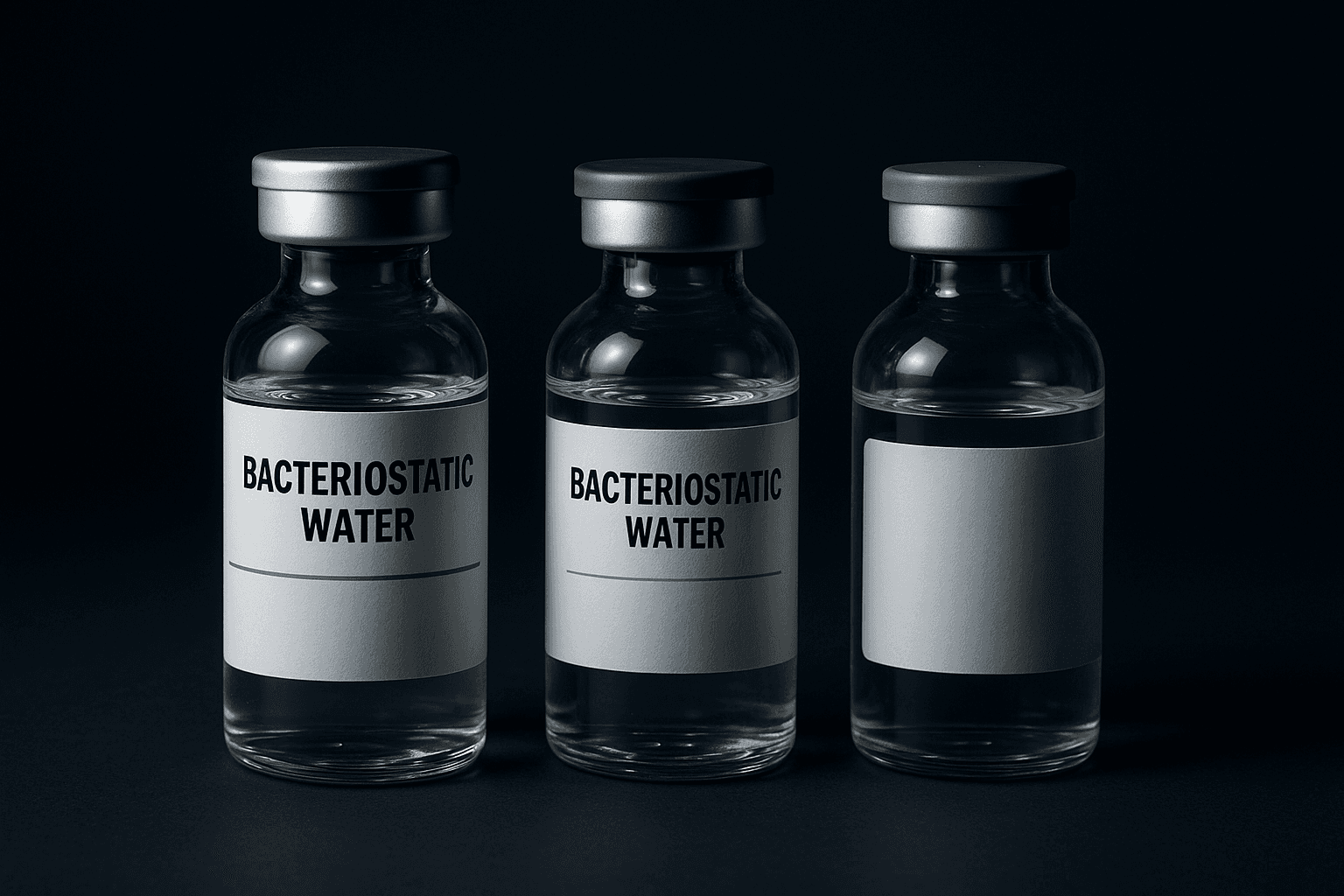
USP bacteriostatic water for injection has a fixed formula: sterile, non-pyrogenic water with 0.9% benzyl alcohol. Every manufacturer that meets the USP specification produces the same product by definition. The formula does not vary between brands.
Research-context information only. Bacteriostatic water for injection is an FDA-regulated injectable product. The information below reflects USP standards, manufacturer prescribing information, published pharmaceutical literature, and self-reported community sources. This article reports what has been documented, not what should be done. Consult a licensed physician for personal medical decisions.
What varies is everything around the formula: manufacturing quality control, COA documentation, packaging integrity, supply chain traceability, and pricing. Those differences determine confidence that the product inside the vial actually meets the spec it claims to meet.
Pfizer/Hospira: the pharmaceutical benchmark
Pfizer (through its Hospira subsidiary) is the most-cited manufacturer of USP bacteriostatic water in pharmaceutical references, trial protocols, and community documentation. The product is manufactured at FDA-registered facilities under Current Good Manufacturing Practice (cGMP) regulations.
Key product details:
| Parameter | Detail |
|---|---|
| NDC (30 mL) | 0409-3977-03 |
| NDC (10 mL) | 0409-3977-01 |
| Specification | USP Bacteriostatic Water for Injection |
| Preservative | 0.9% benzyl alcohol |
| Packaging | Type I borosilicate glass, rubber stopper, aluminum crimp |
| COA availability | Per-lot, available through pharmaceutical distribution |
Pfizer/Hospira product carries full pharmacopeial certification: sterility testing (USP <71>), endotoxin testing (USP <85>), benzyl alcohol assay, pH verification, and particulate matter testing (USP <788>). Lot-level COAs are generated as a standard output of the manufacturing quality system.
Community sources and pharmacy references describe Hospira as the benchmark because of two attributes that the formula itself does not differentiate: supply chain traceability (every vial is traceable from manufacturing through distribution to end user) and regulatory accountability (FDA-registered facilities are subject to inspection and enforcement).
Documented limitations: Hospira bacteriostatic water is a prescription product in the FDA listing, which means direct consumer purchase through retail pharmacy channels typically requires a prescription. Community sources note that this creates a procurement barrier for research-context use, which is one reason the peptide-vendor channel and compounding pharmacy alternatives exist.
Fresenius Kabi
Fresenius Kabi is the second-largest FDA-registered manufacturer of bacteriostatic water for injection in the U.S. pharmaceutical supply chain. The product meets the same USP specification as Hospira — identical formula, identical pharmacopeial testing requirements.
Key product details:
| Parameter | Detail |
|---|---|
| NDC (30 mL) | 0409-4887-17 |
| Specification | USP Bacteriostatic Water for Injection |
| Preservative | 0.9% benzyl alcohol |
| Packaging | Type I borosilicate glass, rubber stopper, aluminum crimp |
Fresenius Kabi product carries the same five-test COA panel as Hospira. Manufacturing occurs at FDA-registered facilities under cGMP. The product is functionally interchangeable with Hospira for the documented use case — the USP specification ensures that compliant product from either manufacturer contains the same formulation at the same quality standard.
Community sources and pharmaceutical supply chain documentation describe Fresenius Kabi as the primary alternative to Hospira in hospital and pharmacy channels. Availability fluctuates — bacteriostatic water has been subject to periodic supply shortages in the pharmaceutical distribution system, and community sources cite Fresenius Kabi as the backup manufacturer when Hospira supply is constrained.
Generic compounding pharmacy sources
Licensed compounding pharmacies prepare bacteriostatic water under state pharmacy board oversight and USP <797> sterile compounding standards. These are not FDA-registered manufacturers in the same sense as Pfizer or Fresenius Kabi — they operate under pharmacy compounding regulations rather than drug manufacturing regulations.
What compounding pharmacies typically provide:
- Sterile preparation under USP <797> clean-room conditions
- Benzyl alcohol at the 0.9% USP specification
- Lot-numbered vials with expiration dating
- Glass vial packaging (typically)
Where compounding pharmacy documentation varies:
- COA availability ranges from full five-test panels to sterility-plus-benzyl-alcohol-only confirmation
- Third-party testing may or may not be standard — some pharmacies rely on internal QC
- Endotoxin testing and particulate matter testing are sometimes performed per-lot, sometimes on a sampling schedule
- Documentation format is less standardized than FDA-registered manufacturer COAs
Community sources describe compounding pharmacy bacteriostatic water as a middle tier in the documentation spectrum. The product is prepared under regulatory oversight (state pharmacy boards inspect compounding pharmacies), but the documentation standard is not as uniform as FDA-registered manufacturing. The critical variable is whether the specific pharmacy can provide lot-level documentation — particularly the benzyl alcohol assay and sterility confirmation — for the product currently in distribution.
Procurement note: Compounding pharmacies may or may not require a prescription depending on the state and the pharmacy's classification. Community sources describe this as a jurisdiction-specific variable with no universal rule.
Peptide-vendor-channel bacteriostatic water
The peptide research vendor ecosystem includes multiple suppliers that package bacteriostatic water as a research-reagent companion product alongside their peptide catalogs. These products are marketed for research-context reconstitution rather than as FDA-listed drugs.
What characterizes the vendor channel:
- Product is sold as a research reagent, typically without prescription requirements
- Pricing ranges from $11-35 per vial depending on size and vendor
- Some vendors source from FDA-registered manufacturers and repackage; others source from compounding pharmacies or other supply chains
- COA availability and documentation standards vary by vendor
Community sources describe the vendor channel as the most common procurement route for peptide research-context use. The relevant quality differentiator is the same as every other source: whether the vendor can provide lot-level COA documentation confirming sterility, benzyl alcohol concentration, and endotoxin levels for the specific product currently in distribution.
Vendors that source from documented manufacturers and maintain lot-level traceability provide a comparable quality assurance level to direct pharmaceutical procurement. Vendors that cannot document their supply chain — where the bacteriostatic water comes from, who manufactured it, what testing was performed — represent the same documentation gap as unverified marketplace sources.
eBac Water
eBac Water is a branded bacteriostatic water product that appears in community discussions about peptide reconstitution supplies. The brand is marketed specifically to the research-peptide community.
Community sources describe eBac Water as a vendor-channel product available through peptide supplier storefronts. Documentation standards — including COA availability, manufacturing provenance, and lot traceability — vary depending on which supplier carries the product at any given time.
The same quality verification criteria apply to eBac Water as to any other bacteriostatic water source: lot number on the vial, COA available per lot, benzyl alcohol assay confirming 0.9% concentration, sterility confirmation, and endotoxin testing below USP limits. The brand name does not inherently guarantee or undermine quality — the documentation does.
For a full breakdown of what eBac Water is, whether it's legit, and how it stacks up against Hospira, see the dedicated eBac Water guide.
What actually differentiates brands
Since the formula is fixed by USP specification, the meaningful differences between bacteriostatic water sources fall into five categories that are independent of the product chemistry.
1. Manufacturing oversight. FDA-registered manufacturers (Hospira, Fresenius Kabi) operate under cGMP with FDA inspection authority. Compounding pharmacies operate under state pharmacy board oversight and USP <797>. Vendor-channel products operate under varying levels of regulatory oversight depending on their supply chain.
2. COA documentation. FDA-registered manufacturers generate per-lot COAs as a standard quality system output. Compounding pharmacies vary. Vendor-channel and marketplace sources range from full documentation to none.
3. Supply chain traceability. Every vial from an FDA-registered manufacturer is traceable through the pharmaceutical distribution system. Compounding pharmacy and vendor-channel traceability depends on the specific supplier's quality practices.
4. Packaging integrity. USP specification calls for Type I borosilicate glass, pharmaceutical-grade rubber stoppers, and machine-applied aluminum crimps. Non-pharmaceutical sources may use different glass types, non-pharmaceutical stoppers, or hand-crimped seals.
5. Pricing. FDA-registered pharmaceutical product through pharmacy channels runs $15-40+ per vial depending on size and distribution markup. Compounding pharmacy product runs $10-30. Vendor-channel product runs $11-35. Marketplace listings range from $3 to $25, with the lowest prices correlating with the highest rate of independent testing failures in community reports.
The quality spectrum
Community testing reports, pharmaceutical documentation, and vendor reputation data describe a quality spectrum for bacteriostatic water that correlates with documentation standards more than brand name.
Highest documentation standard: FDA-registered manufacturers (Hospira, Fresenius Kabi) with per-lot COAs, NDC-traceable product, and cGMP manufacturing.
Documented middle tier: Licensed compounding pharmacies following USP <797> with lot-level benzyl alcohol and sterility confirmation. Peptide vendors that maintain supply chain documentation and provide per-lot COAs.
Lowest documentation standard: Marketplace listings without manufacturer identification, lot numbers, COAs, or NDC. This tier has the highest rate of independent testing failures in community reports — including product that tests as sterile water with no benzyl alcohol, sub-spec preservative concentrations, and endotoxin levels above USP limits.
The brand printed on the label is less informative than the documentation available for the product inside the vial. Any source that can provide a per-lot COA confirming the five USP test parameters — from an identified testing laboratory, matched to the lot number on the vial — meets the minimum documentation standard regardless of brand name.
Bottom line
USP bacteriostatic water has a fixed formula — the chemistry does not vary between compliant manufacturers. What varies is the manufacturing oversight, documentation standard, and supply chain traceability that determine confidence in compliance. Pfizer/Hospira and Fresenius Kabi set the documentation benchmark through FDA-registered cGMP manufacturing with per-lot COAs. Compounding pharmacies and documented vendor-channel sources provide varying levels of the same assurance. The lowest-documentation sources — marketplace listings without manufacturer identification, lot tracking, or COA availability — carry the highest rate of independent testing failures.
Related reading
- How to Spot Fake Bacteriostatic Water (Red Flags) — visual inspection, NDC lookup, and the six red flags that identify counterfeit product
- Why Your Bac Water Needs a COA — the five-test panel and what each result means
- Where to Buy Bacteriostatic Water (Pharmaceutical Grade) — procurement framework for verified USP-grade product
- How to Store Bacteriostatic Water (Pre + Post Puncture) — storage conditions that maintain quality through the documented window
- Bacteriostatic Water vs Sterile Water: Which to Use — the multi-dose vs single-use comparison
References
- Pfizer/Hospira. Bacteriostatic Water for Injection, USP — Prescribing Information. Revised 2023.
- Fresenius Kabi. Bacteriostatic Water for Injection, USP — Product Information. 2023.
- United States Pharmacopeia. USP <797> Pharmaceutical Compounding — Sterile Preparations. USP Convention, 2023.
- United States Pharmacopeia. USP <85> Bacterial Endotoxins Test. USP Convention, 2023.
- FDA. Current Good Manufacturing Practice (CGMP) Regulations. 21 CFR Parts 210-211.
This guide is for educational and informational purposes only. It is not medical advice. Injectable water products are FDA-regulated. Consult a qualified healthcare provider before starting any peptide protocol.