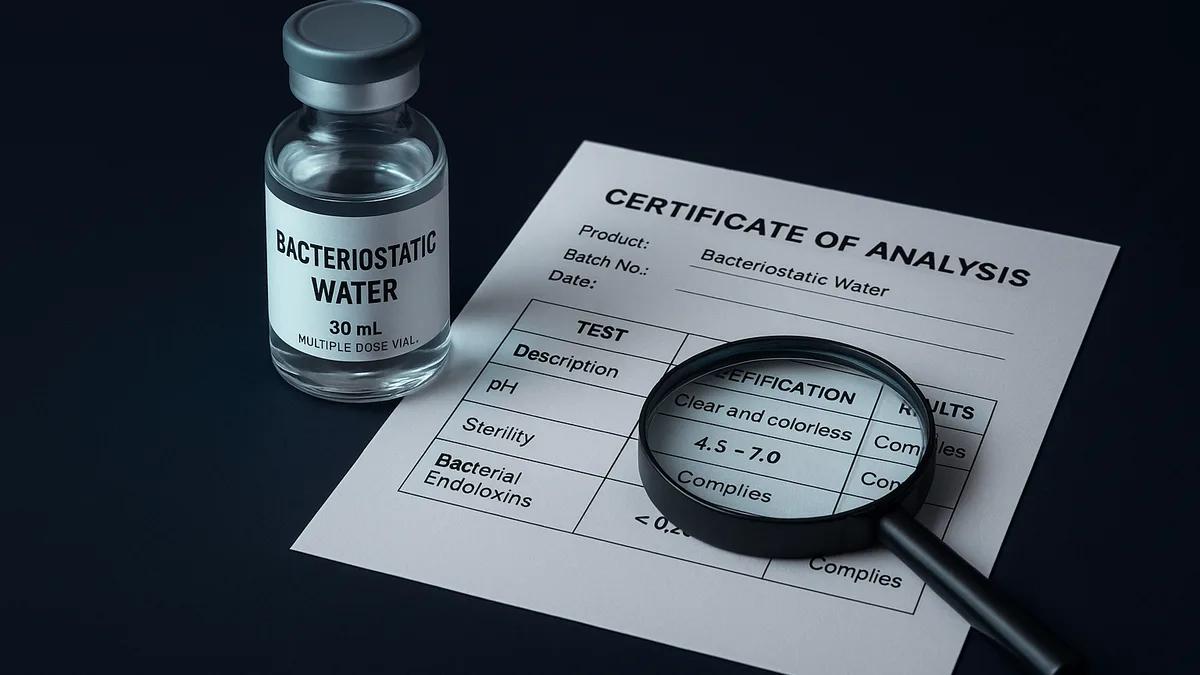
The peptide research community has developed a sophisticated quality-assurance culture around peptide sourcing. Vendors that publish Certificates of Analysis earn trust. Vendors that refuse COA requests lose it. Third-party testing, HPLC purity reports, and mass spectrometry verification have become baseline expectations — not premium features — for any peptide supplier operating in the research market.
That same rigor stops at the water line.
Research-context information only. Bacteriostatic water for injection is an FDA-regulated injectable product. The information below reflects USP standards, manufacturer prescribing information, published pharmaceutical literature, and self-reported community sources. This article reports what has been documented, not what should be done. Consult a licensed physician for personal medical decisions.
Community sources consistently describe a pattern: researchers who verify every peptide purchase with COAs, who cross-reference lot numbers, who test reconstituted solutions for expected concentration — then reconstitute those verified peptides with bacteriostatic water sourced from an unverified marketplace listing. No COA. No lot number. No documented benzyl alcohol concentration. The water becomes the single unverified link in an otherwise verified chain.
This article reports why that gap matters, what the documented failure modes are, and what a real Certificate of Analysis for bacteriostatic water actually contains.
The $300 peptide problem
The economics of peptide research create a paradox. A typical research protocol involves peptides costing $60-470 per vial, purchased from vendors selected specifically for their testing documentation. A 30-day cycle with a single peptide runs $200-400 in peptide cost alone. Multi-peptide protocols can exceed $600-800 per month.
The bacteriostatic water used to reconstitute those peptides is the lowest-cost component in the protocol — but the quality range is enormous. Unverified marketplace listings sell for as low as $5-8 with no COA and no lot traceability. COA-verified product from documented sources runs $25-35. Either way, the water cost is a fraction of the peptide investment.
It is also the one component that contacts every peptide in the protocol. A single 30 mL vial of bacteriostatic water may reconstitute three to five peptide vials over the course of a cycle. If the water is out of spec, every peptide it touches is compromised — regardless of how rigorously those peptides were verified before reconstitution.
Community sources describe the calculation in blunt terms: researchers apply enterprise-grade quality assurance to the $300 peptide and skip verification entirely on the solvent that peptide depends on. The water is not a passive ingredient in this context. It is the delivery vehicle, the preservative system, and the single point of failure in the reconstitution chain.
The cost asymmetry makes the quality gap worse, not better. Because unverified bac water sells for so little, the economic incentive for marketplace sellers to cut corners is high. Margins on a $5 vial are thin. Margins on a $5 vial that skips third-party testing, uses non-pharmaceutical packaging, or ships product that is actually sterile water relabeled as bacteriostatic water are significantly less thin.
What can go wrong with unverified bac water
The failure modes for out-of-spec bacteriostatic water are well-documented in pharmaceutical literature and extensively reported in community sources. They range from silent degradation (no visible signal until the peptide fails) to acute contamination events.
Sub-spec benzyl alcohol concentration
The most commonly cited failure in community quality reports. USP bacteriostatic water requires 0.9% (9 mg/mL) benzyl alcohol as preservative. Published preservative efficacy studies describe a concentration-dependent curve: at 0.9%, bacteriostatic activity suppresses common skin-flora organisms through the documented 28-day multi-dose window. At 0.5%, suppression begins to fail within 7-14 days. Below 0.3%, preservation is effectively absent.
Product that tests at 0.4-0.6% benzyl alcohol may appear normal on day one. By day three to five of multi-dose use — after multiple needle punctures have introduced skin-flora organisms through the rubber stopper — microbial counts begin to climb. The vial contents may not show visible turbidity until day seven or later, by which point several reconstituted peptide doses have already been drawn from a contaminated solution.
Sub-spec preservative concentration is invisible without laboratory testing. The water looks, smells, and behaves identically to compliant product. Only a COA with a benzyl alcohol assay result documents whether the concentration meets USP specification.
No benzyl alcohol at all
A step beyond sub-spec: product sold as bacteriostatic water that is actually sterile water for injection or, in worst-case marketplace scenarios, non-pharmaceutical-grade water with no preservative and no sterility guarantee. Community sources describe this as the most common failure mode for ultra-low-cost marketplace listings — the ones priced at $3-5 per 30 mL vial, well below the cost floor for USP-compliant product.
Sterile water without benzyl alcohol reverts to single-use status within hours of the first needle puncture. There is no preservative to suppress microbial growth. Every subsequent draw from the same vial occurs from an increasingly contaminated solution. Researchers who use this product on a multi-dose schedule — drawing from the same vial over days or weeks — are operating without the bacteriostatic protection the product label claims to provide.
Endotoxin contamination
Endotoxins are lipopolysaccharide fragments from the cell walls of gram-negative bacteria. They are released when bacteria die and are not destroyed by standard sterilization methods — autoclaving kills the organisms but leaves the endotoxin fragments intact. Endotoxin testing (USP <85>, the Bacterial Endotoxins Test) is a separate assay from sterility testing and catches a class of contamination that sterility testing alone misses.
Published pharmaceutical literature describes the physiological response to injected endotoxins: fever (pyrogenic response), injection-site inflammation, and systemic inflammatory markers at higher exposure levels. Community sources commonly cite unexplained fever and injection-site reactions as potential downstream signals of endotoxin-contaminated reconstitution water — reactions attributed to the peptide when the actual source is the solvent.
Endotoxin contamination produces no visible signal in the vial. The water remains clear and colorless. Only LAL (Limulus Amebocyte Lysate) testing, documented on a COA, confirms endotoxin levels are below USP limits.
Particulate contamination
USP standards for injectable products specify limits on both visible and sub-visible particulate matter. Compliant pharmaceutical-grade bacteriostatic water is manufactured in controlled cleanroom environments using pharmaceutical-grade glass or Type I borosilicate vials, pharmaceutical-grade rubber stoppers, and validated fill-finish processes that control for particulate introduction.
Product manufactured or repackaged outside pharmaceutical-grade facilities — in non-cleanroom environments, in non-pharmaceutical containers, or with non-validated sealing processes — introduces particulate risk at every stage. Glass fragments from low-quality vials, rubber particulate from non-pharmaceutical stoppers, and environmental contaminants from uncontrolled fill environments are all documented sources.
Sub-visible particulates (below 50 microns) are not detectable by visual inspection. They pass through standard syringe filters and are injected along with the reconstituted peptide. A COA that includes particulate matter testing (USP <788>) documents that the product has been evaluated for this class of contamination.
Cloudy reconstitution traced to the water
Community sources describe a frustrating diagnostic pattern: a reconstituted peptide vial goes cloudy within hours to days, and the researcher's first assumption is that the peptide is degraded. The peptide vendor is contacted. A replacement is requested. The replacement peptide is reconstituted with the same bac water — and goes cloudy again.
The root cause in these reports is typically the bacteriostatic water, not the peptide. Out-of-spec pH, endotoxin load, or non-pharmaceutical particulates in the water create conditions that destabilize the peptide's tertiary structure, causing aggregation and visible haze. The peptide was fine. The water was the variable.
Published pharmaceutical literature describes peptide molecules as pH-sensitive and aggregation-prone. The solvent environment — pH, ionic strength, preservative chemistry — is a direct input to peptide stability post-reconstitution. Out-of-spec water does not merely fail to preserve the vial contents. It actively degrades them.
The COA is the only verification
The core problem with unverified bacteriostatic water is that every critical quality parameter is invisible to end-user inspection.
Benzyl alcohol at 0.9% concentration is colorless, odorless in dilute solution, and fully dissolved in water. There is no home test for preservative concentration. Sterile water and bacteriostatic water look identical in the vial. A researcher cannot distinguish between them without analytical chemistry equipment.
Endotoxins are molecular-scale fragments measured in endotoxin units per milliliter. They produce no visual signal, no odor, no change in solution clarity. The LAL assay that detects them requires specialized reagents and controlled laboratory conditions.
Sub-visible particulates are, by definition, below the threshold of visual detection. They are counted and sized by automated particle counters (light obscuration or membrane microscopy per USP <788>), not by holding the vial up to a light.
pH can be measured with consumer-grade pH strips, but the relevant range (4.5-7.0) is broad enough that strip-resolution testing provides limited actionable information about whether the product meets the tighter tolerance bands specified in the USP monograph.
The Certificate of Analysis is the document that captures all of these parameters as tested values from a qualified laboratory. It is the only verification mechanism available for the quality parameters that matter most. Visual inspection catches gross contamination — cloudiness, particulates large enough to see, discoloration, seal integrity failure. The COA catches everything else.
What a real COA contains
A compliant Certificate of Analysis for USP bacteriostatic water documents five core test results. Each corresponds to a specific quality parameter and a specific failure mode it is designed to catch.
Sterility (USP <71>)
The foundational test. USP <71> Sterility Testing confirms that the product contains no viable bacterial or fungal organisms at the time of testing. The test involves incubating product samples in growth media (typically Fluid Thioglycollate Medium for bacteria and Soybean-Casein Digest Medium for fungi) for a minimum of 14 days and observing for microbial growth.
A passing result reads "No Growth" or "Passes USP <71>." This confirms the product was sterile at the time the COA sample was drawn. It does not guarantee sterility at the time of delivery — transit damage, seal compromise, and storage failures can introduce contamination post-testing. But it establishes that the product left the manufacturer in a sterile state, which is the minimum threshold for an injectable product.
Benzyl alcohol assay
The test that confirms the product is actually bacteriostatic water and not sterile water or an under-preserved variant. The assay measures the concentration of benzyl alcohol in the solution, typically by HPLC (High-Performance Liquid Chromatography) or UV spectrophotometry.
The result should read 0.9% (9 mg/mL) or within the USP tolerance range. A COA that lists benzyl alcohol as "present" without a quantitative result is incomplete — presence is not the question; concentration is. The difference between 0.9% and 0.4% is the difference between 28-day preservation and 7-day preservation, and only the assay number tells the story.
Endotoxin (USP <85>)
The Bacterial Endotoxins Test, performed using the LAL (Limulus Amebocyte Lysate) method, quantifies endotoxin contamination in endotoxin units per milliliter (EU/mL). USP specifies limits for injectable water products — the result should fall below the stated limit, and the COA should report both the measured value and the specification.
This test catches a contamination class that sterility testing misses entirely. A product can pass USP <71> sterility (no viable organisms) and still carry a clinically significant endotoxin load from organisms that were present earlier in the manufacturing process and killed during sterilization. The endotoxin fragments persist. Only the LAL assay detects them.
pH
A straightforward measurement that confirms the product falls within the USP specification range of 4.5 to 7.0. pH is relevant because it affects both the stability of benzyl alcohol as a preservative and the stability of peptides reconstituted in the water.
Extreme pH values outside the specification range signal a manufacturing or contamination issue. The COA should report a numeric pH value, not just "passes" — the specific number provides context for researchers working with pH-sensitive peptides.
Particulate matter (USP <788>)
The test for sub-visible particulates, performed by light obscuration or membrane microscopy. USP <788> specifies limits for particles at two size thresholds: 10 microns and 25 microns per container. The COA reports particle counts at each threshold against the specification limit.
This test catches contamination from non-pharmaceutical packaging materials, manufacturing environment particulates, and degradation products that are below the threshold of visual inspection but above the threshold of injectable safety.
A COA that includes all five of these tests — with numeric results, not just pass/fail statements — documents that the product has been evaluated against the full USP specification for bacteriostatic water for injection.
Lot numbers: the traceability chain
A COA without a lot number is a document without an anchor. The lot number is the link between the COA (which documents test results for a specific production batch) and the vial in hand (which should carry a label identifying which batch it came from). Without that link, the COA could apply to any batch — or no batch.
Pharmaceutical traceability works on lot-level identification. Every vial produced in a given manufacturing run carries the same lot number. The COA for that lot documents the test results for samples drawn from that specific production run. When a quality issue is identified post-distribution, the lot number is the mechanism for targeted recall — only the affected batch is pulled, not the entire product line.
The peptide research community has internalized this standard. Reputable peptide vendors publish COAs with lot numbers that match the labels on the vials they ship. Researchers routinely verify that the lot number on the COA matches the lot number on the product. This is considered baseline quality assurance, not a premium expectation.
Bacteriostatic water should be held to the same standard for the same reason: a COA is only meaningful if it can be traced to the specific product it claims to represent. Product that ships without a lot number on the vial — or with a lot number that does not correspond to an available COA — breaks the traceability chain at the most basic level.
Community sources describe lot number verification as the fastest quality signal available before any laboratory testing. If the seller cannot provide a COA that matches the lot number on the vial, the remaining quality questions are academic — the documentation chain is already broken.
The marketplace quality gap
Without identifying specific sellers, community quality reports describe a consistent pattern in marketplace-sourced bacteriostatic water.
The price signal. USP-compliant bacteriostatic water manufactured at FDA-registered facilities, in pharmaceutical-grade glass vials, with third-party COA testing, has a cost floor. Raw materials, cleanroom manufacturing, fill-finish, and quality testing set that floor well above the $3-5 price point that characterizes the lowest-tier marketplace listings. Product priced significantly below the cost of compliant manufacturing warrants questions about which manufacturing or testing steps were omitted to achieve that margin.
The documentation gap. Community sources describe a pattern where COA requests to marketplace sellers are met with silence, generic certificates that lack lot numbers, or manufacturer documentation that predates the product by years. The absence of documentation is itself a data point — legitimate pharmaceutical manufacturers generate COAs as a standard output of their quality management systems. If no COA exists, the product likely was not manufactured under a system that generates them.
The identity question. Independent testing of marketplace-sourced bac water, described in community reports, has identified product sold as bacteriostatic water that tests as sterile water (no detectable benzyl alcohol), product with benzyl alcohol concentrations ranging from 0.2% to 0.6% (below the USP 0.9% specification), and product with endotoxin levels above USP limits. These are not rare edge cases in community testing reports — they represent a significant fraction of the ultra-low-cost marketplace listings that community members have independently tested.
The repackaging concern. Some marketplace bac water is not manufactured by the seller but repackaged from bulk sources into retail vials. Repackaging introduces contamination risk at every transfer point — from bulk container to retail vial, from non-pharmaceutical sealing equipment, from non-cleanroom environments. Product that was USP-compliant when it left the original manufacturer may no longer be compliant after repackaging, and the repackager typically does not perform the release testing that would detect the degradation.
What to look for in a verified supplier
Community sources describe five documentation standards that distinguish verified bacteriostatic water suppliers from undocumented ones.
Published COAs per batch. Not a single COA for the entire product line — a COA for each lot number currently in distribution. The COA should be accessible before purchase or immediately upon request, not as a post-purchase afterthought.
Lot numbers on every vial. Every vial should carry a label with a lot number that corresponds to an available COA. The lot number is the minimum unit of traceability. Without it, the COA and the product are disconnected documents.
Quantitative benzyl alcohol reporting. The COA should report benzyl alcohol concentration as a measured value (e.g., 0.9% or 9.0 mg/mL), not as "present" or "passes." The concentration is the critical parameter — presence alone does not confirm that the preservative is at functional levels.
Named third-party testing laboratory. Internal QC testing has value, but third-party testing by a named, independent laboratory provides a level of verification that self-testing cannot. The COA should identify the testing facility. A COA that reports results without identifying who performed the testing lacks the independence that makes COA verification meaningful.
Full USP test panel. Sterility, benzyl alcohol assay, endotoxin, pH, and particulate matter — all five. A COA that reports only sterility, or only benzyl alcohol, documents a partial picture. The five-test panel is the USP specification. Anything less is an incomplete evaluation of whether the product meets the standard it claims to meet.
The verification standard should be uniform
The peptide research community has spent years building a quality-assurance culture around peptide sourcing. COA verification, lot number matching, third-party HPLC testing, and vendor reputation tracking are standard practice. That infrastructure exists because the community learned — through documented failures, wasted research material, and contamination events — that trust without verification is not a quality system.
The bacteriostatic water used to reconstitute those peptides passes through the same needle, enters the same vial, and contacts the same molecules. It is subject to the same contamination risks, the same manufacturing variables, and the same marketplace incentives for corner-cutting. The only difference is price — and a lower price point makes quality shortcuts more likely, not less.
A COA for bacteriostatic water is not a premium feature. It is the same baseline documentation standard that the research community already demands for every other injectable component in the protocol. The water should not be the exception.
Related reading
- How to Spot Fake Bacteriostatic Water (Red Flags) — visual inspection, NDC lookup, and the six red flags that identify counterfeit product before laboratory testing
- Bacteriostatic Water Brands Compared — Hospira, Fresenius Kabi, generic compounding, and vendor-channel sources compared on documentation standards
- Where to Buy Bacteriostatic Water (Pharmaceutical Grade) — procurement framework for verified USP-grade product
- What Is Bacteriostatic Water? Benzyl Alcohol + Uses — composition, benzyl alcohol mechanism, and USP specifications