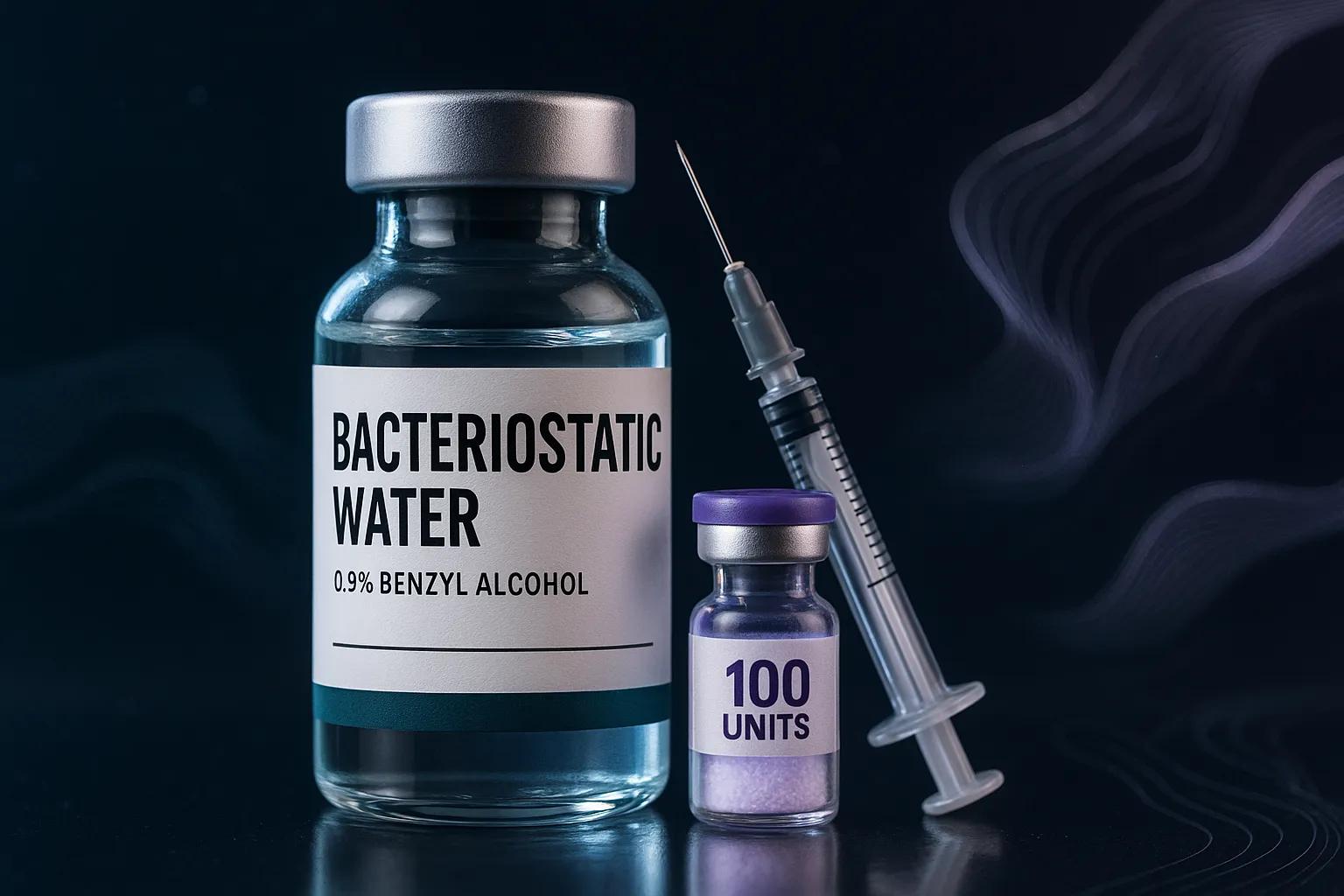
People searching "bacteriostatic water for botox" typically encounter an important distinction: manufacturer prescribing information for onabotulinumtoxinA (the active ingredient in the most widely used botulinum toxin product) specifies 0.9% preservative-free sodium chloride as the reconstitution diluent — not bacteriostatic water.
Research-context information only. Bacteriostatic water for injection is an FDA-regulated injectable product. The information below reflects USP standards, manufacturer prescribing information, published trial protocols, and self-reported community sources. This article reports what has been documented, not what should be done. Consult a licensed physician for personal medical decisions.
That said, published clinical literature documents practitioners using bacteriostatic water or preserved saline as alternative diluents, primarily for patient comfort. This guide reports what manufacturer documentation specifies, what clinical literature has documented, and where the distinction matters.
What manufacturer documentation specifies
Allergan/AbbVie prescribing information for onabotulinumtoxinA states:
- Diluent: 0.9% Sodium Chloride Injection (preservative-free)
- Container: vacuum-sealed 100-unit or 200-unit vials of lyophilized powder
- Technique: slow injection of diluent into the vial; gentle swirling to dissolve; no shaking
- Storage post-reconstitution: refrigerate at 2-8 degrees Celsius, use within 24 hours
- Appearance: clear, colorless to slightly yellow solution; discard if particulate matter is visible
The manufacturer specification for preservative-free saline — rather than bacteriostatic water or preserved saline — is consistent across all approved botulinum toxin products. The prescribing information does not endorse alternative diluents.
The official dilution chart (100-unit vial)
Manufacturer prescribing information documents the following dilutions for a 100-unit onabotulinumtoxinA vial:
| Diluent added | Resulting concentration | Units per 0.1 mL | Common use cited |
|---|---|---|---|
| 1.0 mL | 10 U/0.1 mL | 10 units | Concentrated therapeutic applications |
| 2.0 mL | 5 U/0.1 mL | 5 units | Therapeutic applications |
| 2.5 mL | 4 U/0.1 mL | 4 units | Cosmetic applications (most-cited) |
| 4.0 mL | 2.5 U/0.1 mL | 2.5 units | Wider area therapeutic coverage |
| 8.0 mL | 1.25 U/0.1 mL | 1.25 units | Low-density therapeutic coverage |
Clinical-practice literature most commonly cites the 2.5 mL dilution (4 U per 0.1 mL) for cosmetic applications — glabellar lines, forehead lines, crow's feet. This dilution provides a balance between precision dosing and manageable injection volumes that clinical sources describe as optimal for the small-volume, multi-point injection pattern used in cosmetic treatment.
Why some practitioners use bacteriostatic water
Published clinical literature documents an alternative practice: reconstituting botulinum toxin with preserved saline (0.9% sodium chloride with 0.9% benzyl alcohol) or bacteriostatic water (sterile water with 0.9% benzyl alcohol). The documented rationale centers on patient comfort.
The benzyl alcohol rationale
Benzyl alcohol at 0.9% concentration has documented mild local anesthetic properties. Clinical studies have measured reduced injection-site pain scores when botulinum toxin is reconstituted with preserved diluents compared to preservative-free saline:
- Published studies document statistically significant reductions in patient-reported pain scores using preserved versus preservative-free diluent
- The anesthetic effect is attributed to benzyl alcohol's action on sodium channels at the injection site
- Clinical-practice sources describe the pain reduction as particularly relevant for patients receiving multiple injection points in a single session (20-40+ injection sites for cosmetic treatment)
The clinical evidence
Several published studies have examined potency and safety of botulinum toxin reconstituted with preserved diluents:
- Potency: published stability data documents no clinically significant difference in biological activity between preservative-free saline and preserved alternatives at standard dilutions
- Safety: no additional adverse events attributable to benzyl alcohol have been documented in published botulinum toxin literature at the injection volumes used
- Efficacy: clinical outcome measures (wrinkle reduction scales, duration of effect) show comparable results across diluent types in published comparative studies
The off-label distinction
Despite the clinical evidence supporting preserved diluents, the practice remains off-label. Manufacturer prescribing information has not been updated to include bacteriostatic water or preserved saline as approved diluents. Clinical-practice sources note that this creates a regulatory and liability distinction: practitioners using preserved diluents are deviating from manufacturer specification, which some institutional protocols and malpractice frameworks treat differently than on-label practice.
Bacteriostatic water vs. preserved saline vs. preservative-free saline
| Factor | Preservative-free saline (manufacturer spec) | Preserved saline | Bacteriostatic water |
|---|---|---|---|
| Composition | 0.9% NaCl, sterile | 0.9% NaCl + 0.9% benzyl alcohol | Sterile water + 0.9% benzyl alcohol |
| Manufacturer endorsed | Yes | No | No |
| Injection-site anesthesia | None | Mild (benzyl alcohol) | Mild (benzyl alcohol) |
| Multi-dose window | None (single-use) | 28 days (USP) | 28 days (USP) |
| Tonicity | Isotonic | Isotonic | Hypotonic |
| Clinical evidence | Prescribing information | Published studies | Published studies |
The tonicity distinction is worth noting: preserved saline is isotonic (matches tissue fluid), while bacteriostatic water is hypotonic. Clinical-practice sources that document the off-label use of preserved diluents more commonly cite preserved saline than bacteriostatic water, partly because of the tonicity match. However, at the small injection volumes used in botulinum toxin administration (0.05-0.1 mL per site), published literature does not document clinically significant tissue response differences between isotonic and hypotonic diluents.
Key distinctions from peptide reconstitution
Botulinum toxin reconstitution differs from peptide reconstitution in several ways that affect the bac water question:
- Injection volumes are tiny. Botulinum toxin injections are 0.05-0.1 mL per site — far smaller than typical peptide subcutaneous injections. The total benzyl alcohol exposure per session is minimal.
- Multi-dose window matters differently. Manufacturer documentation specifies 24-hour use for reconstituted botulinum toxin. The 28-day multi-dose window that makes bacteriostatic water essential for peptide vials is less relevant when the manufacturer timeline is 24 hours.
- Clinical setting. Botulinum toxin is administered by licensed practitioners in clinical settings. Peptide reconstitution is commonly performed by end users at home. The quality control environment is different.
Bottom line
Manufacturer prescribing information for onabotulinumtoxinA specifies preservative-free 0.9% sodium chloride as the reconstitution diluent — not bacteriostatic water. Published clinical literature documents practitioners using preserved saline or bacteriostatic water as off-label alternatives, primarily for the mild local anesthetic effect of benzyl alcohol. Clinical evidence documents comparable potency, safety, and efficacy across diluent types. The practice is clinically documented but procedurally off-label, and the distinction matters for regulatory compliance and liability frameworks.
Related reading
- What Is Bacteriostatic Water? Benzyl Alcohol + Uses — USP composition and the role of 0.9% benzyl alcohol
- Benzyl Alcohol in Bacteriostatic Water — mechanism, concentration, and the anesthetic property
- Bacteriostatic Water vs Sterile Water — how the preservative changes the multi-dose window
- How Long Does Bacteriostatic Water Last? 28-Day Rule — USP multi-dose window explained
This guide is for educational and informational purposes only. It is not medical advice. Bacteriostatic water for injection is a regulated injectable product subject to FDA labeling standards. As an affiliate partner, The Peptide Catalog may earn a commission on qualifying purchases at no extra cost to the reader. Bacteriostatic water is sold for research and professional use only.