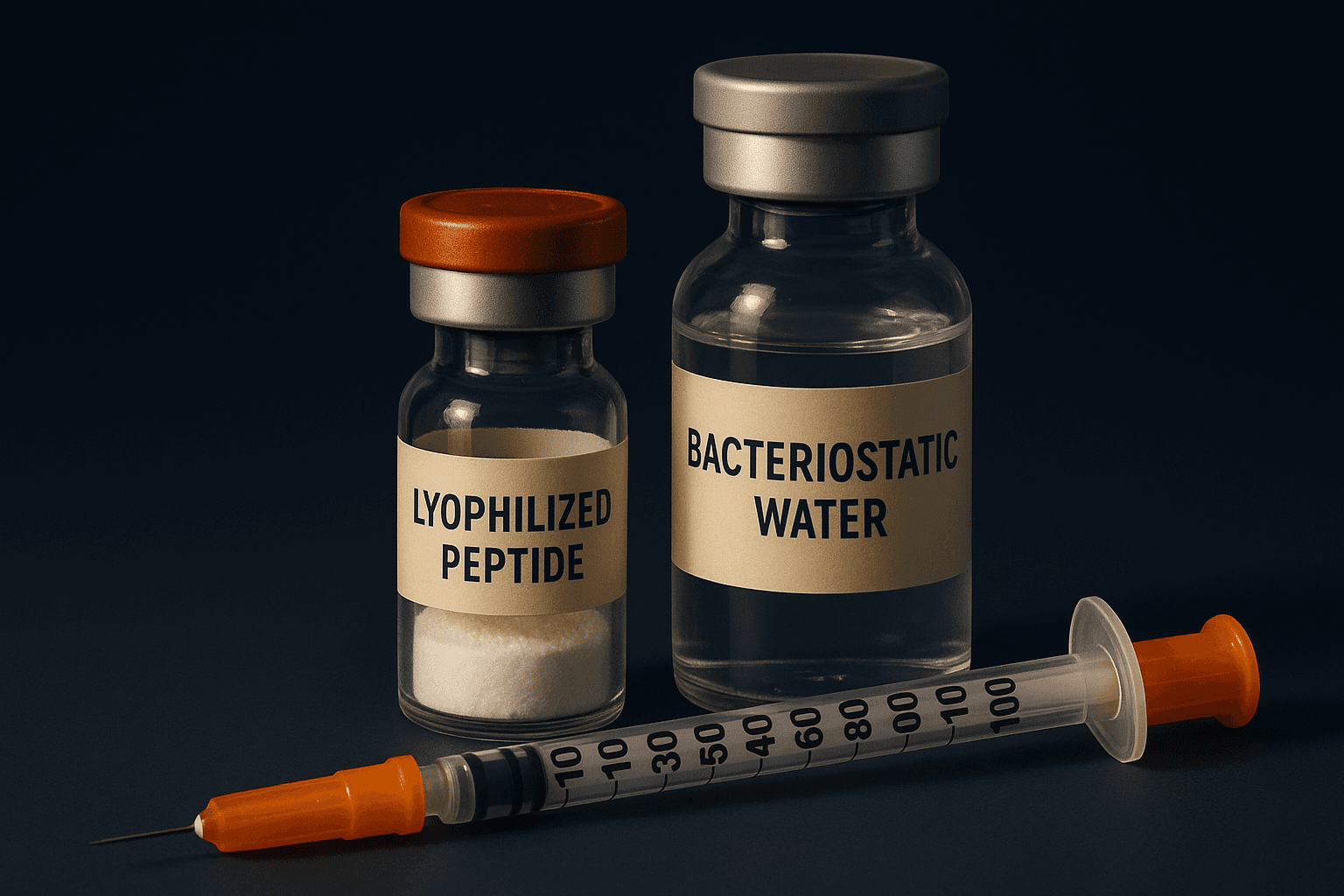
A 10mg PT-141 (bremelanotide) vial reconstituted with 2 mL of bacteriostatic water yields a 5 mg/mL solution — the ratio community reconstitution sheets cite most commonly because it maps the documented 1-2 mg dose range to clean unit marks on a U-100 insulin syringe.
Research-context information only. PT-141 (bremelanotide) is a melanocortin receptor agonist. The FDA-approved finished product is a different formulation than research-peptide lyophilized vials; research-format PT-141 is sold for research purposes only. Protocols, doses, and reactions reported below come from clinical trials and self-reported community sources. This article reports what has been documented, not what should be done. Consult a licensed physician for personal medical decisions.
PT-141 occupies a distinct position in the reconstitution context: it is an as-needed peptide, not a daily or weekly one. That on-demand dosing pattern changes the practical math around vial consumption and the 28-day bacteriostatic water window.
How much bacteriostatic water for PT-141
Research-format PT-141 is sold as a lyophilized powder in vials. The 10mg vial is the most common format across community vendor documentation.
The table below reports the concentrations community sources most commonly cite.
| Vial size | Bacteriostatic water added | Final concentration | U-100 syringe: units per 1 mg | Notes from community sources |
|---|---|---|---|---|
| 10 mg | 2 mL | 5 mg/mL | 20 units | Most-cited ratio; clean mapping for 1-2 mg dose range |
| 10 mg | 1 mL | 10 mg/mL | 10 units | More concentrated; smaller injection volume |
| 5 mg | 1 mL | 5 mg/mL | 20 units | Same concentration as the standard 10mg-plus-2-mL ratio |
At 5 mg/mL on a U-100 insulin syringe, each 10-unit mark corresponds to 0.5 mg. The documented dose range maps as follows:
| Dose | Units on U-100 syringe (at 5 mg/mL) |
|---|---|
| 1 mg | 20 units |
| 1.25 mg | 25 units |
| 1.5 mg | 30 units |
| 1.75 mg | 35 units |
| 2 mg | 40 units |
Community sources cite 2 mL as the standard reconstitution volume for a 10mg vial because the 5 mg/mL concentration places the full documented dose range (1-2 mg) within the 20-40 unit range on a U-100 syringe — easy to read, easy to measure, no dose step requiring fractions of a unit mark.
As-needed dosing and vial planning
PT-141 is documented as an as-needed (PRN) peptide in clinical trial protocols and community references — administered on a per-occasion basis rather than on a fixed daily or weekly schedule.
Documented frequency constraints from trial protocols and community sources:
- No more than one dose per 24-hour period
- Community sources commonly cite a maximum of eight doses per month as the documented upper bound
- No fixed schedule — administration timing is occasion-dependent
Vial consumption math at common dose amounts (10mg vial at 5 mg/mL):
| Dose per use | Doses per 10mg vial | Approximate vial duration at 2 uses/week |
|---|---|---|
| 1 mg | 10 doses | 5 weeks |
| 1.5 mg | 6.67 doses | ~3.3 weeks |
| 1.75 mg | 5.7 doses | ~2.9 weeks |
| 2 mg | 5 doses | 2.5 weeks |
The 28-day bacteriostatic water window is the binding constraint for PT-141 reconstitution planning. Unlike daily-dosed peptides (where vial contents are consumed rapidly) or weekly peptides (where consumption is predictable), as-needed dosing means a reconstituted PT-141 vial may sit in the refrigerator for days or weeks between draws. Community sources describe the planning calculus as: reconstitute only when anticipated use falls within the next 28 days.
At 2 uses per week and 1.75 mg per use, a 10mg vial provides approximately 2.9 weeks of use — fitting cleanly within the 28-day window. At lower frequency (once per week), the same vial would span nearly six weeks at 1.75 mg per dose — exceeding the 28-day window. In that scenario, community documentation describes reconstituting a smaller amount or accepting that some reconstituted peptide may be discarded when the window expires.
Step-by-step reconstitution as documented in community sources
The reconstitution sequence for PT-141 follows the same pattern documented for other lyophilized peptides. Community reconstitution sheets and vendor instruction inserts describe the steps below. This is not an instruction set.
- Surface preparation. Both vial tops — PT-141 and bacteriostatic water — are wiped with separate alcohol swabs and allowed to air-dry.
- Bacteriostatic water draw. A fresh insulin syringe is used to draw the documented water volume (2 mL for a 10mg vial at the 5 mg/mL target). Community sources note that a standard U-100 insulin syringe holds 1 mL; drawing 2 mL requires two pulls or a larger syringe.
- Water injection at the vial wall. The needle is inserted into the PT-141 vial aimed at the glass wall rather than directly at the lyophilized powder.
- Gentle dissolution. The vial is swirled slowly. PT-141 typically dissolves within 1-2 minutes into a clear, colorless solution.
- Refrigerated storage. The reconstituted vial is moved to refrigeration at 2-8°C immediately after reconstitution.
Syringe note: If reconstituting with 2 mL and using a U-100 (1 mL) insulin syringe, two separate 1 mL draws are required to transfer the full volume. Community sources describe adding the first 1 mL, allowing it to begin dissolving the peptide, then adding the second 1 mL. Some protocols use a 3 mL syringe with a separate needle for the reconstitution step, then switch to an insulin syringe for dose draws.
Storage after reconstitution
USP guidance describes a 28-day multi-dose window for bacteriostatic water under aseptic technique. Community sources commonly cite the same window for reconstituted PT-141 held continuously refrigerated at 2-8°C.
Because PT-141 is dosed on an as-needed basis, the 28-day window is more likely to be the binding constraint than for daily or weekly peptides. Community sources describe the following storage practices:
- Temperature: 2-8°C (refrigerator, not freezer)
- Light: protected from direct light; vial kept in the original carton or opaque container
- Date tracking: Community sources consistently cite marking the vial with the date of first puncture as a standard practice for PT-141 specifically, because the irregular dosing schedule makes it easier to lose track of how long the vial has been open
- Aseptic technique: alcohol swab on the stopper before every draw; fresh needle per puncture
The bacteriostatic water storage guide covers full storage details including travel and light exposure considerations.
PT-141 and the melanocortin family
PT-141 (bremelanotide) is a derivative of melanotan-2 — both are melanocortin receptor agonists acting on the MC1R through MC5R receptor family. The reconstitution chemistry is identical: both are lyophilized peptides that dissolve in bacteriostatic water using the same gentle-swirl technique.
The dose ranges differ significantly between the two molecules:
| Peptide | Typical community-cited dose range | Reconstitution target | Common vial size |
|---|---|---|---|
| Melanotan-2 | 100-1000 mcg | 5 mg/mL (2 mL into 10mg vial) | 10 mg |
| PT-141 | 1-2 mg (1000-2000 mcg) | 5 mg/mL (2 mL into 10mg vial) | 10 mg |
Despite the different dose ranges, both peptides commonly reconstitute to the same 5 mg/mL concentration from the same 10mg vial format. The difference appears in the draw volume: melanotan-2 draws are in the 2-10 unit range for 100-500 mcg doses, while PT-141 draws are in the 20-40 unit range for 1-2 mg doses.
Reconstitution details for the parent molecule are covered in the bacteriostatic water for melanotan guide.
Common mistakes community sources cite
Community reconstitution reports and vendor documentation describe a handful of recurring handling issues specific to PT-141:
- Reconstituting too far in advance. Because PT-141 is used on an as-needed basis, community sources describe a pattern where a vial is reconstituted but then not used for two or three weeks. By the time the first dose is drawn, a significant portion of the 28-day window has already elapsed. Community documentation recommends timing reconstitution to anticipated use.
- Confusion with melanotan-2 dosing. Community sources cite dose-range confusion between PT-141 and its parent molecule. Melanotan-2 is typically dosed in the 100-500 mcg range; PT-141 in the 1-2 mg range. Applying melanotan-2 dose math to PT-141 — or vice versa — produces a ten-fold error in either direction.
- Using too little bacteriostatic water. Community sources describe protocols where 0.5 mL is used for a 10mg vial, producing a 20 mg/mL concentration. At that concentration, the 1.75 mg dose corresponds to just 8.75 units on a U-100 syringe — measurable but with less precision than the 35-unit mark at 5 mg/mL. The more dilute ratio is cited as producing fewer measurement errors.
- Shaking the vial. The same mechanical-denaturation risk documented for all lyophilized peptides. Gentle swirling is the documented technique.
Common questions
The FAQ at the top of this article covers reconstitution ratios, dose range, vial planning around the as-needed schedule, the 28-day storage window, and the relationship to melanotan-2.
Bottom line
The most-cited reconstitution ratio for research-format PT-141 is 2 mL of bacteriostatic water per 10mg vial, producing a 5 mg/mL concentration that maps the documented 1-2 mg dose range to clean 20-40 unit marks on a U-100 insulin syringe. The as-needed dosing pattern means the 28-day bacteriostatic water window is the primary vial-planning constraint — reconstitution timing should align with anticipated use within that window. Storage is documented at 2-8°C with date-of-first-puncture tracking cited as standard practice for irregular-schedule peptides.
Related reading
- Buying PT-141: Vendor Comparison + COA Checks (2026) — vendor comparison, COA verification, and current pricing on thepeptidecatalog
- What Is Bacteriostatic Water? Benzyl Alcohol + Uses (2026) — composition, benzyl alcohol mechanism, and USP-grade specifications
- How Long Does Bacteriostatic Water Last? 28-Day Rule (2026) — the 28-day window and what shortens it
- Bacteriostatic Water vs Sterile Water: Which to Use (2026) — why the 28-day window matters
- How Much Bacteriostatic Water for Melanotan (2026) — reconstitution math for the parent melanocortin peptides
- How to Store Bacteriostatic Water (Pre + Post Puncture) — full storage reference including date tracking for irregular-schedule peptides