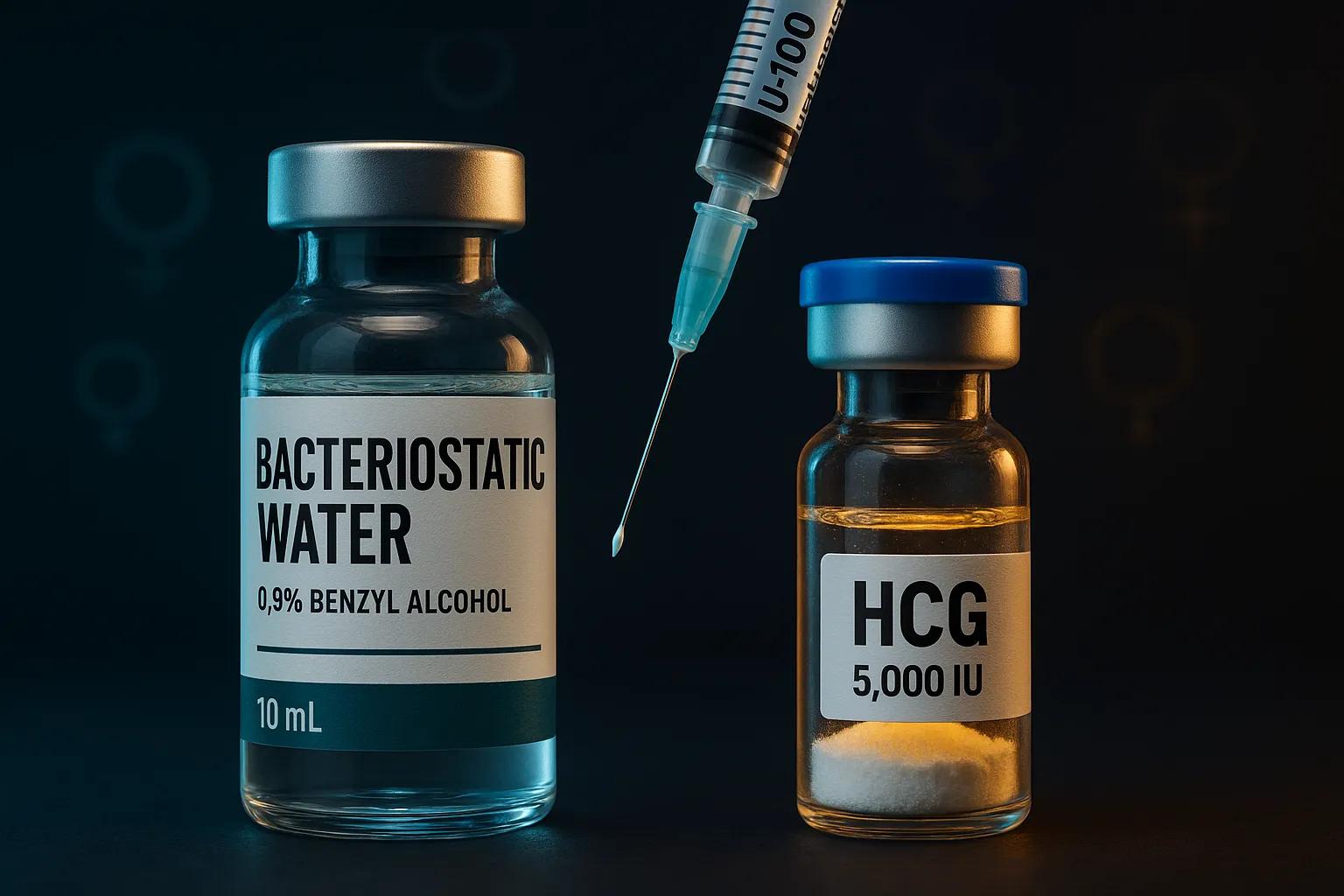
HCG (human chorionic gonadotropin) is one of the most commonly reconstituted injectable medications in the US, prescribed across fertility, TRT fertility preservation, and weight management protocols. The reconstitution process is the same as any lyophilized peptide — bacteriostatic water added to powder, swirled gently, refrigerated — but HCG carries a key distinction: it is an FDA-approved drug product with established prescribing information, not a research peptide.
Research-context information only. Bacteriostatic water for injection is an FDA-regulated injectable product. The information below reflects USP standards, manufacturer prescribing information, published trial protocols, and self-reported community sources. This article reports what has been documented, not what should be done. Consult a licensed physician for personal medical decisions.
The dose math below reports what prescribing documentation and community sources cite for the standard HCG vial sizes.
HCG vial sizes and reconstitution math
HCG is commonly available in two lyophilized vial sizes: 5,000 IU and 10,000 IU. Some compounding pharmacies produce 11,000 IU and other non-standard sizes. The reconstitution math follows the universal formula: IU in the vial divided by mL of bacteriostatic water added equals concentration in IU/mL.
5,000 IU vial
| Bac water added | Concentration | 250 IU dose | 500 IU dose | 1,000 IU dose |
|---|---|---|---|---|
| 1 mL | 5,000 IU/mL | 5 units | 10 units | 20 units |
| 2 mL | 2,500 IU/mL | 10 units | 20 units | 40 units |
| 5 mL | 1,000 IU/mL | 25 units | 50 units | 100 units |
Community sources most commonly cite 1 mL of bacteriostatic water for a 5,000 IU vial. The resulting 5,000 IU/mL concentration places the three most common dose steps (250 IU, 500 IU, 1,000 IU) on clean syringe marks at 5, 10, and 20 units respectively.
10,000 IU vial
| Bac water added | Concentration | 250 IU dose | 500 IU dose | 1,000 IU dose |
|---|---|---|---|---|
| 1 mL | 10,000 IU/mL | 2.5 units | 5 units | 10 units |
| 2 mL | 5,000 IU/mL | 5 units | 10 units | 20 units |
| 5 mL | 2,000 IU/mL | 12.5 units | 25 units | 50 units |
Community sources most commonly cite 2 mL of bacteriostatic water for a 10,000 IU vial — producing the same 5,000 IU/mL concentration as the 5,000 IU vial with 1 mL. This keeps the dose-per-unit math identical between vial sizes, which community sources describe as reducing the chance of dosing errors when switching between vial sizes.
Common HCG protocols and dose context
HCG appears in clinical documentation and prescribing information across several contexts. The dose ranges below reflect what prescribing information and clinical protocols document — not recommendations.
TRT fertility preservation
Clinical documentation describes HCG used alongside testosterone replacement therapy to maintain intratesticular testosterone and spermatogenesis. Prescribing documentation and community sources commonly cite:
- 250 IU every other day or three times per week — the most commonly cited maintenance dose in community TRT protocols
- 500 IU two to three times per week — cited in clinical protocols as a higher-end maintenance dose
- 1,000 IU two to three times per week — cited in some clinical fertility protocols and prescribing documentation for short-term use
Fertility protocols
Clinical fertility protocols documented in prescribing information describe HCG doses of 5,000-10,000 IU as a single injection for ovulation induction. These are single-use administrations rather than multi-dose cycles, and the reconstitution math is typically handled by the prescribing clinic.
Weight management (historical)
HCG was historically used in conjunction with very-low-calorie diets. The FDA has stated that HCG is not effective for weight loss and has required labeling to reflect this position. Community sources still cite historical HCG diet protocols, typically at 125-200 IU daily, but this use is not supported by prescribing information.
Reconstitution technique
The reconstitution sequence for HCG follows the same steps documented for peptide reconstitution generally:
- Alcohol swab both vial tops — HCG vial and bacteriostatic water vial — and allow to air-dry.
- Draw the target volume of bacteriostatic water with a fresh insulin syringe.
- Inject slowly against the vial wall, not directly onto the lyophilized powder.
- Swirl gently — never shake. HCG typically dissolves within 30-60 seconds into a clear solution.
- Refrigerate immediately at 2-8 degrees Celsius.
HCG reconstitutes more readily than many peptides — community sources describe it as dissolving almost immediately on contact with bacteriostatic water, often requiring minimal swirling.
Storage after reconstitution
Manufacturer prescribing information for HCG products generally describes refrigerated stability of 30-60 days after reconstitution with bacteriostatic water. USP guidance describes a 28-day multi-dose window for the bacteriostatic water itself. Community sources commonly cite 28-30 days as the practical window.
Key storage parameters from prescribing documentation:
- Temperature: 2-8 degrees Celsius (standard refrigerator)
- Light protection: HCG is documented as light-sensitive; storage in the original carton or an opaque container is cited in prescribing information
- Freeze avoidance: freezing reconstituted HCG is not documented as a validated storage method
- Aseptic technique: alcohol swab on the stopper before every draw; fresh syringe per administration
HCG vs. research peptides: what differs
The reconstitution chemistry is identical — bacteriostatic water dissolves lyophilized protein in both cases. The differences are regulatory and practical:
| Factor | HCG | Research peptides |
|---|---|---|
| FDA status | Approved drug product | Sold for research only |
| Prescription | Required | Not typically required |
| Source | Pharmacy or compounding pharmacy | Research peptide vendors |
| Dosing unit | International Units (IU) | Milligrams or micrograms |
| Prescribing info | FDA-approved labeling | Community documentation |
| Stability data | Manufacturer-validated | Community-reported |
The bacteriostatic water specification is the same regardless of what it reconstitutes: USP-grade, sterile, non-pyrogenic, 0.9% benzyl alcohol, glass multi-dose vial.
Bottom line
HCG reconstitution follows universal peptide math: IU divided by mL equals concentration. Community sources and prescribing documentation most commonly cite 1 mL of bacteriostatic water for a 5,000 IU vial (producing 5,000 IU/mL) and 2 mL for a 10,000 IU vial (producing the same 5,000 IU/mL). At that concentration, the 250 IU, 500 IU, and 1,000 IU dose steps documented in clinical protocols fall on the 5-unit, 10-unit, and 20-unit marks of a U-100 insulin syringe. Storage is documented at 2-8 degrees Celsius across the 28-30 day multi-dose window.
Related reading
- How Much Bac Water per Vial? Universal Charts — reconstitution math for every standard vial size
- What Is Bacteriostatic Water? Benzyl Alcohol + Uses — USP composition and preservation mechanism
- Bacteriostatic Water vs Sterile Water — why multi-dose protocols require the bacteriostatic version
- How Long Does Bacteriostatic Water Last? 28-Day Rule — the USP multi-dose window explained
- Insulin Syringe Units to mL Conversion — unit-to-volume mapping for accurate dosing
- TRT Catalog: HCG and Testosterone — HCG's role in TRT fertility preservation
This guide is for educational and informational purposes only. It is not medical advice. Bacteriostatic water for injection is a regulated injectable product subject to FDA labeling standards. As an affiliate partner, The Peptide Catalog may earn a commission on qualifying purchases at no extra cost to the reader. Bacteriostatic water is sold for research and professional use only.