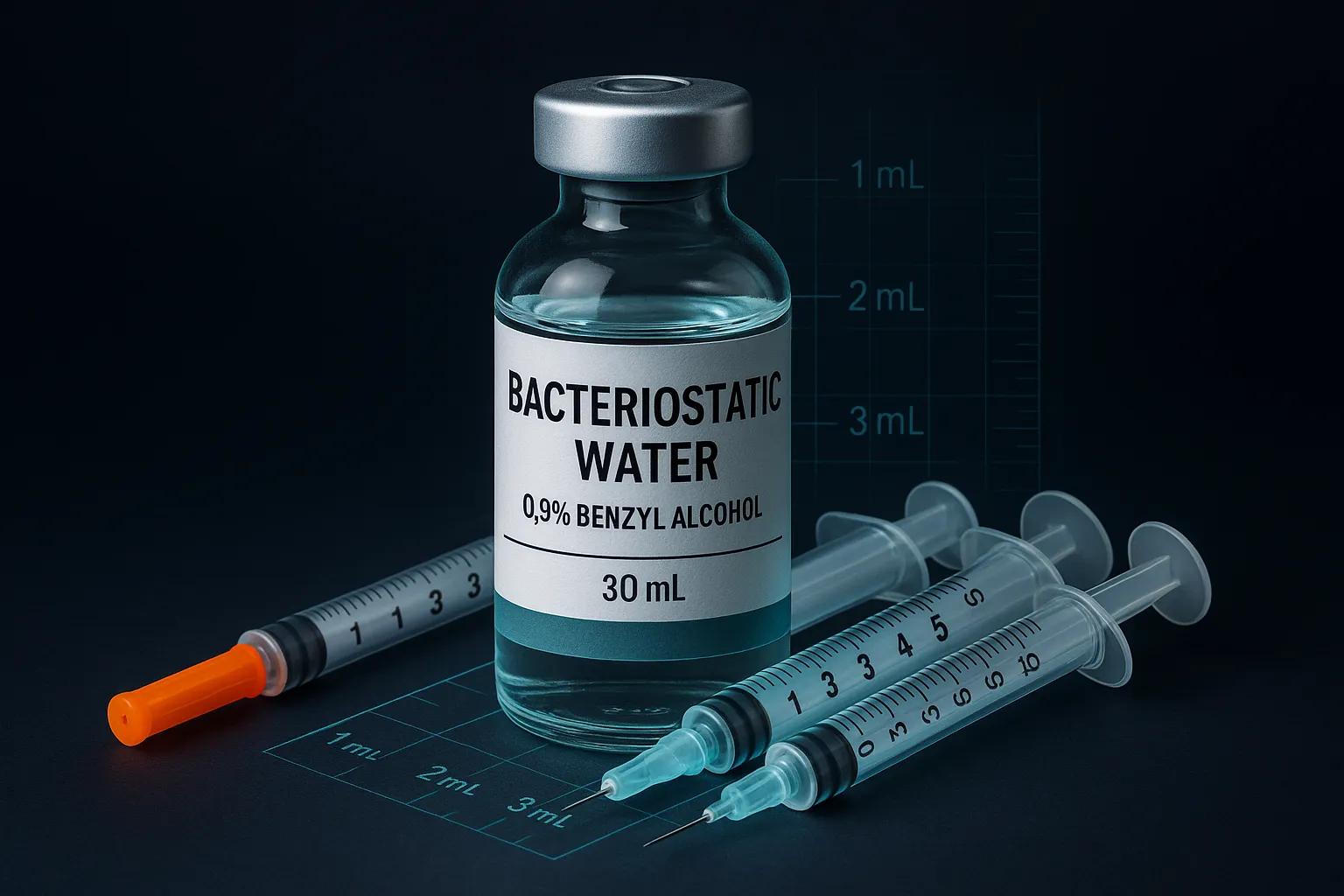
The universal reconstitution question — how much bacteriostatic water to add to a peptide vial — reduces to a single calculation: milligrams of peptide divided by milliliters of water equals concentration in mg/mL. The concentration determines how many units on an insulin syringe correspond to each dose step.
Research-context information only. Bacteriostatic water for injection is an FDA-regulated injectable product. The information below reflects USP standards, manufacturer prescribing information, published trial protocols, and self-reported community sources. This article reports what has been documented, not what should be done. Consult a licensed physician for personal medical decisions.
Community sources consistently cite round-number concentrations as the most important practical safeguard — simpler math means fewer dosing errors. The tables below report the ratios documented across community reconstitution sheets for each common vial size.
The core math
The formula is the same for every peptide:
Concentration (mg/mL) = Peptide amount (mg) / Bacteriostatic water added (mL)
On a U-100 insulin syringe, 100 units = 1 mL. So each unit = 0.01 mL. The dose per unit is:
Dose per unit = Concentration (mg/mL) x 0.01 mL
Or equivalently: Dose per 10 units = Concentration (mg/mL) x 0.1 mL
This math is universal. The peptide identity, the vial size, and the dose target do not change the formula — they change the inputs.
Universal reconstitution chart
The table below reports the most commonly cited bac water amounts for each standard vial size, the resulting concentration, and the dose per 10 units on a U-100 insulin syringe.
| Vial size | Bac water added | Concentration | Dose per 10 units | Common peptides at this size |
|---|---|---|---|---|
| 2 mg | 1 mL | 2 mg/mL | 0.2 mg (200 mcg) | PT-141, some BPC-157 |
| 2 mg | 2 mL | 1 mg/mL | 0.1 mg (100 mcg) | PT-141 (wider dose range) |
| 5 mg | 1 mL | 5 mg/mL | 0.5 mg (500 mcg) | BPC-157, TB-500, Selank, Semax |
| 5 mg | 2 mL | 2.5 mg/mL | 0.25 mg (250 mcg) | Semaglutide, GHK-Cu |
| 10 mg | 2 mL | 5 mg/mL | 0.5 mg (500 mcg) | TB-500, BPC-157, tirzepatide |
| 10 mg | 4 mL | 2.5 mg/mL | 0.25 mg (250 mcg) | Semaglutide (10mg vial) |
| 15 mg | 3 mL | 5 mg/mL | 0.5 mg (500 mcg) | Semaglutide (15mg vial) |
| 15 mg | 6 mL | 2.5 mg/mL | 0.25 mg (250 mcg) | Semaglutide (wider range) |
| 20 mg | 4 mL | 5 mg/mL | 0.5 mg (500 mcg) | Retatrutide |
| 20 mg | 2 mL | 10 mg/mL | 1.0 mg (1000 mcg) | Retatrutide (compact volume) |
Two concentration targets dominate community documentation: 2.5 mg/mL and 5 mg/mL. The choice between them depends on the dose range of the specific peptide being reconstituted.
Choosing the right ratio
When 5 mg/mL is commonly cited
Peptides dosed in the 250-500 mcg range per injection — BPC-157, TB-500, Selank, Semax — are commonly reconstituted at 5 mg/mL. At this concentration, the 250 mcg dose falls on the 5-unit mark and the 500 mcg dose falls on the 10-unit mark. Injection volumes stay small (0.05-0.1 mL), which community sources describe as more comfortable for subcutaneous delivery.
When 2.5 mg/mL is commonly cited
Peptides with wider dose ranges — semaglutide (0.25 mg to 2.4 mg), tirzepatide (2.5 mg to 15 mg), retatrutide — are commonly reconstituted at 2.5 mg/mL. The lower concentration spreads the dose range across more syringe units, giving finer control during titration. At 2.5 mg/mL, each 10-unit mark is 0.25 mg, and the full 100-unit syringe covers 2.5 mg.
When 10 mg/mL appears
Higher concentrations (10 mg/mL) appear in community sources for peptides with large per-dose amounts or when minimizing injection volume is a priority. Retatrutide at 20mg vials reconstituted with 2 mL produces 10 mg/mL. This works when the dose range is narrow and lands on convenient unit marks, but community sources note that measurement errors at high concentrations have proportionally larger consequences.
Reading the insulin syringe
A U-100 insulin syringe has 100 units representing 1 mL total volume. The relationship between units, volume, and dose:
| Units drawn | Volume (mL) | Dose at 2.5 mg/mL | Dose at 5 mg/mL | Dose at 10 mg/mL |
|---|---|---|---|---|
| 5 units | 0.05 mL | 0.125 mg | 0.25 mg | 0.5 mg |
| 10 units | 0.10 mL | 0.25 mg | 0.5 mg | 1.0 mg |
| 20 units | 0.20 mL | 0.5 mg | 1.0 mg | 2.0 mg |
| 40 units | 0.40 mL | 1.0 mg | 2.0 mg | 4.0 mg |
| 50 units | 0.50 mL | 1.25 mg | 2.5 mg | 5.0 mg |
| 100 units | 1.00 mL | 2.5 mg | 5.0 mg | 10.0 mg |
Community sources consistently cite this table — or a version of it — as the essential reference for translating reconstitution math into syringe draws.
For peptide-specific reconstitution math, the reconstitution calculator automates the conversion for any vial size and water volume combination.
The golden rule: simpler math, fewer errors
Community sources across forums, vendor documentation, and reconstitution guides converge on a single principle: choose the bac water volume that produces the simplest dose-to-syringe-unit math. A concentration where the target dose falls on a round syringe mark eliminates the mental arithmetic that produces dosing errors.
The practical consequence: when in doubt, community sources cite using more bac water rather than less. A slightly larger injection volume is a smaller problem than a dosing miscalculation from awkward concentration math.
Bottom line
Reconstitution math is universal: peptide milligrams divided by bac water milliliters equals concentration. The two dominant community concentrations are 2.5 mg/mL (for peptides with wide dose ranges) and 5 mg/mL (for peptides dosed in the 250-500 mcg range). Round-number concentrations that map cleanly onto insulin syringe unit marks are what community sources cite as the most important practical safeguard against dosing errors.
Related reading
- Insulin Syringe Units to mL Conversion — the unit-to-volume relationship explained
- What Is Bacteriostatic Water? Benzyl Alcohol + Uses — composition, USP specs, and preservation mechanism
- Bacteriostatic Water vs Sterile Water — why multi-dose vials require the bacteriostatic version
- How Long Does Bacteriostatic Water Last? 28-Day Rule — storage window after first puncture
This guide is for educational and informational purposes only. It is not medical advice. Bacteriostatic water for injection is a regulated injectable product subject to FDA labeling standards. As an affiliate partner, The Peptide Catalog may earn a commission on qualifying purchases at no extra cost to the reader. Bacteriostatic water is sold for research and professional use only.