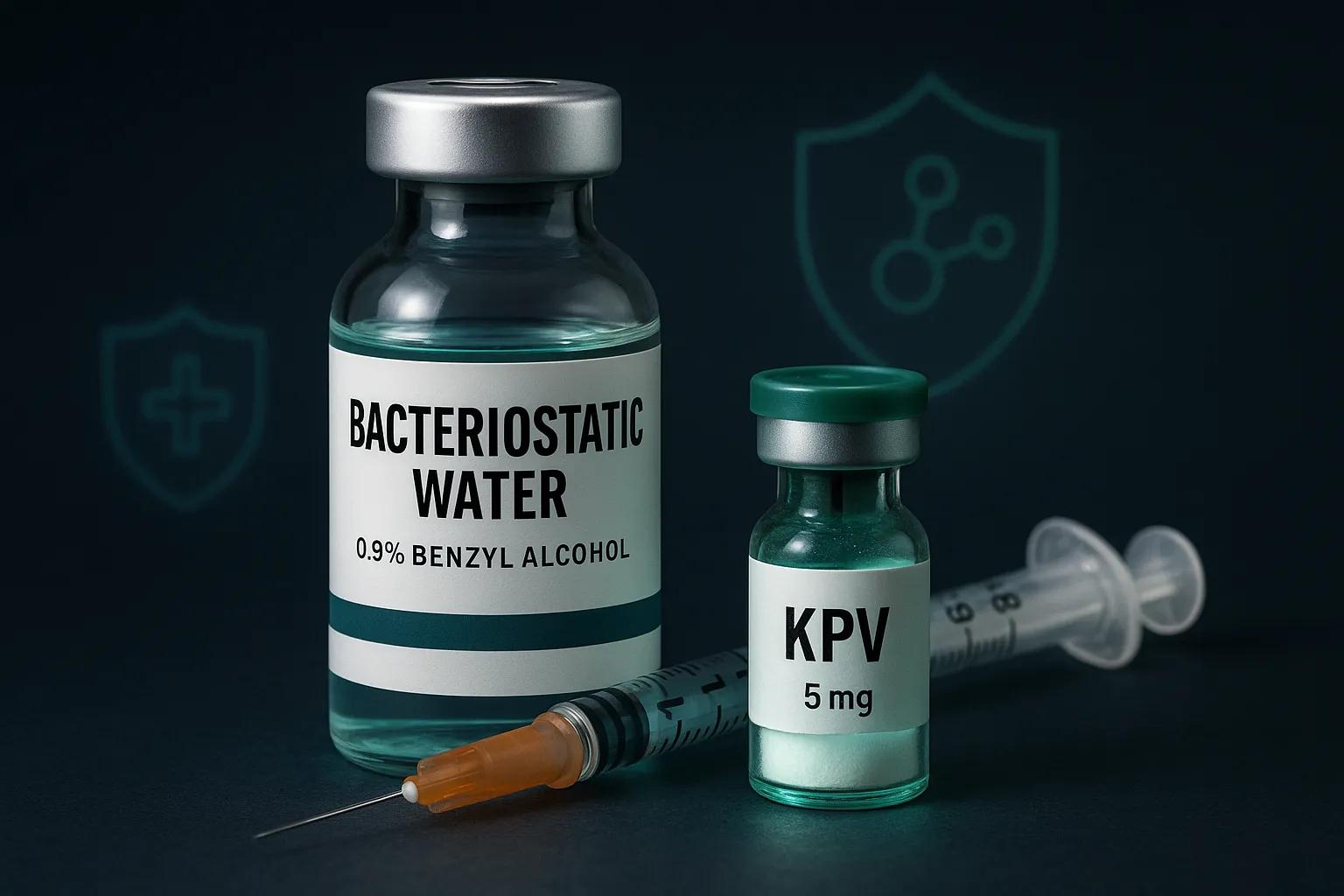
KPV is a tripeptide (Lys-Pro-Val) derived from the C-terminal fragment of alpha-melanocyte-stimulating hormone (alpha-MSH). It is one of the smallest research peptides available at approximately 342 Da molecular weight, which gives it a practical reconstitution advantage: it dissolves in bacteriostatic water almost immediately. Community sources cite KPV primarily in anti-inflammatory protocols, and it is one of four components in the KLOW blend alongside BPC-157, TB-500, and GHK-Cu.
Research-context information only. KPV is a research chemical without FDA approval as a finished pharmaceutical product. The reconstitution math reflects vendor documentation and community-reported protocols. Research and community sources describe anti-inflammatory and melanocortin-pathway applications; outcome claims are not supported by FDA-approved indications. This article reports what has been documented, not what should be done. Consult a licensed physician for personal medical decisions.
KPV vial sizes
KPV is most commonly packaged in 5mg or 10mg lyophilized vials in the research peptide market. Both formats are small by total mass — reflecting the microgram-scale dose ranges community sources cite for this peptide (typically 200-500 mcg per administration).
The lyophilized peptide appears as a small white or off-white powder or cake inside the vial. Because of KPV's low molecular weight (approximately 342 Da), the lyophilized amount is physically smaller than what most users expect — a 5mg KPV vial may appear nearly empty compared to a 5mg vial of a larger peptide.
Reconstitution math — 5mg KPV vial
Community sources and vendor reconstitution sheets commonly cite 1 mL of bacteriostatic water for a 5mg KPV vial. That produces a concentration of 5 mg/mL (5000 mcg/mL).
| U-100 Syringe Units | Volume (mL) | KPV Amount (mcg) |
|---|---|---|
| 4 units | 0.04 mL | 200 mcg |
| 5 units | 0.05 mL | 250 mcg |
| 6 units | 0.06 mL | 300 mcg |
| 8 units | 0.08 mL | 400 mcg |
| 10 units | 0.10 mL | 500 mcg |
| 20 units | 0.20 mL | 1000 mcg |
The 200-500 mcg dose steps documented across community protocols land within the 4-unit to 10-unit range — small, precise draws on a U-100 insulin syringe. At this concentration, a single 5mg vial contains 10 doses at 500 mcg or up to 25 doses at 200 mcg.
Some vendor sheets cite 2 mL of bacteriostatic water for the same 5mg vial, producing 2.5 mg/mL (2500 mcg/mL). On that concentration, each 10-unit mark corresponds to 250 mcg — the commonly cited lower dose step lands cleanly on the 10-unit mark. The trade-off is a larger injection volume per dose.
| U-100 Syringe Units | Volume (mL) | KPV Amount (mcg) at 2.5 mg/mL |
|---|---|---|
| 8 units | 0.08 mL | 200 mcg |
| 10 units | 0.10 mL | 250 mcg |
| 12 units | 0.12 mL | 300 mcg |
| 16 units | 0.16 mL | 400 mcg |
| 20 units | 0.20 mL | 500 mcg |
Reconstitution math — 10mg KPV vial
Community sources commonly cite 2 mL of bacteriostatic water for a 10mg KPV vial. That produces a concentration of 5 mg/mL — matching the 5mg-vial standard concentration. The dose-per-unit math is identical to the table above: 500 mcg per 10-unit mark on a U-100 insulin syringe.
Alternative documentation cites 1 mL of bacteriostatic water for the same 10mg vial, producing 10 mg/mL. On that concentration, each 10-unit mark corresponds to 1 mg (1000 mcg). Community sources note that this higher concentration is workable because KPV doses are small — a 500 mcg dose is only 5 units on the syringe. The trade-off is that small volume errors translate to larger dose errors at higher concentrations.
| U-100 Syringe Units | Volume (mL) | KPV Amount (mcg) at 5 mg/mL | KPV Amount (mcg) at 10 mg/mL |
|---|---|---|---|
| 2 units | 0.02 mL | 100 mcg | 200 mcg |
| 4 units | 0.04 mL | 200 mcg | 400 mcg |
| 5 units | 0.05 mL | 250 mcg | 500 mcg |
| 10 units | 0.10 mL | 500 mcg | 1000 mcg |
| 20 units | 0.20 mL | 1000 mcg | 2000 mcg |
The 5 mg/mL concentration (2 mL into a 10mg vial) is the more commonly cited choice because it matches the 5mg-vial concentration and keeps the dose-per-unit math consistent across vial sizes.
KPV's rapid dissolution
KPV dissolves notably faster than most research peptides. The tripeptide's molecular weight of approximately 342 Da places it among the smallest peptides in community use — for comparison, BPC-157 is approximately 1419 Da and TB-500 is approximately 4963 Da.
Community sources describe the reconstitution process as nearly instantaneous: adding bacteriostatic water to the vial and gentle swirling typically produces a clear, colorless solution within seconds. Vendor documentation corroborates this observation. There is no need for extended swirling or waiting.
If the peptide does not dissolve within a minute of gentle swirling, community sources cite this as unusual for KPV and suggest checking that the bacteriostatic water is USP-grade and that the vial has been stored properly.
KPV in the KLOW blend
KPV is one of four peptides in the KLOW blend — a combined-vial format packaged by some vendors containing KPV, BPC-157, TB-500, and GHK-Cu. The blend name references the four components. Community sources describe KPV's role in the blend as the anti-inflammatory melanocortin-pathway component, complementing the tissue-repair properties of BPC-157 and TB-500 and the collagen-signaling properties of GHK-Cu.
The reconstitution math for a KLOW blend vial follows the same logic as any combined-vial format: bacteriostatic water dissolves all four peptides simultaneously, and each peptide's concentration depends on its individual amount in the vial and the total water volume added. The per-peptide dose math must be calculated independently based on the vendor's label listing each component amount.
Storage and stability
Bacteriostatic water itself carries a 28-day multi-dose window under USP guidance with aseptic technique. Community sources and vendor documentation commonly cite KPV as stable within that window when stored properly:
- Refrigerated storage at 2-8°C after reconstitution
- Shielding from light — amber vials or opaque storage container
- Avoiding repeated temperature cycling — keeping the vial in consistent cold storage rather than removing it for room-temperature periods
- Finishing the reconstituted vial within 28 days — aligning with the bacteriostatic water window
KPV's small tripeptide structure is described in community sources as contributing to reasonable stability after reconstitution. Lyophilized (unreconstituted) KPV vials are typically cited as stable for extended periods at freezer temperatures (-20°C or below).
Common mistakes (community reports)
Community sources and vendor support documentation commonly cite a handful of recurring reconstitution mistakes that apply to KPV:
- Adding bacteriostatic water too forcefully — directing the stream at the lyophilized peptide rather than the vial wall. Community sources cite slow injection down the vial wall as the standard technique, though KPV's small size and rapid dissolution make it less sensitive to this than larger peptides.
- Using too little bac water for the vial size — reconstituting a 10mg vial with 0.5 mL produces 20 mg/mL, where dose-per-unit errors become significant. Community sources cite using enough water to keep concentrations in the 2.5-5 mg/mL range.
- Leaving the reconstituted vial at room temperature — community sources cite immediate refrigeration after reconstitution as the standard.
- Using cloudy bacteriostatic water — cloudy water is reported as a quality signal that the bacteriostatic water itself may be off-spec. Community sources cite clear, colorless water as the standard appearance.
Common questions
The FAQ at the top of this article covers vial-size reconstitution math, KPV's rapid dissolution, the KLOW blend, reconstituted stability, and nasal/oral route reconstitution.
Bottom line
KPV reconstitutes with bacteriostatic water using vendor-documented and community-cited ratios that depend on vial size and concentration preference. The 5 mg/mL concentration produced by 1 mL into a 5mg vial (or 2 mL into a 10mg vial) is the most commonly cited because it places the 200-500 mcg dose steps documented in community protocols within the 4-unit to 10-unit range on a U-100 insulin syringe. KPV's low molecular weight (approximately 342 Da) means it dissolves almost immediately — faster than most research peptides. Refrigerate at 2-8°C after reconstitution and finish the vial within 28 days.
Related reading
- KPV Buying Guide — vendor comparison, COA verification, and current pricing on thepeptidecatalog
- What Is Bacteriostatic Water? Benzyl Alcohol + Uses (2026) — definition, USP standards, benzyl alcohol mechanism
- How Long Does Bacteriostatic Water Last? 28-Day Rule (2026) — the post-puncture window and storage variables
- How Much Bac Water per Vial? Universal Charts (2026) — universal reconstitution math for any peptide vial size
- Insulin Syringe Units to mL Conversion (2026) — the unit-to-volume relationship explained
- Bac Water for BPC-157 + TB-500 (Wolverine Stack, 2026) — healing-peptide reconstitution math for two KLOW blend components
This guide is for educational and informational purposes only. It is not medical advice. Bacteriostatic water for injection is a regulated injectable product subject to FDA labeling standards. As an affiliate partner, The Peptide Catalog may earn a commission on qualifying purchases at no extra cost to the reader. Bacteriostatic water is sold for research and professional use only.