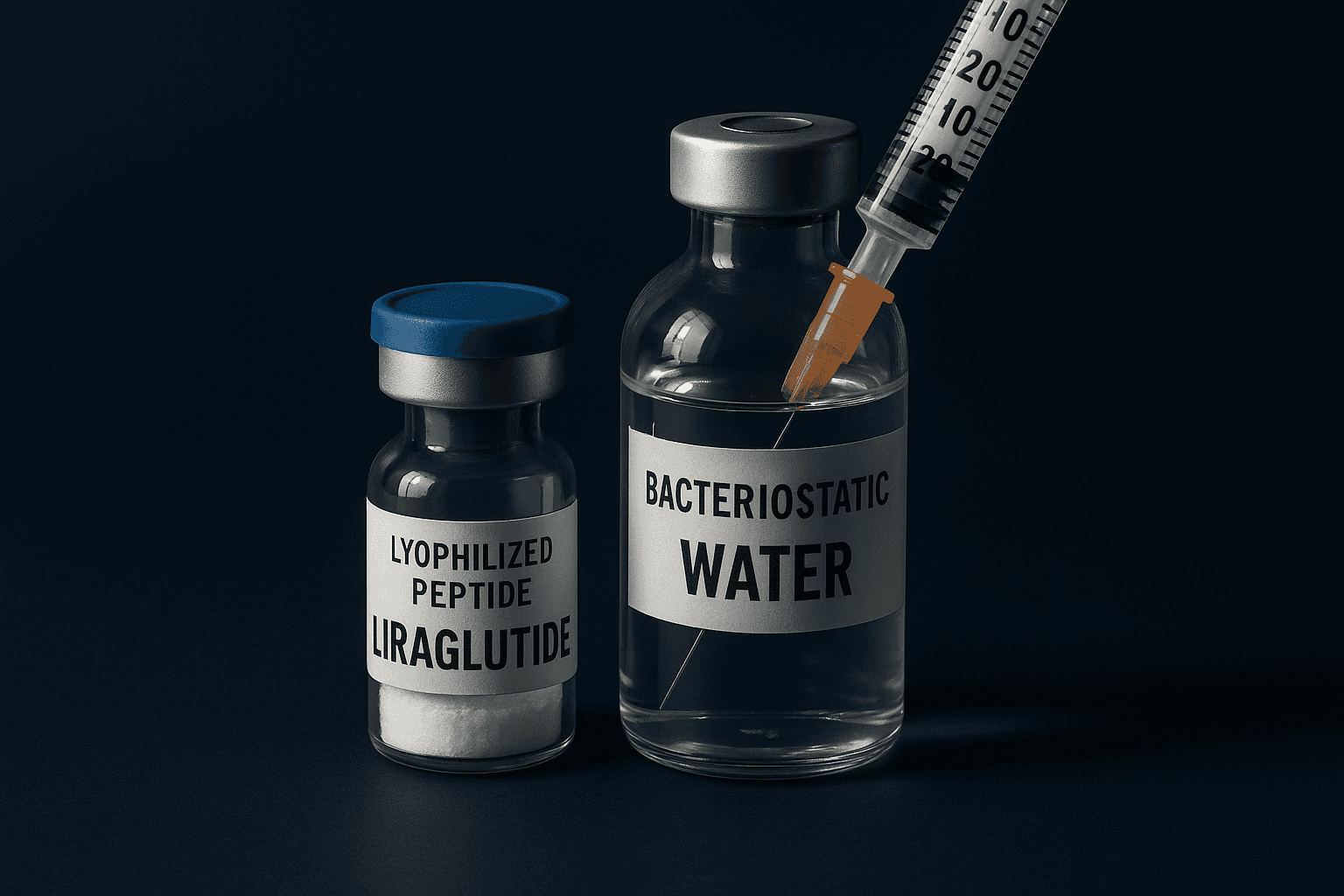
A 3mg liraglutide vial reconstituted with 1 mL of bacteriostatic water yields a 3 mg/mL solution — the ratio that maps the documented 0.6 mg through 3 mg daily titration range onto a U-100 insulin syringe within a single 100-unit draw. Larger 5mg vials appear in community vendor documentation with proportional reconstitution volumes.
Research-context information only. Liraglutide is the active ingredient in FDA-approved products for type 2 diabetes and chronic weight management; research-peptide and compounded forms are not FDA-approved and are sold for research purposes only. Protocols, doses, and reactions reported below come from clinical trials and self-reported community sources. This article reports what has been documented, not what should be done. Consult a licensed physician for personal medical decisions.
Liraglutide differs from the other GLP-1 receptor agonists in the reconstitution context in one critical way: it is dosed daily rather than weekly. That daily dosing schedule changes the vial-consumption math and the practical economics of reconstitution compared to weekly peptides like semaglutide and tirzepatide.
How much bacteriostatic water for liraglutide
Research-format liraglutide is sold in lyophilized vials. Community vendor documentation describes 3mg and 5mg vials as the most common formats.
The table below reports the concentrations community sources most commonly cite for each documented vial size.
| Vial size | Bacteriostatic water added | Final concentration | U-100 syringe: units per 0.6 mg | Notes from community sources |
|---|---|---|---|---|
| 3 mg | 1 mL | 3 mg/mL | 20 units | Full 0.6-3 mg titration fits within 100 units; most-cited ratio |
| 5 mg | 1 mL | 5 mg/mL | 12 units | Concentrated; smaller injection volumes at higher doses |
| 5 mg | 2 mL | 2.5 mg/mL | 24 units | Lower concentration; finer per-unit dosing at lower titration steps |
At 3 mg/mL on a U-100 insulin syringe, each 10-unit mark corresponds to 0.3 mg. The documented titration steps map as follows:
| Titration step | Dose | Units on U-100 syringe (at 3 mg/mL) |
|---|---|---|
| Week 1 | 0.6 mg | 20 units |
| Week 2 | 1.2 mg | 40 units |
| Week 3 | 1.8 mg | 60 units |
| Week 4 | 2.4 mg | 80 units |
| Week 5+ | 3 mg | 100 units |
Community sources cite 3 mg/mL as the most practical concentration because the full titration range — from starting dose to target dose — fits within a single 100-unit insulin syringe draw. No dose step exceeds 100 units, which means no draw requires a larger syringe or multiple pulls.
Daily dosing and vial consumption
Liraglutide's daily administration schedule is the practical distinction from weekly GLP-1 agonists like semaglutide and tirzepatide. A reconstituted vial is accessed every day rather than once per week, which changes both the vial-consumption timeline and the number of punctures the rubber stopper accumulates.
Vial consumption at each titration step (3mg vial at 3 mg/mL):
| Titration step | Daily dose | Days per 3mg vial |
|---|---|---|
| 0.6 mg (week 1) | 0.6 mg | 5 days |
| 1.2 mg (week 2) | 1.2 mg | 2.5 days |
| 1.8 mg (week 3) | 1.8 mg | 1.67 days |
| 2.4 mg (week 4) | 2.4 mg | 1.25 days |
| 3 mg (week 5+) | 3 mg | 1 day |
At the 3 mg target dose, a single 3mg vial is consumed in one day. Community sources describe this consumption rate as the reason 5mg vials or multi-vial procurement is the documented approach for sustained protocols — a 3mg vial at the target dose does not span multiple days.
5mg vial consumption at target dose (5 mg/mL concentration):
At 3 mg daily, a 5mg vial lasts approximately 1.67 days — still consumed within the 28-day bacteriostatic water window by a wide margin. The daily-dosing schedule means the multi-dose window is rarely the limiting factor for liraglutide; vial contents are consumed well before the 28-day clock expires.
Step-by-step reconstitution as documented in community sources
The reconstitution sequence for liraglutide follows the same pattern documented for other lyophilized peptides. Community reconstitution sheets and vendor instruction inserts describe the steps below. This is not an instruction set.
- Surface preparation. Both vial tops — liraglutide and bacteriostatic water — are wiped with separate alcohol swabs and allowed to air-dry. Community sources commonly cite 10-30 seconds of dry time.
- Bacteriostatic water draw. A fresh U-100 insulin syringe is used to draw the documented water volume (1 mL for a 3mg vial at the 3 mg/mL target).
- Water injection at the vial wall. The needle is inserted into the liraglutide vial at an angle aimed at the glass wall — not directly at the lyophilized powder. Community sources cite the side-wall approach as the standard practice.
- Gentle dissolution. The vial is swirled slowly rather than shaken. Liraglutide typically dissolves within 1-3 minutes into a clear, colorless solution. Community sources and vendor documentation note that liraglutide may take slightly longer to dissolve than some smaller peptides.
- Refrigerated storage. The reconstituted vial is moved to refrigeration at 2-8°C immediately after reconstitution.
Storage after reconstitution
USP guidance describes a 28-day multi-dose window for bacteriostatic water under aseptic technique. Community sources commonly cite the same window for reconstituted liraglutide held continuously refrigerated at 2-8°C.
The practical storage window for liraglutide is driven more by vial consumption rate than by the 28-day limit. At the 3 mg target dose, a 3mg vial is consumed in one day and a 5mg vial in less than two days. Even at the 0.6 mg starting dose, a 3mg vial lasts five days. The 28-day window is rarely approached.
Storage conditions community sources consistently cite:
- Temperature: 2-8°C (refrigerator, not freezer)
- Light: protected from direct light
- Aseptic technique: alcohol swab on the stopper before every puncture; fresh insulin syringe per draw
Detailed storage guidance — including room temperature vs refrigerated, light protection, and travel storage — is covered in the bacteriostatic water storage guide.
Common mistakes community sources cite
Community reconstitution reports and vendor support documentation describe a handful of recurring handling failures specific to liraglutide:
- Starting at the target dose without titration. Community sources commonly cite skipping the titration schedule as the most frequent source of severe nausea reports. The documented titration protocol — 0.6 mg for the first week, escalating weekly — exists in clinical trial documentation specifically to manage gastrointestinal tolerance.
- Under-estimating vial consumption rate. Because liraglutide is dosed daily at relatively high per-dose amounts, community sources describe running out of reconstituted peptide mid-titration as a common planning failure. A single 3mg vial at the 1.8 mg dose step lasts less than two days.
- Confusing liraglutide dosing with semaglutide dosing. Community sources cite this as a recurring error — researchers familiar with semaglutide's weekly 0.25-2.4 mg dose range sometimes apply the same numbers to liraglutide without adjusting for daily vs weekly administration. Liraglutide's 0.6-3 mg range is daily, not weekly; the total weekly peptide consumption is substantially higher.
- Shaking the vial instead of swirling. The same mechanical-denaturation risk documented for all lyophilized peptides. Gentle swirling is the documented reconstitution technique.
- Using non-USP bacteriostatic water. Community sources cite the same cloudy-vial outcomes for liraglutide as for other peptides when reconstituted with unverified bac water.
Common questions
The FAQ at the top of this article covers vial-size reconstitution math, the titration schedule, the daily vs weekly dosing distinction, and the storage window.
Bottom line
The most-cited reconstitution ratio for research-format liraglutide is 1 mL of bacteriostatic water per 3mg vial, producing a 3 mg/mL concentration that maps the documented 0.6-3 mg daily titration range onto a U-100 insulin syringe within 100 units. The daily dosing schedule means vial consumption is rapid — a 3mg vial at target dose lasts one day — and vial-count planning is more critical than for weekly peptides. Storage is documented at 2-8°C across the 28-day multi-dose window described by USP guidance, though the consumption rate typically resolves the vial well before the window expires.
Related reading
- Buying Liraglutide: Vendor Comparison + COA Checks (2026) — vendor comparison, COA verification, and current pricing on thepeptidecatalog
- What Is Bacteriostatic Water? Benzyl Alcohol + Uses (2026) — composition, benzyl alcohol mechanism, and USP-grade specifications
- How Long Does Bacteriostatic Water Last? 28-Day Rule (2026) — what the USP guidance actually says and where community sources track it
- Bacteriostatic Water vs Sterile Water: Which to Use (2026) — why the 28-day window matters for daily-dose peptides especially
- How Much Bacteriostatic Water for Semaglutide (2026) — sibling GLP-1 reconstitution math for comparison
- How Much Bacteriostatic Water for Tirzepatide (2026) — dual-agonist GLP-1/GIP reconstitution math
- How to Store Bacteriostatic Water (Pre + Post Puncture) — full storage reference including travel and light exposure