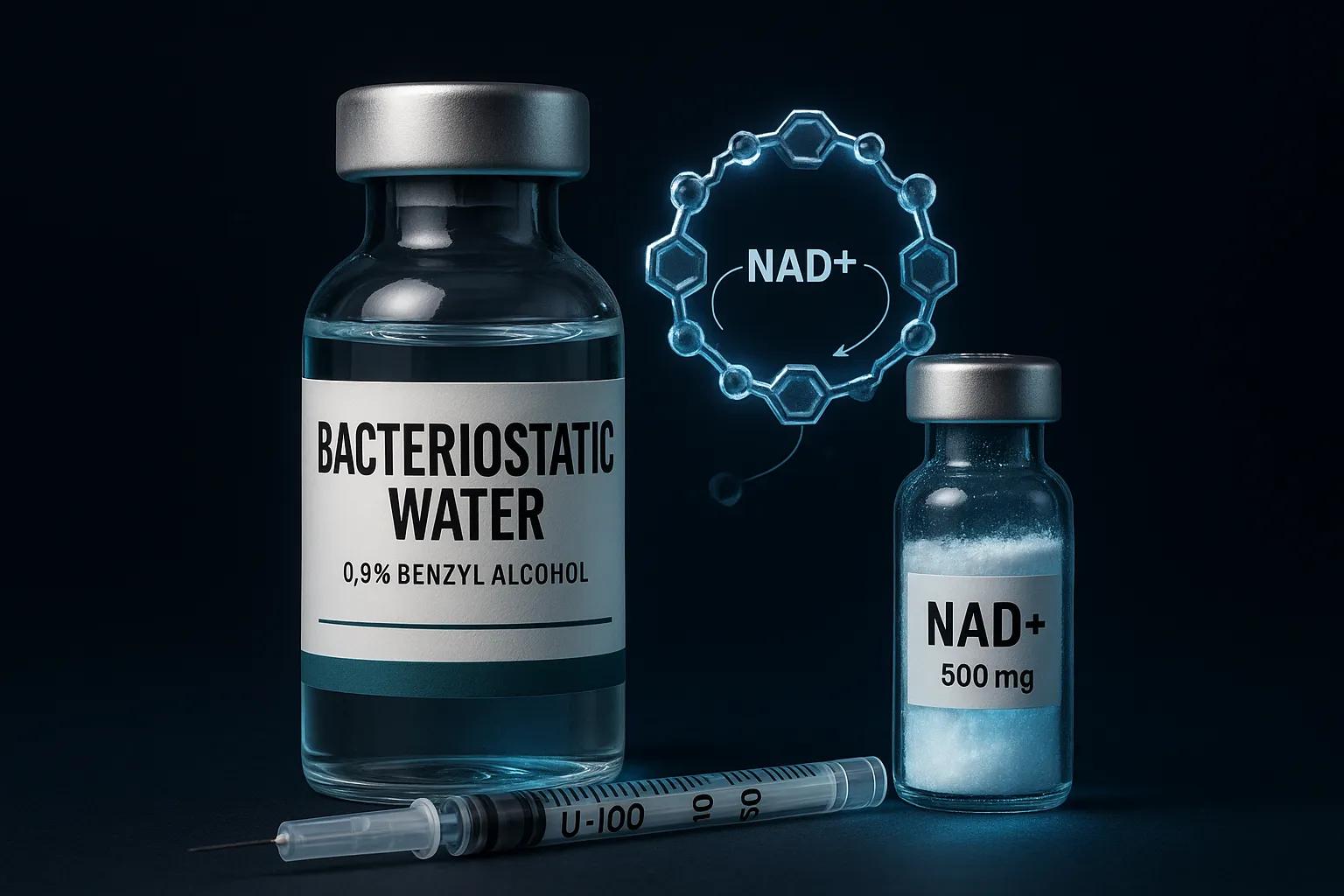
NAD+ (nicotinamide adenine dinucleotide) is one of the most straightforward compounds to reconstitute — highly water-soluble, dissolves almost immediately, and available in standardized lyophilized vial sizes. Community sources describe it as the easiest reconstitution in the peptide and research-compound space.
Research-context information only. Bacteriostatic water for injection is an FDA-regulated injectable product. The information below reflects USP standards, manufacturer prescribing information, published trial protocols, and self-reported community sources. This article reports what has been documented, not what should be done. Consult a licensed physician for personal medical decisions.
The dose math below reports what vendor documentation and community sources cite for the standard NAD+ vial sizes.
NAD+ vial sizes and reconstitution math
Research-format NAD+ is commonly available in 100mg, 250mg, and 500mg lyophilized vials. The reconstitution math follows the universal formula: milligrams divided by milliliters equals concentration in mg/mL. NAD+ doses are significantly larger than most peptide doses (50-500 mg vs. 0.25-2.5 mg for typical peptides), which affects the bac water ratios.
100mg vial
| Bac water added | Concentration | 50 mg dose | 100 mg dose |
|---|---|---|---|
| 1 mL | 100 mg/mL | 50 units | 100 units (full syringe) |
| 2 mL | 50 mg/mL | 10 units | 20 units |
Community sources most commonly cite 1 mL of bacteriostatic water for a 100mg vial, producing 100 mg/mL. At this concentration, the 50 mg dose step falls on the 50-unit mark and the full 100 mg vial content is drawn at 100 units (full syringe). Some community sources cite 2 mL for a lower concentration that provides more precision on smaller doses.
250mg vial
| Bac water added | Concentration | 50 mg dose | 100 mg dose | 250 mg dose |
|---|---|---|---|---|
| 2.5 mL | 100 mg/mL | 5 units | 10 units | 25 units |
| 5 mL | 50 mg/mL | 10 units | 20 units | 50 units |
The 250mg vial is the most commonly cited size in community protocols. At 100 mg/mL (2.5 mL of bac water), the full dose range from 50 mg to 250 mg fits within a single U-100 insulin syringe. At 50 mg/mL (5 mL of bac water), the syringe marks spread further apart, giving more precision but requiring a larger draw for higher doses.
500mg vial
| Bac water added | Concentration | 100 mg dose | 250 mg dose | 500 mg dose |
|---|---|---|---|---|
| 5 mL | 100 mg/mL | 10 units | 25 units | 50 units |
| 10 mL | 50 mg/mL | 20 units | 50 units | 100 units |
Community sources most commonly cite 5 mL of bacteriostatic water for a 500mg vial, maintaining the 100 mg/mL standard concentration. The 500mg vial at this concentration provides enough volume for multiple doses across the 28-day multi-dose window.
Why NAD+ reconstitution is simpler than peptides
Community sources consistently describe NAD+ reconstitution as more forgiving than peptide reconstitution for several documented reasons:
- High solubility. NAD+ is a small, hydrophilic molecule (molecular weight ~663 Da) compared to peptides like semaglutide (~4,114 Da) or BPC-157 (~1,419 Da). It dissolves almost instantly in bacteriostatic water without extended swirling.
- Structural stability. NAD+ is not a peptide — it is a dinucleotide coenzyme. It does not have the tertiary protein structure that makes peptides vulnerable to denaturation from shaking or mechanical force. While gentle handling is still good practice, NAD+ is less susceptible to the mechanical damage that community sources cite as a common peptide reconstitution failure.
- pH tolerance. NAD+ is stable across a wider pH range than most peptides, making it less sensitive to variations in bacteriostatic water pH within the USP-specified 4.5-7.0 range.
- Visual clarity. Reconstituted NAD+ is consistently described as clear and colorless. Any cloudiness or particulate formation is a clearer discard signal than with some peptides that may exhibit slight turbidity during dissolution.
Reconstitution steps
The technique follows the same general sequence documented for peptide reconstitution, with the recognition that NAD+ is more tolerant of handling variation:
- Alcohol swab both vial tops — NAD+ vial and bacteriostatic water vial — and allow to air-dry.
- Draw the target volume of bacteriostatic water with a fresh insulin syringe (or a larger syringe for volumes above 1 mL).
- Inject against the vial wall. NAD+ is less susceptible to direct-stream damage than peptides, but the wall-injection technique is standard practice.
- Observe dissolution. Community sources describe NAD+ as dissolving within seconds. Gentle swirling may not even be necessary for most vials.
- Refrigerate at 2-8 degrees Celsius.
For volumes above 1 mL, a 3 mL syringe is commonly used for the initial reconstitution draw (bacteriostatic water into the NAD+ vial), with U-100 insulin syringes used for subsequent dose draws.
Storage after reconstitution
Community sources and vendor documentation cite the same storage parameters as other reconstituted compounds:
- Temperature: 2-8 degrees Celsius (standard refrigerator)
- Light: protected from direct light
- Multi-dose window: 28 days per USP guidance for bacteriostatic water
- Aseptic technique: alcohol swab on the stopper before every draw; fresh syringe per dose
NAD+ stability after reconstitution is consistently described in community sources as comparable to or better than most peptides. The 28-day window is typically the limiting factor — the bacteriostatic water preservative window, not NAD+ molecular degradation.
SubQ injection context
Community sources document subcutaneous injection as the primary self-administration route for NAD+. Key context from community documentation:
- Injection volume. At 100 mg/mL, a 100 mg dose is 0.1 mL (10 units) — a small, comfortable SubQ volume. A 250 mg dose is 0.25 mL (25 units) — still within comfortable SubQ range. Doses above 500 mg at 100 mg/mL start to produce injection volumes (0.5 mL+) that some community sources describe as less comfortable for SubQ.
- Injection site sensation. Community self-reports commonly describe a mild sting or burning sensation at the injection site with SubQ NAD+. This is attributed to the molecule itself rather than the bacteriostatic water — NAD+ solutions are mildly acidic. The sensation is described as brief (30 seconds to 2 minutes) and self-limiting.
- Injection site rotation. Standard SubQ injection site rotation (abdomen, outer thigh, upper arm) is cited in community protocols for NAD+ as with any SubQ injectable.
IV NAD+ administration — documented in clinical-setting protocols at 250-1,000 mg per session — is a different use case with different reconstitution requirements (typically uses sterile saline, not bacteriostatic water, and is administered in clinical settings). The SubQ route documented in community protocols is the primary context for bacteriostatic water reconstitution.
Bottom line
NAD+ reconstitution is the simplest in the research-compound space — highly soluble, structurally stable, and forgiving of technique variation. Community sources most commonly cite 100 mg/mL as the target concentration: 1 mL per 100mg vial, 2.5 mL per 250mg vial, 5 mL per 500mg vial. At that concentration, the 50-250 mg dose range documented in community protocols maps cleanly onto a U-100 insulin syringe. Storage follows the standard 28-day refrigerated window.
Related reading
- NAD+ Dosing Guide — full protocol documentation on thepeptidecatalog
- How Much Bac Water per Vial? Universal Charts — reconstitution math for every standard vial size
- What Is Bacteriostatic Water? Benzyl Alcohol + Uses — USP composition and preservation mechanism
- How Long Does Bacteriostatic Water Last? 28-Day Rule — the multi-dose window explained
- Insulin Syringe Units to mL Conversion — unit-to-volume mapping for accurate dosing
- Peptide Reconstitution Supplies Checklist — everything needed for safe reconstitution
This guide is for educational and informational purposes only. It is not medical advice. Bacteriostatic water for injection is a regulated injectable product subject to FDA labeling standards. As an affiliate partner, The Peptide Catalog may earn a commission on qualifying purchases at no extra cost to the reader. Bacteriostatic water is sold for research and professional use only.