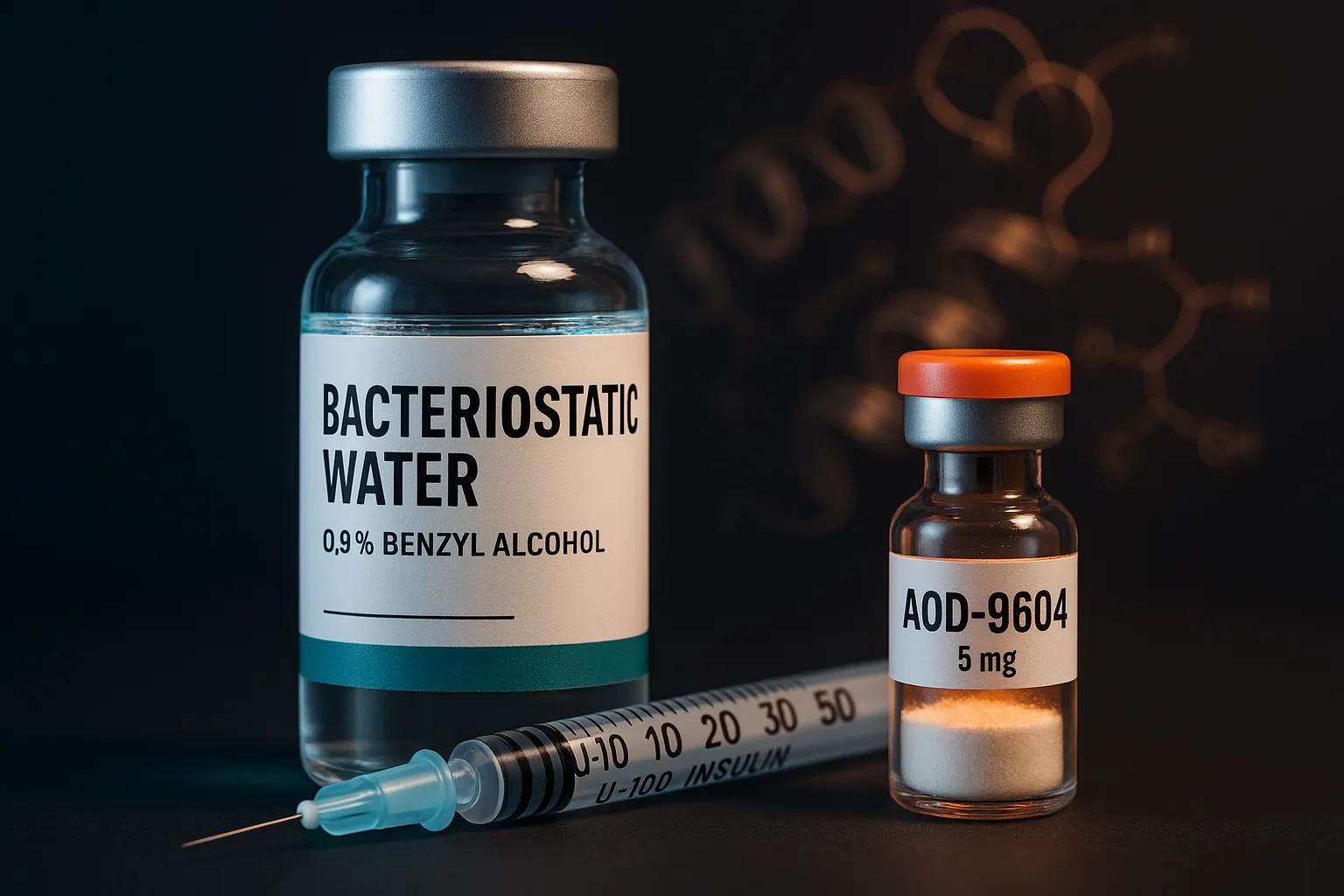
AOD-9604 is a modified fragment of human growth hormone (hGH fragment 176-191) with a molecular weight of approximately 1,815 Da. Research-format AOD-9604 is sold as a lyophilized powder in 2mg and 5mg vials, and the reconstitution math is straightforward: 1 mL of bacteriostatic water per vial at either size is the ratio community sources cite most commonly.
Research-context information only. AOD-9604 is a research peptide without FDA approval for the indications community sources commonly cite. The reconstitution math below reflects vendor documentation and community-reported protocols. Research and community sources describe fat-metabolism applications; outcome claims about specific body-composition results are not supported by approved labeling. This article reports what has been documented, not what should be done. Consult a licensed physician for personal medical decisions.
The peptide dissolves quickly — community sources describe 1-2 minutes of gentle swirling producing a clear, colorless solution. The daily dosing schedule and relatively small vial sizes mean reconstitution planning is simple: one vial lasts approximately one week (2mg) or two and a half weeks (5mg) at the most commonly cited dose.
How much bacteriostatic water for AOD-9604
Research-format AOD-9604 is sold as a lyophilized powder. The 2mg and 5mg vials are the most common formats across community vendor documentation.
The table below reports the concentrations community sources most commonly cite.
| Vial size | Bacteriostatic water added | Final concentration | U-100 syringe: units per 300 mcg | Notes from community sources |
|---|---|---|---|---|
| 2 mg | 1 mL | 2 mg/mL | 15 units | Most-cited ratio for 2mg vials; clean mapping for 300mcg dose |
| 5 mg | 1 mL | 5 mg/mL | 6 units | Most-cited ratio for 5mg vials; compact injection volume |
| 5 mg | 2 mL | 2.5 mg/mL | 12 units | Alternative ratio; finer dose resolution |
Dose-to-unit mapping: 2mg vial at 2 mg/mL (1 mL bac water)
At 2 mg/mL on a U-100 insulin syringe, each 10-unit mark corresponds to 0.2 mg (200 mcg). The documented dose range maps as follows:
| Dose | Units on U-100 syringe (at 2 mg/mL) |
|---|---|
| 250 mcg | 12.5 units |
| 300 mcg | 15 units |
| 400 mcg | 20 units |
| 500 mcg | 25 units |
Community sources cite 300mcg as the most common daily dose. At 2 mg/mL, that dose lands on the 15-unit mark — a clean, readable position on a U-100 insulin syringe.
Dose-to-unit mapping: 5mg vial at 5 mg/mL (1 mL bac water)
At 5 mg/mL on a U-100 insulin syringe, each 10-unit mark corresponds to 0.5 mg (500 mcg). The documented dose range maps as follows:
| Dose | Units on U-100 syringe (at 5 mg/mL) |
|---|---|
| 250 mcg | 5 units |
| 300 mcg | 6 units |
| 400 mcg | 8 units |
| 500 mcg | 10 units |
The 5 mg/mL concentration produces smaller injection volumes — 6 units for 300mcg versus 15 units at the 2 mg/mL concentration. Community sources cite the 5mg vial with 1 mL of bacteriostatic water as the standard choice when minimizing injection volume is preferred. The trade-off is finer syringe reading precision: the 6-unit mark is harder to read than the 15-unit mark for some users.
Dose-to-unit mapping: 5mg vial at 2.5 mg/mL (2 mL bac water)
At 2.5 mg/mL on a U-100 insulin syringe, each 10-unit mark corresponds to 0.25 mg (250 mcg). The documented dose range maps as follows:
| Dose | Units on U-100 syringe (at 2.5 mg/mL) |
|---|---|
| 250 mcg | 10 units |
| 300 mcg | 12 units |
| 400 mcg | 16 units |
| 500 mcg | 20 units |
The 2 mL reconstitution for a 5mg vial produces a middle-ground concentration. Community sources cite this ratio when both dose resolution and vial longevity matter — the 250mcg dose lands on the 10-unit mark (a clean round number), and the 5mg vial still provides approximately 16 doses at 300mcg per day.
Vial consumption and the 28-day window
AOD-9604 is documented as a daily peptide in community protocols. Community sources commonly cite once-daily subcutaneous administration, with morning timing in a fasted state as the most frequently reported schedule.
Vial duration at common dose amounts:
| Vial size | Dose per day | Doses per vial | Approximate vial duration |
|---|---|---|---|
| 2 mg | 250 mcg | 8 doses | ~8 days |
| 2 mg | 300 mcg | 6.7 doses | ~7 days |
| 2 mg | 500 mcg | 4 doses | ~4 days |
| 5 mg | 250 mcg | 20 doses | ~20 days |
| 5 mg | 300 mcg | 16.7 doses | ~17 days |
| 5 mg | 500 mcg | 10 doses | ~10 days |
All vial-size and dose combinations fall well within the 28-day bacteriostatic water window described in USP guidance. The 5mg vial at 300mcg per day — the most commonly cited combination — lasts approximately two and a half weeks of daily use.
Step-by-step reconstitution as documented in community sources
The reconstitution sequence for AOD-9604 follows the same pattern documented for other lyophilized peptides. Community reconstitution sheets and vendor instruction inserts describe the steps below. This is not an instruction set.
- Surface preparation. Both vial tops — AOD-9604 and bacteriostatic water — are wiped with separate alcohol swabs and allowed to air-dry.
- Bacteriostatic water draw. A fresh insulin syringe is used to draw the documented water volume (1 mL for either a 2mg or 5mg vial at the standard concentrations).
- Water injection at the vial wall. The needle is inserted into the AOD-9604 vial aimed at the glass wall rather than directly at the lyophilized powder.
- Gentle dissolution. The vial is swirled slowly. AOD-9604 typically dissolves within 1-2 minutes into a clear, colorless solution. Community sources describe the peptide as dissolving readily without extended wait times.
- Refrigerated storage. The reconstituted vial is moved to refrigeration at 2-8°C immediately after reconstitution.
Storage after reconstitution
USP guidance describes a 28-day multi-dose window for bacteriostatic water under aseptic technique. Community sources commonly cite the same window for reconstituted AOD-9604 held continuously refrigerated at 2-8°C.
Community sources describe the following storage practices:
- Temperature: 2-8°C (refrigerator, not freezer)
- Light: protected from direct light; vial kept in the original carton or opaque container
- Date tracking: marking the vial with the date of first puncture is cited as standard practice
- Aseptic technique: alcohol swab on the stopper before every draw; fresh needle per puncture
- Unreconstituted storage: lyophilized AOD-9604 vials are cited as stable for months at freezer temperatures (-20°C or below) when not yet reconstituted
Common mistakes community sources cite
Community reconstitution reports and vendor documentation describe a handful of recurring handling issues relevant to AOD-9604:
- Directing the stream at the lyophilized cake. Community sources cite slow injection of bacteriostatic water down the vial wall as the standard technique. Directing the stream directly onto the peptide powder is reported to risk denaturing the peptide through mechanical force.
- Shaking the vial after adding water. Gentle swirling is the documented technique. Vigorous shaking is reported to denature peptides through mechanical stress and foaming.
- Using cloudy or discolored bacteriostatic water. Community sources cite clear, colorless water as the expected appearance. Cloudy or particulate-containing water is described as a quality signal that the bacteriostatic water may be contaminated or degraded.
- Leaving the reconstituted vial at room temperature. Community sources cite immediate refrigeration after reconstitution as the standard. Peptide stability decreases at room temperature, and the 28-day window assumes continuous cold storage.
- Confusing AOD-9604 dose units with other peptides. AOD-9604 doses are in the 250-500mcg range — similar in magnitude to BPC-157 but much smaller than TB-500 loading doses (2-2.5mg) and much larger than some other research peptides. Community sources cite checking the concentration math against the specific peptide and vial size before drawing.
Common questions
The FAQ at the top of this article covers vial-size reconstitution math for 2mg and 5mg formats, dose range, vial duration at daily dosing, and the 28-day storage window.
Bottom line
The most-cited reconstitution ratio for research-format AOD-9604 is 1 mL of bacteriostatic water per vial — producing 2 mg/mL from a 2mg vial or 5 mg/mL from a 5mg vial. The commonly cited 300mcg daily dose lands on the 15-unit mark at 2 mg/mL or the 6-unit mark at 5 mg/mL on a U-100 insulin syringe. Both vial sizes are consumed well within the 28-day bacteriostatic water window at daily dosing. Storage is documented at 2-8°C with standard aseptic technique.
Related reading
- AOD-9604 Dosing Guide — dose ranges, timing, and protocol documentation on thepeptidecatalog
- AOD-9604 Buying Guide — vendor comparison, COA verification, and current pricing on thepeptidecatalog
- What Is Bacteriostatic Water? Benzyl Alcohol + Uses (2026) — composition, benzyl alcohol mechanism, and USP-grade specifications
- How Long Does Bacteriostatic Water Last? 28-Day Rule (2026) — the 28-day window and what shortens it
- How Much Bacteriostatic Water Per Vial (2026) — general reconstitution ratio reference across peptide types
- Insulin Syringe Units to mL Conversion (2026) — U-100 syringe math and unit-to-volume mapping
- Peptide Reconstitution Supplies Checklist (2026) — everything needed for reconstitution in one reference
This guide is for educational and informational purposes only. It is not medical advice. Bacteriostatic water for injection is a regulated injectable product subject to FDA labeling standards. As an affiliate partner, The Peptide Catalog may earn a commission on qualifying purchases at no extra cost to the reader. Bacteriostatic water is sold for research and professional use only.