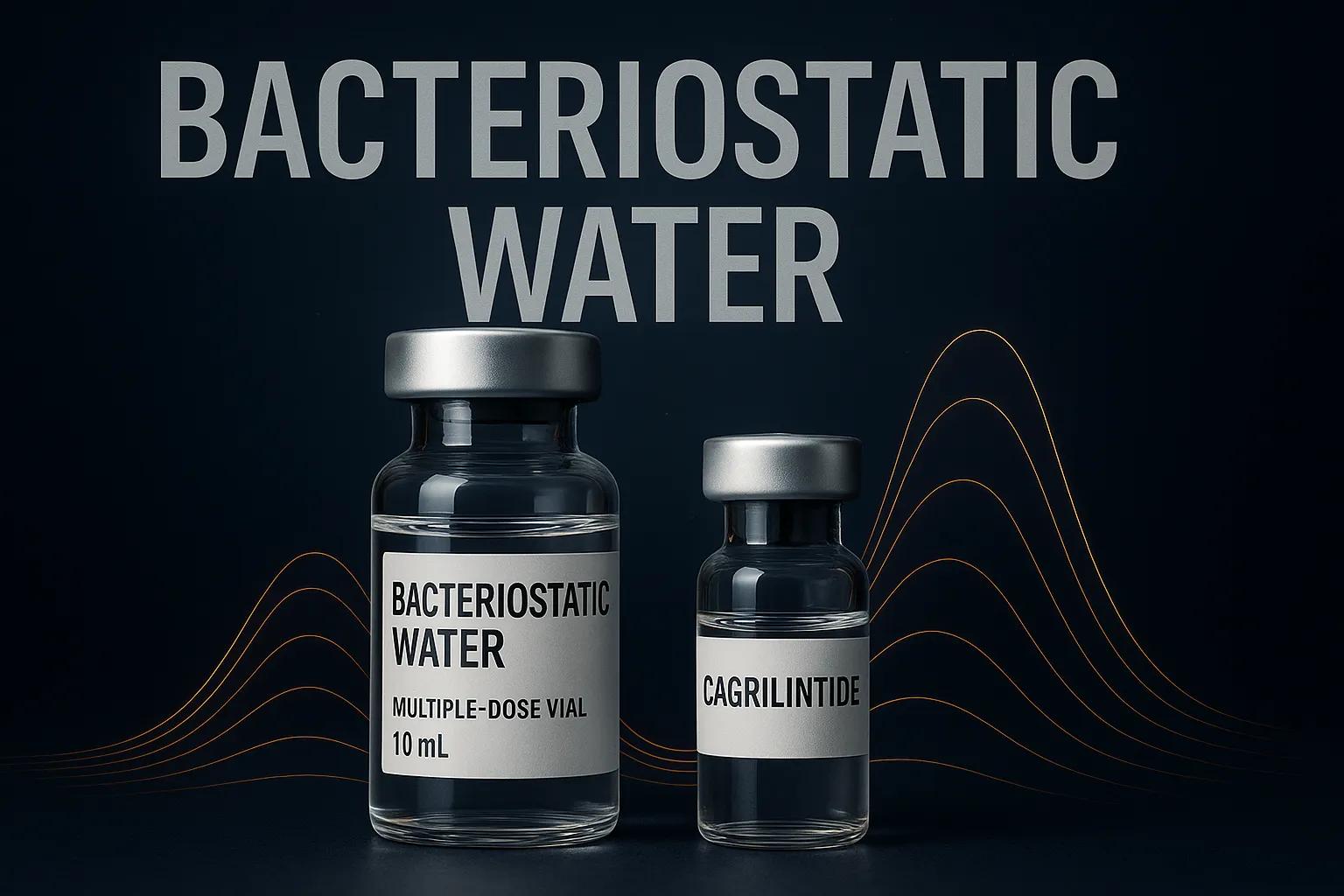
Cagrilintide is a long-acting amylin analog studied in metabolic and weight-management research contexts, often alongside retatrutide or semaglutide. It arrives as a lyophilized powder, and the reconstitution math is straightforward: community sources document two standard vial sizes (5mg and 10mg) with simple bacteriostatic water ratios.
Research-context information only. Cagrilintide is a research chemical without FDA approval as a finished pharmaceutical product. The reconstitution math below reflects vendor documentation and community-reported protocols. Research sources describe amylin-analog and appetite-regulation applications; outcome claims are not supported by FDA-approved indications. This article reports what has been documented, not what should be done. Consult a licensed physician for personal medical decisions.
Cagrilintide vial sizes
Cagrilintide is most commonly available in 5mg and 10mg lyophilized vials in the research peptide market. The lyophilized peptide appears as a white to off-white powder or cake. With a molecular weight of approximately 3,732 Da, cagrilintide is a mid-sized peptide — comparable in scale to semaglutide (~4,114 Da).
Community sources describe cagrilintide as a once-weekly compound titrated upward over time, with per-dose amounts in the sub-milligram to low-milligram range. Because the early titration steps are small, the bacteriostatic water ratio is usually chosen to keep those small doses readable on a U-100 insulin syringe.
Reconstitution math
5mg vial
| Bac water added | Concentration | 0.25 mg dose | 0.5 mg dose |
|---|---|---|---|
| 2 mL | 2.5 mg/mL | 10 units | 20 units |
| 3 mL | 1.67 mg/mL | 15 units | 30 units |
Community sources most commonly cite 2 mL of bacteriostatic water for a 5mg vial, producing 2.5 mg/mL. At this concentration, each 10-unit mark on a U-100 insulin syringe corresponds to 0.25 mg (250 mcg). The 3 mL ratio (1.67 mg/mL) spreads each milligram across more units, which community sources cite as useful for the small early-titration doses.
10mg vial
| Bac water added | Concentration | 0.5 mg dose | 1 mg dose |
|---|---|---|---|
| 3 mL | 3.33 mg/mL | 15 units | 30 units |
| 1 mL | 10 mg/mL | 5 units | 10 units |
Community sources commonly cite 3 mL of bacteriostatic water for a 10mg vial, producing about 3.33 mg/mL. The 1 mL ratio (10 mg/mL) is cited where larger per-dose amounts are used and a more concentrated solution is preferred.
Step-by-Step Reconstitution
- Allow the cagrilintide vial and the bacteriostatic water to reach room temperature (community sources cite 15-20 minutes out of the refrigerator).
- Wipe both rubber stoppers with a fresh alcohol swab.
- Draw the chosen bacteriostatic water volume into a syringe.
- Insert the needle at an angle so the water runs down the inside glass wall — not directly onto the powder.
- Let the powder dissolve on its own, then swirl gently. Do not shake.
- The reconstituted solution should be clear and colorless. Cloudiness or particulate matter after gentle swirling is cited as a signal to discard the vial.
Storage After Reconstitution
Community sources and vendor documentation cite 28 days of refrigerated stability at 2-8 degrees Celsius for reconstituted cagrilintide, consistent with the USP multi-dose window that the bacteriostatic water's benzyl alcohol preservative establishes. Lyophilized, unreconstituted vials are described as stable for months at freezer temperatures.
Common Mistakes (Community Reports)
These are anecdotal patterns reported in community sources, not clinical findings:
- Under-diluting early titration doses. Community reports describe small titration amounts becoming hard to measure accurately when a low bac water volume puts the dose at only 1-2 syringe units.
- Shaking the vial. Reports cite foaming and concern about peptide degradation from vigorous shaking; gentle swirling is the consistently cited method.
- Assuming a pre-blend ratio applies to single vials. Reports note confusion when reta-cagri stack instructions are applied to a single-compound cagrilintide vial.
Bottom Line
For a 5mg cagrilintide vial, community sources most commonly cite 2 mL of bacteriostatic water (2.5 mg/mL); for a 10mg vial, 3 mL (3.33 mg/mL). Reconstituted solution holds for the 28-day refrigerated multi-dose window. Match your bacteriostatic water volume to the per-dose amount your protocol uses — the math is milligrams divided by milliliters.