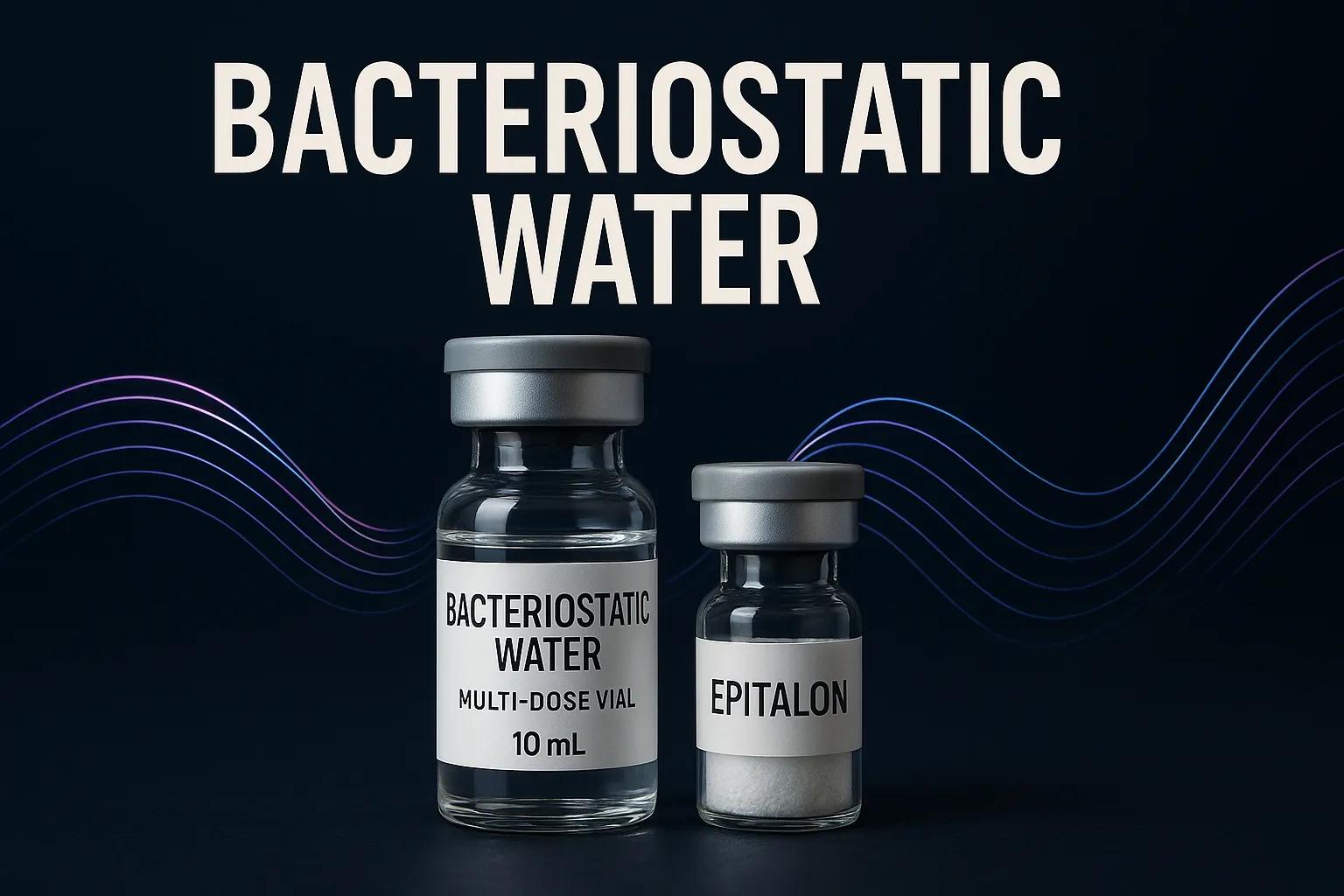
Epitalon (also spelled epithalon) is a four-amino-acid peptide studied in longevity and circadian research contexts, typically run as a short daily loading cycle. It arrives as a lyophilized powder and dissolves readily — community sources document 10mg and 50mg vials with simple bacteriostatic water ratios.
Research-context information only. Epitalon is a research chemical without FDA approval as a finished pharmaceutical product. The reconstitution math below reflects vendor documentation and community-reported protocols. Research sources describe telomerase and circadian-regulation applications; outcome claims are not supported by FDA-approved indications. This article reports what has been documented, not what should be done. Consult a licensed physician for personal medical decisions.
Epitalon vial sizes
Epitalon is most commonly available in 10mg and 50mg lyophilized vials in the research peptide market, with some vendors offering 100mg formats. The lyophilized peptide appears as a white powder. With a molecular weight of approximately 390 Da, epitalon is among the smallest peptides covered here — far smaller than GH secretagogues or GLP analogs.
Community sources cite doses around 5-10 mg per day across short loading cycles (commonly 10-20 days), often repeated a few times per year. Because the cycle uses daily doses, the bacteriostatic water ratio is usually chosen so a single vial covers as much of the cycle as possible within the 28-day window.
Reconstitution math
10mg vial
| Bac water added | Concentration | 5 mg dose | 10 mg dose |
|---|---|---|---|
| 2 mL | 5 mg/mL | 100 units (full syringe) | two full draws |
| 1 mL | 10 mg/mL | 50 units | 100 units (full syringe) |
Community sources most commonly cite 2 mL of bacteriostatic water for a 10mg vial, producing 5 mg/mL. The 1 mL ratio (10 mg/mL) is cited where a 5 mg dose at 50 units is preferred so the vial splits cleanly into two doses.
50mg vial
| Bac water added | Concentration | 5 mg dose | 10 mg dose |
|---|---|---|---|
| 5 mL | 10 mg/mL | 50 units | 100 units (full syringe) |
| 2.5 mL | 20 mg/mL | 25 units | 50 units |
Community sources commonly cite 5 mL of bacteriostatic water for a 50mg vial, producing 10 mg/mL — a ratio that lets one reconstituted vial supply a full daily loading cycle.
Step-by-Step Reconstitution
- Allow the vial and the bacteriostatic water to reach room temperature (community sources cite 15-20 minutes out of the refrigerator).
- Wipe both rubber stoppers with a fresh alcohol swab.
- Draw the chosen bacteriostatic water volume into a syringe.
- Insert the needle at an angle so the water runs down the inside glass wall, not onto the powder.
- Epitalon dissolves quickly; a brief gentle swirl is typically enough. Do not shake.
- The solution should be clear and colorless; cloudiness or particulate after swirling is cited as a signal to discard.
Storage After Reconstitution
Community sources cite 28 days of refrigerated stability at 2-8 degrees Celsius for reconstituted epitalon, consistent with the bacteriostatic water's USP multi-dose window. For the typical 10-20 day cycle, a single reconstituted vial usually lasts the full cycle. Lyophilized, unreconstituted vials are described as stable for months at freezer temperatures.
Common Mistakes (Community Reports)
These are anecdotal patterns reported in community sources, not clinical findings:
- Reconstituting a 50mg vial too thin. Reports describe large bac water volumes pushing daily doses past a full syringe, forcing multiple draws per dose.
- Running a cycle past the 28-day window. Reports note leftover reconstituted solution being used beyond the preservative window; the 28-day limit is the consistently cited cutoff.
- Shaking the vial. Even for a fast-dissolving peptide, gentle swirling is the consistently cited method to avoid foaming.
Bottom Line
For a 10mg epitalon vial, community sources most commonly cite 2 mL of bacteriostatic water (5 mg/mL); for a 50mg vial, 5 mL (10 mg/mL). Epitalon dissolves quickly given its small size, and a reconstituted vial holds for the 28-day refrigerated window — usually enough to cover a full daily loading cycle.