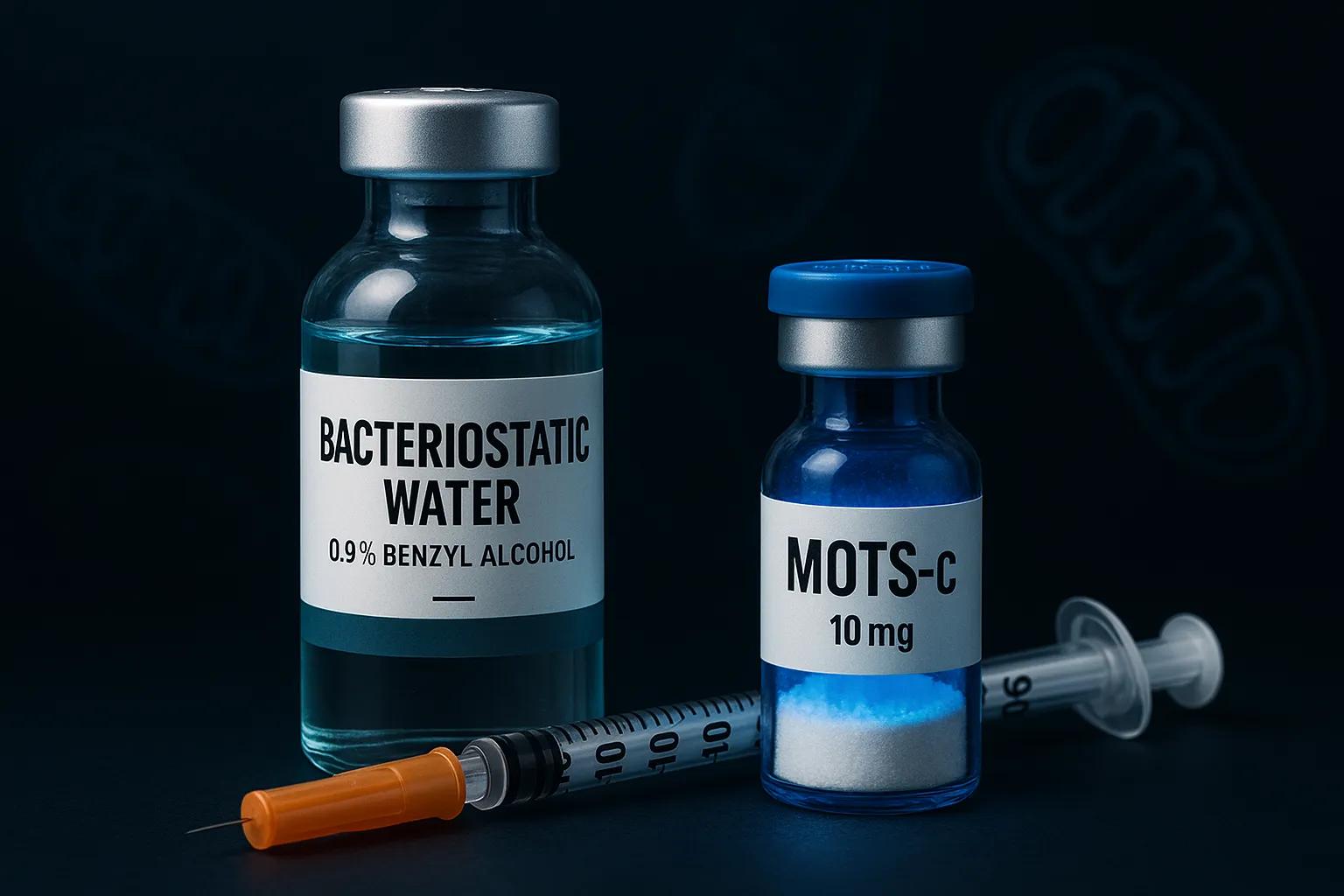
MOTS-c is a 16-amino-acid mitochondrial-derived peptide encoded by the mitochondrial genome. It is one of a class of mitochondrial-derived peptides (MDPs) studied in metabolic and exercise-mimetic research contexts, primarily through its role as an AMPK activator. The reconstitution math is straightforward — community sources document two standard vial sizes (5mg and 10mg) with simple bac water ratios.
Research-context information only. MOTS-c is a research chemical without FDA approval as a finished pharmaceutical product. The reconstitution math below reflects vendor documentation and community-reported protocols. Research sources describe metabolic and exercise-mimetic applications; outcome claims are not supported by FDA-approved indications. This article reports what has been documented, not what should be done. Consult a licensed physician for personal medical decisions.
MOTS-c vial sizes
MOTS-c is most commonly available in 5mg and 10mg lyophilized vials in the research peptide market. The lyophilized peptide appears as a white to off-white powder or cake inside the vial. With a molecular weight of approximately 2,174 Da, MOTS-c is a mid-sized peptide — larger than GHK-Cu (~840 Da) but smaller than semaglutide (~4,114 Da).
Community sources cite dose ranges of 5-10 mg per injection, administered 2-3 times per week. Some community documentation describes 5 mg daily protocols. These dose ranges are notably higher than many research peptides (which operate at mcg-scale), which means the bac water ratios are calibrated to keep injection volumes practical at mg-scale doses.
Reconstitution math
5mg vial
| Bac water added | Concentration | 5 mg dose | 10 mg dose |
|---|---|---|---|
| 0.5 mL | 10 mg/mL | 50 units | 100 units (full syringe) |
| 1 mL | 5 mg/mL | 100 units (full syringe) | N/A (exceeds syringe) |
Community sources most commonly cite 1 mL of bacteriostatic water for a 5mg vial, producing 5 mg/mL. At this concentration, the entire vial content (5 mg) requires a full 100-unit draw. For protocols that use 5 mg per dose, the 5mg vial is effectively a single-dose format at 1 mL reconstitution.
Some vendor documentation cites 0.5 mL of bacteriostatic water for a 5mg vial, producing 10 mg/mL. At this concentration, the 5 mg dose falls on the 50-unit mark — leaving room for a second draw if the protocol calls for splitting the vial across two doses.
10mg vial
| Bac water added | Concentration | 5 mg dose | 10 mg dose |
|---|---|---|---|
| 1 mL | 10 mg/mL | 50 units | 100 units (full syringe) |
| 2 mL | 5 mg/mL | 100 units (full syringe) | N/A (exceeds syringe) |
Community sources most commonly cite 2 mL of bacteriostatic water for a 10mg vial, producing 5 mg/mL. At this concentration, each 10-unit mark on a U-100 insulin syringe corresponds to 0.5 mg. The 5 mg dose step falls on the 100-unit mark (full syringe draw).
Alternatively, vendor documentation describes 1 mL of bacteriostatic water for a 10mg vial, producing 10 mg/mL. At this concentration, each 10-unit mark corresponds to 1 mg. The 5 mg dose falls on the 50-unit mark and the full 10 mg vial content draws at 100 units. This higher concentration is commonly cited in community sources for protocols using 5 mg per injection, because it provides two full 5 mg doses from a single 10mg vial.
Concentration summary
| Vial size | Bac water | Concentration | Units per mg |
|---|---|---|---|
| 5 mg | 0.5 mL | 10 mg/mL | 10 units = 1 mg |
| 5 mg | 1 mL | 5 mg/mL | 20 units = 1 mg |
| 10 mg | 1 mL | 10 mg/mL | 10 units = 1 mg |
| 10 mg | 2 mL | 5 mg/mL | 20 units = 1 mg |
The 10 mg/mL concentration — achieved with 0.5 mL per 5mg vial or 1 mL per 10mg vial — is commonly cited in community sources as the practical choice because it keeps injection volumes smaller and allows multiple doses per vial at the 10mg vial size.
Reconstitution steps
The standard reconstitution technique documented across community sources and vendor instructions:
- Alcohol swab both vial tops — MOTS-c vial and bacteriostatic water vial — and allow to air-dry.
- Draw the target volume of bacteriostatic water with a fresh syringe.
- Inject slowly against the vial wall. Directing the stream against the glass wall rather than directly onto the lyophilized cake is the standard technique cited for peptide reconstitution. MOTS-c is a peptide with secondary structure — direct high-pressure streams are cited as a potential source of denaturation.
- Gentle swirling. Community sources describe MOTS-c as dissolving within 1-2 minutes with gentle circular swirling. Do not shake — mechanical agitation is cited across peptide reconstitution documentation as a source of foaming and potential structural damage.
- Inspect the solution. The reconstituted solution is described as clear and colorless. Cloudiness or particulate matter after swirling is cited as a discard signal.
- Refrigerate at 2-8 degrees Celsius immediately after reconstitution.
Storage after reconstitution
Community sources and vendor documentation cite the same storage parameters as other reconstituted peptides:
- Temperature: 2-8 degrees Celsius (standard refrigerator)
- Light: protected from direct light
- Multi-dose window: 28 days per USP guidance for bacteriostatic water
- Aseptic technique: alcohol swab on the stopper before every draw; fresh syringe per dose
Lyophilized (unreconstituted) MOTS-c vials are described in vendor documentation as stable for extended periods at freezer temperatures (-20 degrees Celsius or below). Community sources cite storing backup vials in the freezer until ready for reconstitution.
Common mistakes
Community sources document several reconstitution errors that apply to MOTS-c:
- Shaking the vial. MOTS-c is a peptide — shaking creates foam and mechanical stress that community sources cite as a degradation risk. Gentle swirling is the documented technique.
- Injecting directly onto the powder cake. High-pressure streams from the syringe directed onto the lyophilized cake are cited as a denaturation vector. The wall-injection technique is standard.
- Using sterile water for multi-dose vials. Sterile water lacks the benzyl alcohol preservative. Without antimicrobial protection, multi-dose punctures over days or weeks risk contamination. Bacteriostatic water is the standard for any vial drawn from more than once.
- Leaving the vial at room temperature. Reconstituted peptides degrade faster at ambient temperatures. Community sources cite immediate refrigeration after reconstitution and minimal time outside the refrigerator during dose draws.
- Reusing syringes. A fresh syringe for every dose draw is cited as essential for aseptic technique across all peptide reconstitution documentation.
MOTS-c in the mitochondrial peptide context
MOTS-c is one of several mitochondrial-derived peptides studied in research. It is often compared to SS-31 (elamipretide) — both target mitochondrial function but through different mechanisms. MOTS-c activates AMPK (AMP-activated protein kinase), an energy-sensing pathway studied in metabolic and exercise-mimetic contexts. SS-31 targets cardiolipin in the inner mitochondrial membrane. The reconstitution math differs primarily in dose scale — MOTS-c doses are cited at mg-scale while SS-31 operates at mcg-scale.
Subcutaneous injection is the primary administration route documented in community sources for MOTS-c. Standard injection site rotation (abdomen, outer thigh, upper arm) is cited in community protocols as with any SubQ injectable.
Bottom line
MOTS-c reconstitutes with bacteriostatic water at straightforward ratios. Community sources most commonly cite 1 mL per 5mg vial (5 mg/mL) or 2 mL per 10mg vial (5 mg/mL), with a higher-concentration alternative of 10 mg/mL achieved by halving the bac water volume. The peptide dissolves within 1-2 minutes with gentle swirling. Storage follows the standard 28-day refrigerated window at 2-8 degrees Celsius. The 10mg vial at 10 mg/mL (1 mL of bac water) is the most practical format for protocols using 5 mg per injection — it provides two clean 50-unit draws from a single vial.
Related reading
- MOTS-c Dosing Guide — full protocol documentation on thepeptidecatalog
- MOTS-c Buying Guide — vendor comparison and COA verification on thepeptidecatalog
- What Is Bacteriostatic Water? Benzyl Alcohol + Uses — USP composition and preservation mechanism
- How Long Does Bacteriostatic Water Last? 28-Day Rule — the multi-dose window explained
- How Much Bac Water per Vial? Universal Charts — reconstitution math for every standard vial size
- Insulin Syringe Units to mL Conversion — unit-to-volume mapping for accurate dosing
- Peptide Reconstitution Supplies Checklist — everything needed for safe reconstitution
This guide is for educational and informational purposes only. It is not medical advice. Bacteriostatic water for injection is a regulated injectable product subject to FDA labeling standards. As an affiliate partner, The Peptide Catalog may earn a commission on qualifying purchases at no extra cost to the reader. Bacteriostatic water is sold for research and professional use only.