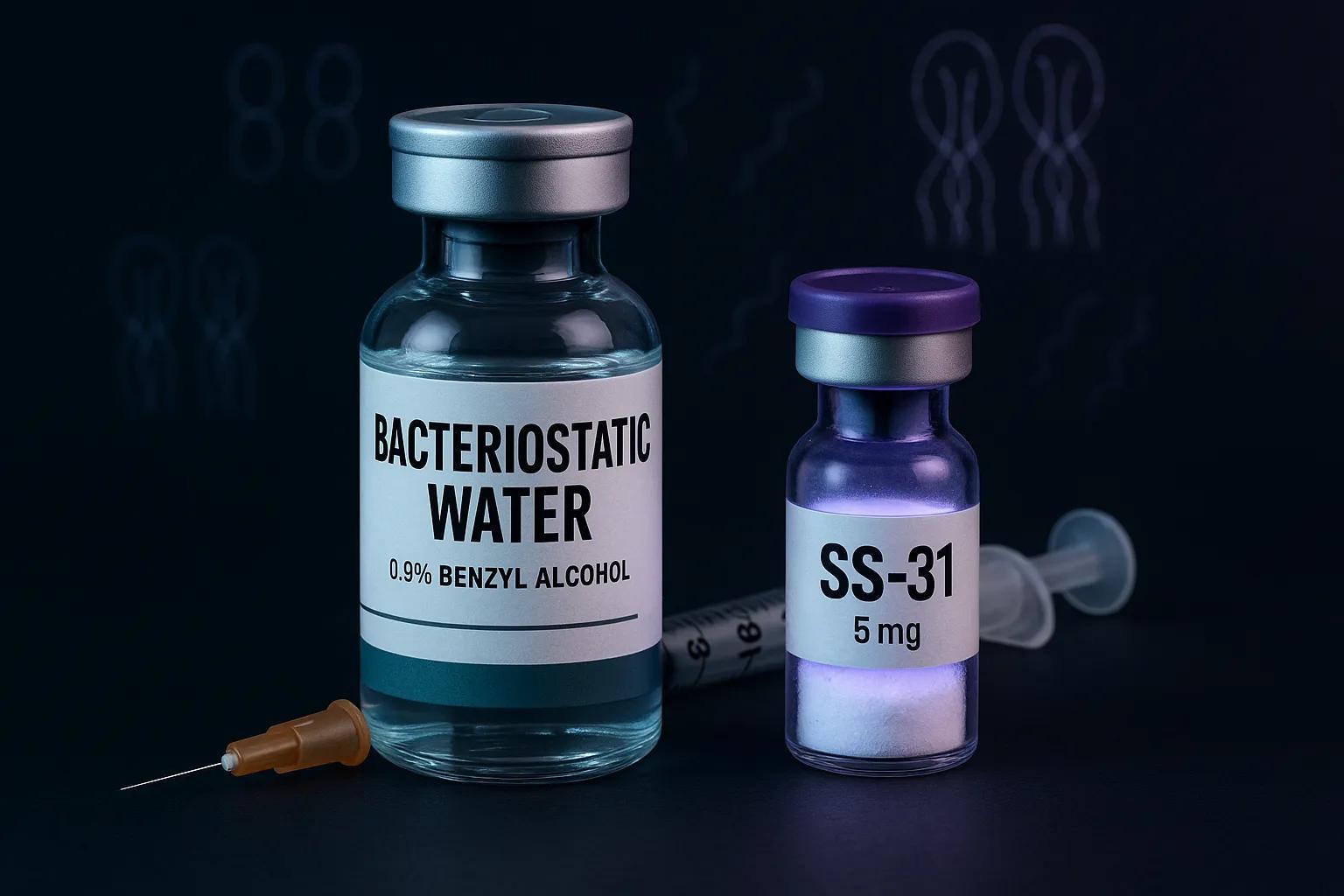
SS-31 (elamipretide) is a mitochondrial-targeted tetrapeptide (D-Arg-Dmt-Lys-Phe-NH2) that targets cardiolipin in the inner mitochondrial membrane. At approximately 639.8 Da, it is one of the smallest research peptides in common use — significantly smaller than GLP-1 receptor agonists or growth-hormone-releasing peptides — which means it dissolves in bacteriostatic water faster than most peptides community sources reference. The reconstitution math below covers the 5mg, 10mg, and 50mg vial sizes that appear across vendor documentation and community reconstitution sheets.
Research-context information only. SS-31 (elamipretide) is a research peptide. The reconstitution math below reflects vendor documentation and community-reported protocols. Research sources describe mitochondrial membrane stabilization and cardiolipin interaction; outcome claims are not supported by FDA-approved indications for the research-format product. This article reports what has been documented, not what should be done. Consult a licensed physician for personal medical decisions.
How much bacteriostatic water for SS-31
Research-format SS-31 is sold in lyophilized vials. The most common vial sizes cited across community vendor sheets are 5mg, 10mg, and 50mg. The reconstitution ratio determines the final concentration in mg/mL, which determines how many U-100 syringe units correspond to each dose step community sources document.
The table below reports the concentrations community sources most commonly cite for each documented vial size.
| Vial size | Bacteriostatic water added | Final concentration | Notes from community sources |
|---|---|---|---|
| 5 mg | 1 mL | 5 mg/mL | Most-cited ratio; 1-5 mg dose range maps onto 20-100 unit marks |
| 5 mg | 0.5 mL | 10 mg/mL | Concentrated format; halves injection volume, each 10-unit mark = 1 mg |
| 10 mg | 2 mL | 5 mg/mL | Mirrors the 5mg-plus-1-mL ratio; same unit-to-dose mapping |
| 10 mg | 1 mL | 10 mg/mL | Concentrated; each 10-unit mark = 1 mg, but syringe resolution narrows at lower doses |
| 50 mg | 10 mL | 5 mg/mL | Standard concentration at the largest vial size; longer between-vial intervals |
| 50 mg | 5 mL | 10 mg/mL | Concentrated format; each 10-unit mark = 1 mg |
U-100 syringe unit mapping
At the most-cited 5 mg/mL concentration (1 mL bac water per 5mg vial), the dose-to-unit mapping on a U-100 insulin syringe:
| Target dose | Syringe units (U-100) | Volume drawn |
|---|---|---|
| 0.5 mg | 10 units | 0.10 mL |
| 1 mg | 20 units | 0.20 mL |
| 2 mg | 40 units | 0.40 mL |
| 3 mg | 60 units | 0.60 mL |
| 5 mg | 100 units | 1.00 mL |
At 10 mg/mL (0.5 mL bac water per 5mg vial), the same doses require half the syringe units — 1 mg at 10 units, 2 mg at 20 units, 5 mg at 50 units. Community sources cite the 10 mg/mL concentration as useful for higher doses where minimizing injection volume is preferred, and the 5 mg/mL concentration as the default because it offers better syringe-unit resolution across the full 1-5 mg dose range.
Why SS-31 dissolves faster than most peptides
SS-31 is a tetrapeptide — four amino acids — with a molecular weight of approximately 639.8 Da. For comparison, BPC-157 is approximately 1,419 Da, semaglutide is approximately 4,114 Da, and tirzepatide is approximately 4,810 Da. The low molecular weight and high aqueous solubility mean that SS-31 dissolves in bacteriostatic water within 30 to 60 seconds of gentle swirling, compared to the 1 to 5 minutes community sources cite for larger peptides.
The fast dissolution does not change the reconstitution protocol. Community sources and vendor documentation still cite gentle swirling rather than shaking — the peptide bond integrity and the D-amino acid modifications (D-Arg and Dmt) that give SS-31 its stability profile are still subject to mechanical disruption from aggressive agitation.
Step-by-step reconstitution as documented in community sources
The sequence below reports the steps community reconstitution sheets and vendor instruction inserts most commonly describe. It is not an instruction set.
- Surface preparation. Both vial tops — SS-31 and bacteriostatic water — are wiped with separate alcohol swabs and allowed to air-dry. Community sources commonly cite 10 to 30 seconds of dry time.
- Bacteriostatic water draw. A fresh U-100 insulin syringe is used to draw the documented water volume (1 mL for a 5mg vial at the 5 mg/mL target). For the 50mg vial at 10 mL, community sources cite using a larger syringe (3 mL or 5 mL) to minimize repeated puncture of the water vial.
- Water injection at the vial wall. The needle is inserted into the SS-31 vial at an angle aimed at the glass wall — not directly at the lyophilized powder. Community sources cite the side-wall approach as the standard practice for protecting peptide integrity.
- Gentle dissolution. The vial is swirled with a slow rotating motion rather than shaken. SS-31 typically dissolves within 30 to 60 seconds into a clear, colorless solution — faster than most research peptides due to the low molecular weight.
- Refrigerated storage. The reconstituted vial is moved to refrigeration at 2 to 8 degrees Celsius. Community sources cite the move immediately after reconstitution rather than leaving the vial at room temperature.
Storage after reconstitution
USP guidance describes a 28-day multi-dose window for bacteriostatic water under aseptic technique. Community sources commonly cite the same 28-day window for reconstituted SS-31 held continuously refrigerated at 2 to 8 degrees Celsius.
The conditions community reconstitution sheets cite as the documented storage protocol:
- Temperature: 2 to 8 degrees Celsius (refrigerator, not freezer)
- Light: protected from direct light; vials kept in the original carton or opaque container
- Movement: minimal disturbance; vials not stored in the refrigerator door where temperature cycling is greatest
- Aseptic technique: alcohol swab on the stopper before every puncture; fresh insulin syringe per draw
Lyophilized (unreconstituted) SS-31 vials are typically more stable than reconstituted ones. Community sources cite long-term storage at freezer temperatures (-20 degrees Celsius or below) as the standard approach for vials not yet reconstituted.
Common mistakes community sources cite
Several handling failures appear repeatedly in community reconstitution reports for SS-31 and similar small peptides. The list below reports what community sources describe, not instruction.
- Shaking the vial instead of swirling. SS-31 dissolves quickly, which sometimes leads to the assumption that agitation speed does not matter. Community sources still cite shaking as a denaturation risk — mechanical disruption affects peptide bonds regardless of dissolution speed.
- Injecting water directly onto the lyophilized cake. Direct-stream injection onto the powder has been cited as a mechanical-damage source. Community sheets describe aiming the water stream at the glass wall instead.
- Using non-USP bacteriostatic water. Community sources commonly cite cloudy-vial outcomes traced to bacteriostatic water sourced from marketplace listings that lack USP labeling, lot tracking, or 0.9% benzyl alcohol confirmation. USP-grade product from documented manufacturers is the conservative reference.
- Storing at room temperature between doses. Community degradation reports cluster around room-temperature storage as the most common contributing factor for potency loss. The 2 to 8 degrees Celsius range is the documented standard.
- Re-using insulin syringes across draws. A single-use syringe per draw is the documented practice cited in community sources. Repeated use of the same syringe introduces a contamination pathway that compounds with each draw.
- Over-diluting the 50mg vial. The 50mg research-format vial reconstituted with 10 mL of bacteriostatic water produces 5 mg/mL — the standard target. Community sources note that adding significantly more water (e.g. 25 mL) produces concentrations so dilute that the per-dose draw volumes become impractically large on a standard insulin syringe.
SS-31 vs. MOTS-c: reconstitution comparison
Both SS-31 and MOTS-c are mitochondrial-targeted peptides, but they arrive at mitochondrial function through different mechanisms — SS-31 stabilizes cardiolipin in the inner mitochondrial membrane, while MOTS-c activates AMPK signaling. For reconstitution purposes, the key differences are:
| Factor | SS-31 (elamipretide) | MOTS-c |
|---|---|---|
| Molecular weight | ~639.8 Da | ~2,174 Da |
| Common vial sizes | 5mg, 10mg, 50mg | 5mg, 10mg |
| Dissolution speed | Fast (30-60 seconds) | Moderate (1-3 minutes) |
| Community-cited dose range | 1-5 mg/day SubQ | 5-10 mg SubQ |
| Standard bac water ratio | 1 mL per 5mg vial | 1 mL per 5mg vial |
| Vial duration at typical dose | 1-5 days per 5mg vial | 0.5-1 day per 5mg vial |
The practical implication is that SS-31's lower per-dose amounts mean each vial lasts longer, and the 28-day multi-dose window is less likely to be a limiting factor. MOTS-c vials at 5mg are often consumed in a single dose at the upper end of the community-cited range, reducing the multi-dose window to a single-use scenario.
Bottom line
The most-cited reconstitution ratio for research-format SS-31 is 1 mL of bacteriostatic water per 5mg vial, producing a 5 mg/mL concentration that maps the community-documented 1-5 mg dose range onto clean unit marks on a U-100 insulin syringe. Larger vials (10mg, 50mg) scale proportionally to preserve the same 5 mg/mL target, with 10 mg/mL alternates cited for users who prefer smaller injection volumes. SS-31's low molecular weight (~639.8 Da) makes it one of the fastest-dissolving research peptides — reconstitution typically completes within 30 to 60 seconds of gentle swirling. Storage is documented at 2 to 8 degrees Celsius across the 28-day multi-dose window described by USP guidance.
Related reading
- SS-31 Dosing Guide — community-cited dose ranges, titration, and protocol documentation on thepeptidecatalog
- SS-31 Buying Guide — vendor comparison, COA verification, and current pricing on thepeptidecatalog
- What Is Bacteriostatic Water? Benzyl Alcohol + Uses (2026) — definition, USP standards, benzyl alcohol mechanism
- How Long Does Bacteriostatic Water Last? 28-Day Rule (2026) — the post-puncture window and storage variables
- How Much Bacteriostatic Water Per Vial (2026) — general reconstitution math across peptide types
- Insulin Syringe Units to mL Conversion (2026) — U-100 syringe unit mapping reference
- Peptide Reconstitution Supplies Checklist (2026) — everything needed before reconstitution
This guide is for educational and informational purposes only. It is not medical advice. Bacteriostatic water for injection is a regulated injectable product subject to FDA labeling standards. As an affiliate partner, The Peptide Catalog may earn a commission on qualifying purchases at no extra cost to the reader. Bacteriostatic water is sold for research and professional use only.