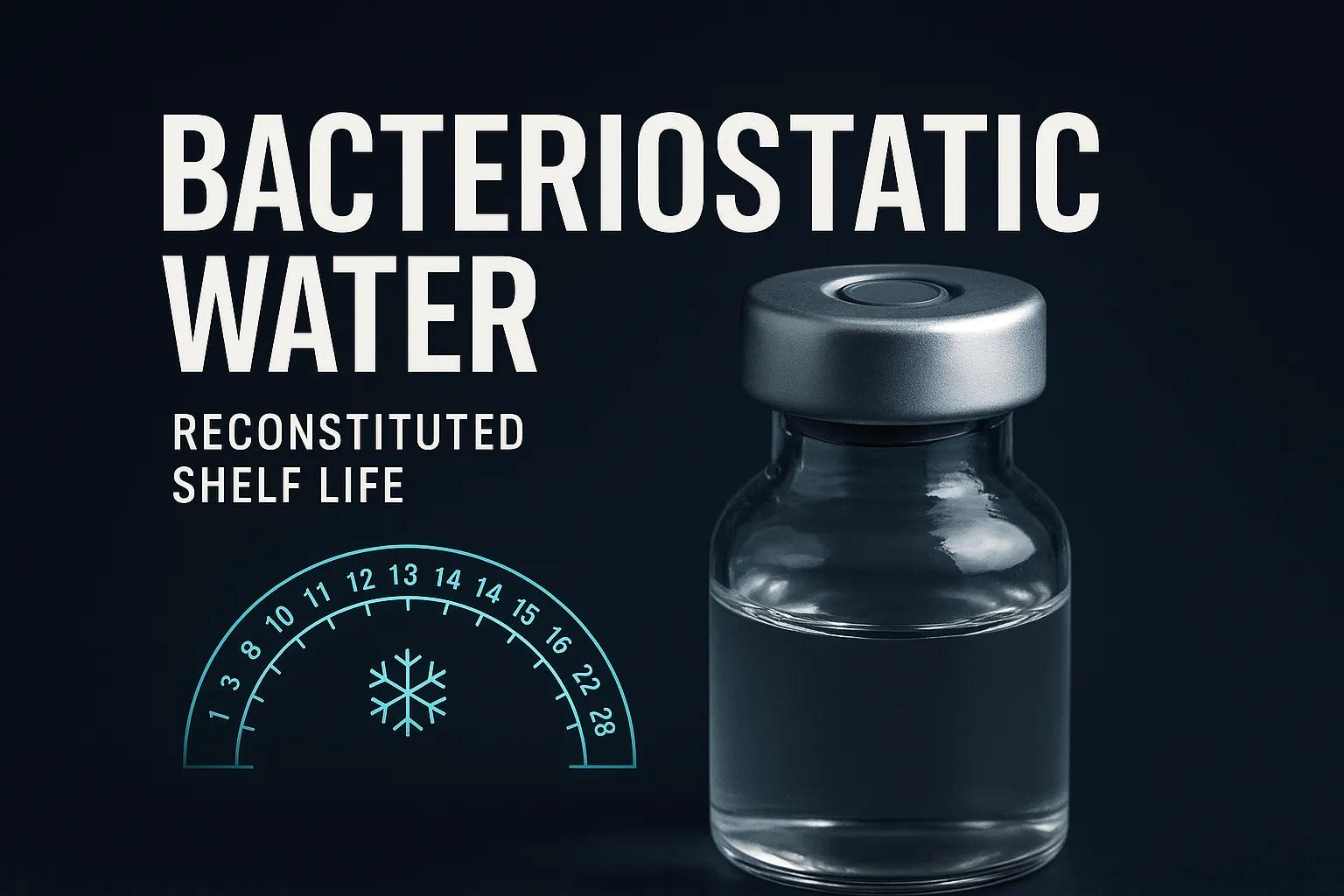
Reconstituted peptides most commonly last about 28 days refrigerated at 2-8 degrees Celsius — and that limit comes from the bacteriostatic water's preservative, not the peptide itself. Here's how the storage math actually works, and where the common "30-day" framing gets it slightly wrong.
The 28-day window is the preservative's limit
When a peptide is reconstituted with bacteriostatic water, the controlling shelf-life factor is the 0.9% benzyl alcohol preservative in that water. USP guidance caps the multi-dose window for benzyl-alcohol-preserved water at 28 days after first puncture. Community sources and vendor documentation consistently cite that same 28-day window for the reconstituted peptide stored at 2-8 degrees Celsius.
This is the key distinction most storage guides blur: the 28 days is about the water's antimicrobial protection across repeated punctures, not the peptide's chemical stability. Many peptides remain chemically intact longer than 28 days — but once the preservative window lapses on a vial that's been accessed many times, it's treated as past safe use.
(For the shelf life of the bacteriostatic water before it touches a peptide, see our bacteriostatic water shelf-life guide.)
Fridge vs freezer
- Refrigerated (2-8°C): the standard. Community sources cite ~28 days for a reconstituted, in-use multi-dose vial, governed by the preservative window above.
- Frozen: cited as a way to extend usable life beyond 28 days — but only with single-use aliquots. The consistently described risk is freeze-thaw cycling, which is cited as a cause of aggregation and degradation. Dividing the solution into single-use portions before freezing means each is thawed exactly once.
- Room temperature: cited as accelerating degradation rapidly. Reconstituted peptides are described as belonging in the refrigerator between draws, not left out.
The "30-day myth"
The commonly repeated "peptides last 30 days reconstituted" figure is a rounded approximation of the 28-day USP preservative window — and it gets attributed to the peptide rather than the water. The more accurate framing community sources support: the 28-day window is the bacteriostatic water's preservative limit, refrigeration is required throughout, and the peptide's own stability is a separate (often longer) question that only matters if the solvent and sterility are controlled.
Signs to discard
Community sources cite these as reasons to discard a reconstituted vial, regardless of date:
- Cloudiness or haze in a solution that was clear
- Visible particulate matter
- Discoloration
- Any vial left at room temperature for an extended period
- Any uncertainty about whether aseptic technique was maintained across draws
A properly reconstituted solution is described as clear and colorless. Because not all degradation is visible, the 28-day refrigerated window and aseptic technique are treated as the controlling limits — not appearance alone.
How to maximize the window
- Reconstitute with bacteriostatic water (not sterile water) for any vial used across multiple draws — the preservative is what creates the 28-day window in the first place.
- Refrigerate between every use.
- Swab the stopper with alcohol before each draw and use a fresh syringe per dose.
- For peptides you won't finish in 28 days, aliquot and freeze single-use portions rather than repeatedly thawing one vial.
Bottom Line
Reconstituted peptides last about 28 days refrigerated at 2-8°C, a limit set by the bacteriostatic water's benzyl alcohol preservative — not the peptide. Freezing single-use aliquots can extend that, but freeze-thaw cycling degrades peptides. Refrigerate between draws, keep technique aseptic, and discard on any cloudiness or discoloration.